Showing posts with label Harry Potter. Show all posts

Thursday, April 16, 2009

The Harry Potter and the Half-Blood Prince Preview is out ;)

It's bad ass.

Nothing more to say.

Enjoy!


If the video doesn't come up either just watch the YouTube one below or run a search for "Harry Potter" and it will come up in the cue.

Also, it's the Hulu.com version. If you're not in the States, it won't work. That completely sucks. I hated that before I moved back to the States, but that's how it is :(

Here is the YouTube version courtesy of GeekTyrant.com:

Read More...

Sphere: Related Content

Tuesday, July 31, 2007

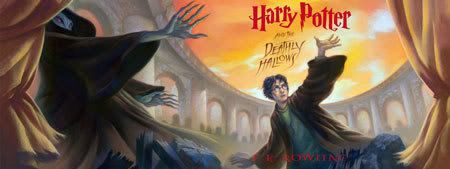
Repost: 'Beyond the book: page 1379 of Deathly Hallows...' from the Gypsy Scholar

I'm having much more fun read tonight than writing.

Since I usually end up writing way too much, that's a good thing.

This one is from the Gypsy Scholar who is another expat in Korea. It's about the Deathly Hallows and it pokes fun at well, you'll figure that out after you read it.

Good one Gypsy Scholar!

Beyond the book: page 1379 of Deathly Hallows...

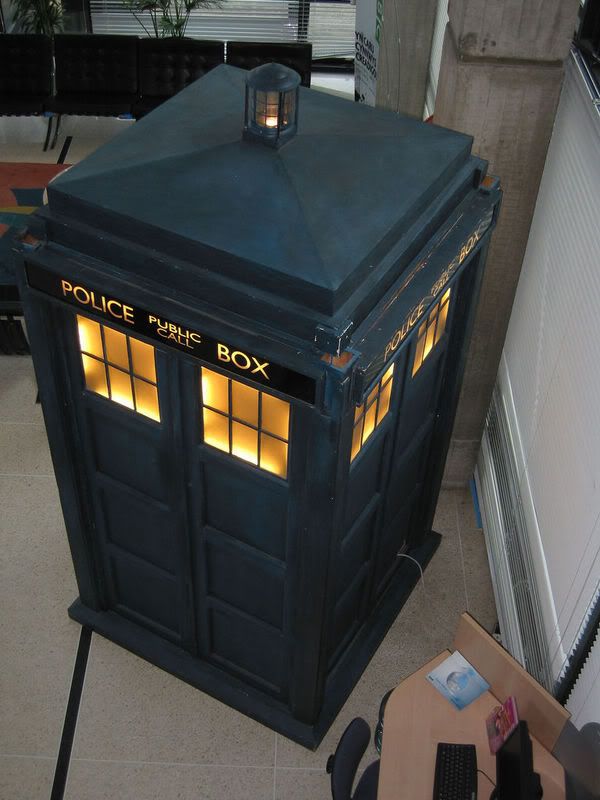
(Image from Wikipedia)

Though still a little-known fact, the latest Potter volume contains more than 759 pages.

No, I don't mean those those seven blank pages nor the "About the Author" page, another blank page, the "About the Illustrator" page, or that last visible page, on art direction and the choice of font.

Nope, not those.

I mean the part of the book that extends into another dimension, much like Doctor Who's TARDIS, which is bigger on the inside than on the outside. In those pages beyond our earthly dimensions, Rowling's Harry Potter and the Deathly Hallows never seems to end.

It is, indeed, a hypertext, unbounded in all directions and linked to every other text in the universe, a veritable universe of discourse.

I've reached page 1379, where Voldemort fully melds with the Antichrist, something I've been anticipating for several volumes now as Voldemort has taken on ever-more-serpentine qualities and thereby grown ever-more Satanic. Turns out, then, that the entire anti-Potter faction among evangelicals has been utterly wrong the whole time about Rowling's supposed 'anti-Christian' magic. In these hypertextual pages, the Christian imagery grows ever more obvious. Those evangelicals who had opposed the Potter phenomenon for its 'pagan' worldview will just have to learn to read it in much the way that they've learned to read C.S. Lewis, seeing the deeper magic beneath the witchery and accepting the pagan details as vehicles for a Christian message, as Elisabeth Gruner has been arguing for some time.

Deathly Hallows is simply another expression for the valley of the shadow of death, so we should fear no evil...

Read More...

Sphere: Related Content

Friday, July 27, 2007

Another Review: Harry's Final Fantasy: Last Time's the Charm

What I really like, and have never shared is Powell's Books Review-A-Day feature.

Basically, they post one book review daily from various newspapers and magazines on their website. I have them emailed to me.

This way you get the scoop, so to speak, on new and notable books coming out.

This review is about my Dear Harry.

Unlike Kakutani and the New York Times, the Washington Post, where this review is from, seems to have taken Rowlings request so to heart that they've posted their review almost a week after the book's release. Even though I've finished, it's still interesting to read.

Enjoy!

Oh, and yes, there are spoilers...

Harry's Final Fantasy: Last Time's the Charm
A Review by Elizabeth Hand

[Ed. Note: This review contains spoilers! Well, maybe not the biggest spoilers you could think of, but if you really don't want to know anything about Harry Potter and the Deathly Hallows, then you probably want to stay away from anyone talking about it: friends, strangers, your children....Even here at Powells.com we had to ask a number of people till we found someone brave enough to prepare this review for our site!]

All great writers are wizards. Considering the mass Harrysteria of the last few days, who would have been surprised if they had logged on to YouTube at 12.01 a.m. Saturday and seen J.K. Rowling pronounce a curse -- "Mutatio libri!" -- that would magically change the final pages of her book and foil the overeager reviewers and Web spoilsports who revealed its surprise ending?

Yet Rowling's spell remains unshattered, despite the broken embargo: It's hard to imagine a better ending than the one she's written for her saga after 10 years, more than 4,000 pages and close to 400 million copies in print. Harry Potter and the Deathly Hallows may be a miracle of marketing, but it's also a miraculous book that earns out, emotionally and artistically.

Was it worth the wait? You bet.

I was a somewhat reluctant Potter convert. Rowling's debt to the great 20th-century English fantasists -- J.R.R. Tolkien, C.S. Lewis, E. Nesbit, Alan Garner -- made her work seem less homage than unabashedly derivative. Still, I read the first five books aloud to my two children, and also listened to Stephen Fry's delectable audiobooks (more than once). I found Rowling's prose style clunky (though Fry made her words sing like Shakespeare) and her storytelling workmanlike in the early books.

But Rowling's darker, more resolute vision in Prisoner of Azkaban won me over. By Book 6, my kids were teenagers, and I no longer had reading aloud as an excuse. I was hooked. So Friday night I lined up at midnight at my local bookstore, along with a hundred other readers, and scored my copy of Deathly Hallows. Sleepless, over-caffeinated and teary-eyed, I finally finished it on Saturday morning.

Tolkien continues to cast a long shadow over Harry Potter's world, along with C.S. Lewis, but the writer most evoked by Deathly Hallows is Charles Dickens. Rowling's enchantments have always lived easily in a secular world, rooted in mundane details of Muggle life and wry, careful accounts of wizards who work side-by-side, if unobserved, by their non-magical neighbors. Like Dickens, she has a gift for marvelous names -- Severus Snape is as brilliant a moniker as Magwitch or Ebenezer Scrooge -- as well as that of making the everyday seem at once familiar and extraordinary. Her magical world is grounded in small, meticulous observations -- that liminal train platform at King's Cross; the disgusting flavors of Bertie Bott's Every Flavor Beans; the wearying bureaucracy of the Ministry of Magic -- that can make her invented world seem as real as ours.

In Deathly Hallows, the thin protective veil between the Muggle and Wizarding worlds is torn away. Voldemort no longer lurks in the shadows: His forces have infiltrated the Ministry of Magic and Hogwarts School of Witchcraft and Wizardry itself, intent upon practicing their form of wizardly genocide. Half-blood wizards and Muggles are designated Undesirables, and Harry Potter is "Undesirable Number One." Muggle families like the Dursleys and the Grangers resort to a kind of Wizard Protection Program to escape being tormented by Dementors, and a mass escape from Azkaban Prison is hushed up by a corrupt Ministry of Magic, which has embraced the Orwellian slogan "Magic is Might."

Against this grim backdrop, Harry and his closest friends, Hermione and Ron, become fugitives. All three refuse to return to a Hogwarts where the murderous Severus Snape is now Headmaster, after having killed the beloved Albus Dumbledore at the end of Book 6. The aftermath of Dumbledore's death is not easily resolved. In his will, he left three enigmatic objects to Harry, Ron and Hermione, artifacts that they hope will aid them in locating the hidden Horcruxes, which contain Voldemort's divided soul, and so defeat him.

But their quest for the Horcruxes leads them into the stranger and darker territory of Dumbledore's past, and a dizzying labyrinth of betrayals and counterplots that both reverses and deepens a reader's understanding of everything that has happened in the previous volumes.

Deathly Hallows is exhilarating but also exhausting: Rowling's prose suddenly shifts into high gear, and the spectacularly complex interplay of narrative and character often reads as though an entire trilogy's worth of summing-up has been crammed into one volume. The novel's breakneck speed is reminiscent of John Buchan's fervid The 39 Steps. Harry Potter and the Deathly Hallows is a far bleaker, unapologetically adult novel than its predecessors, which now have the feel of a long, picturesque prologue, rather as The Hobbit is a prelude to The Lord of the Rings, with subplots involving goblins and warring factions who behave like orcs quarreling over the injured Frodo. But the echoes of Tolkien and Lewis are sometimes too obvious. The locket that is one of Voldemort's Horcruxes exerts a malignant power over its owners, inevitably evoking the One Ring, and the story owes too much to The Lion, the Witch and the Wardrobe.

Yet Rowling trumps even Tolkien in the sheer humanity of her characters. She nimbly and unsparingly dissects the master-slave relationship of the wizards to their elf and goblin helpmeets, and the arrogance of the sorcerers -- even ostensibly good ones -- toward their ordinary, human counterparts. And the maturation of Harry and his friends is as moving as it is realistic: Their romantic and emotional bonds are frayed and sometimes appear to be severed, but Harry and Ron and Hermione stumble on, dogged and damp and quarrelsome as real adolescents.

"The rain was pounding the tent, tears were pouring down Hermione's face, and the excitement of a few minutes before had vanished as if it had never been, a short-lived firework that had flared and died, leaving everything dark, wet and cold. The sword of Gryffindor was hidden they knew not where, and they were three teenagers in a tent whose only achievement was not, yet, to be dead."

Beloved figures die in this book. But it's part of Rowling's greatness that she permits her surviving characters to grieve, and they -- and the reader -- are the better for it. Rowling understands that grief is part of what makes us wholly human, along with the ability to love and forgive and show remorse.

And while magic is ultimately seen to have limits -- Death has its dominion, even at Hogwarts -- love does not. Rowling's major theme throughout the Harry Potter books is not the power of magic to maintain the wizards' social order, but that of love to create and sustain a community, to establish a sometimes fragile but remarkably resilient network of families, good, bad and indifferent. Parental love triumphs over even death; the love not just of biological mothers and fathers but of godparent and grandparents. There may be no broken families of divorce in the Harry Potter books, but there are blended families made up of orphaned children, Muggle and magic alike -- another trope Rowling shares with Dickens, who also understood the anguish and longing of the awkward, unlovable child shunted aside by his better-off, better-looking peers. The much-maligned loner Snape does not come onstage until the latter part of Deathly Hallows, but when he does the book becomes his: Snape's fate, more than Voldemort's, perhaps more even than Harry's, is the most heartbreaking, surprising and satisfying of all of Rowling's achievements.

I cried at the end of Harry Potter and the Deathly Hallows. It's that rare thing, an instant classic that earns its catharsis honestly, not through hype or sentiment but through the author's vision and hard work. One gets the feeling that J.K. Rowling is as relieved and joyous as we are to reach this point at last; that she's grown and suffered and struggled through the last 10 years, just like Harry. Just like us.

Read More...

Sphere: Related Content

Thursday, July 19, 2007

Michiko Kakutani's Review of "Harry Potter and the Deathly Hallows"

Update: July 21, 2007 @5:10pm

Well, I have the book, but I'm still rushing to finish Book 6. Anyway, Rowling did a reading of Harry Potter and the Deathly Hallows.

Here it is: Bloomsbury presents J.K. Rowling reading from Harry Potter and the Deathly Hallows at the Natural History Museum, London on the 21st July 2007

Enjoy!

Update: July 20, 2007 @8:07pm

Huh? I got an email from a friend today:

In fact, it seems that there is a review of the book already. It seems that the New York Times found a bookstore that was selling the book. They bought it Wednesday.
Well, let's put it this way. If I'm the owner of a New York City bookstore, I'm not saying no to Michiko Kakutani. However, I never thought it would be an issue. Her review merely stirs up more anticipation about what happens. At least, that's my read on this.

However, Reuters reports that Rowling isn't pleased one bit: Rowling angered as NYT reviews last Potter.

Someone help me understand this one. I'm totally into the secrecy, but Kakutani didn't reveal anything of substance and the book has been on sale for weeks.

The NYT has published four letters on its website on it, and honestly I'm with Tricia Lugger. I was glad to read the review and it didn't give anything away. Rowling herself said characters were going to die.

Eh, [...shrug...] it's done and I get to get my copy in four hours. Woot! Woot!

-----------------------------------------

I'm on a blogging roll today. My excuse: it's a rainy day and blogging is always much more fun than cleaning my apartment. However, yesterday it was a four hour lunch with a friend. I'll do anything to put off cleaning my place.

I got an email today that my local bookstore will be open on Friday at 12:01am for people who want the book. (I'm intentionally not linking them 'cause their customer service is crap). I've yet to put in an order with them, because, like I just said, their customer service is crap and the big Korean chain Kyobo Bookstore will have it too. However, since this bookstore is in the foreigners' area of town and I can go drinking beforehand, I've decided to place an order today (they warned they only have 100 books left.)

The cool thing is we're a day ahead...ahahahahahahaha! So I'll have it in my hands before most of you. However, what I've done is get my copy of Harry Potter and the Half Blood Prince to read because, as I mentioned, I've been too busy to finish it.

With that said, here is the reason for this post: the New York Times' Pulitzer Prize winning queen of literary criticsm, Michiko Kakutani, has reviewed Harry Potter and the Deathly Hallows. I just got it in my email.

So, um, stop here if you don't want to know.

I'll let her do the rest of the talking as I'm sure there are soon to be more Harry Potter posts from me in the very near future.
For Harry Potter, Good Old-Fashioned Closure

by Michiko Kakutani

So, here it is at last: the final confrontation between Harry Potter, the Boy Who Lived, the Chosen One, the “symbol of hope” for both the Wizard and Muggle worlds, and Lord Voldemort, He Who Must Not Be Named, the nefarious leader of the Death Eaters and would-be ruler of all. Good versus Evil. Love versus Hate. The Seeker versus the Dark Lord.

J.K. Rowling’s monumental, spell-binding epic, 10 years in the making, is deeply rooted in traditional literature and Hollywood sagas — from the Greek myths to Dickens and Tolkien to Star Wars — and true to its roots, it ends not with modernist, Soprano-esque equivocation, but with good old-fashioned closure: a big screen, heart-racing, bone-chilling confrontation and an epilogue that clearly lays out people’s fates. Getting to the finish line is not seamless — the last portion of the final book has some lumpy passages of exposition and a couple of clunky detours — but the overall conclusion of the series and its determination of the main characters’ storylines possess a convincing inevitability that make some of the pre-publication speculation seem curiously blinkered in retrospect.

With each installment, the Potter series has grown increasingly dark, and this volume — a copy of which was purchased at a New York City retail outlet today, although the book is embargoed for release until 12:01 a.m. this Saturday — is no exception. While Ms. Rowling’s astonishingly limber voice still moves effortlessly between Ron’s adolescent sarcasm and Harry’s growing solemnity, from youthful exuberance to more philosophical gravity, “Harry Potter and the Deathly Hallows” is, for the most part, a somber book that marks Harry’s final initiation into the complexities and sadnesses of adulthood.

From his first days at Hogwarts, the young, green-eyed boy bore the burden of his destiny as a leader, coping with the expectations and duties of his role, and in this volume he is clearly more Henry V than Prince Hal, more King Arthur than young Wart: high-spirited war games of Quidditch have given way to real war, and Harry often wishes he were not the de facto leader of the Resistance movement, shouldering terrifying responsibilities, but an ordinary teenage boy — free to romance Ginny Weasley and hang out with his friends.

Harry has already lost his parents, his godfather Sirius and his teacher Professor Dumbledore (all mentors he might have once received instruction from), and in this volume the losses mount with unnerving speed: at least half a dozen characters we have come to know die in these pages, and many others are wounded or tortured. Voldemort and his followers have infiltrated Hogwarts and the Ministry of Magic, creating havoc and terror in both the Wizard and Muggle worlds alike, and the members of various populations — including elves, goblins and centaurs — are choosing up sides.

No wonder then that Harry often seems overwhelmed with disillusionment and doubt in the final installment of this seven-volume bildungsroman. Harry continues to struggle to control his temper, and as he and Ron and Hermione search for the missing Horcruxes (secret magical objects in which Voldemort has stashed parts of his soul, objects that Harry must destroy if he hopes to kill the evil lord), he literally enters a dark wood, in which he must do battle not only with the Death Eaters, but also with the temptations of hubris and despair.

Harry’s weird psychic connection with Voldemort (symbolized by the lightning-bolt forehead scar he bears, as a result of the Dark Lord’s attack on him when he was a baby) seems to have grown stronger too, giving him clues to Voldemort’s actions and whereabouts, even as it lures him ever closer to the dark side. One of the plot’s key turning points concerns Harry’s decision whether to continue looking for the Horcruxes — the mission assigned to him by the late Dumbledore — or whether to pursue, instead, three magical objects known as the Hallows, which are said to make their possessor the master of Death.

Harry’s journey will propel him forwards to a final showdown with his archenemy, and also send him backwards into the past, back to the house in Godric’s Hollow where his parents died, to learn about his own family history and the equally mysterious history of Dumbledore’s family. At the same time, he will be forced to ponder the equation between fraternity and independence, free will and fate, and to come to terms with his own frailties and those of others. Indeed, ambiguities proliferate throughout “The Deathly Hallows”: we are made to see that kindly Dumbledore, sinister Severus Snape and perhaps even awful Muggle cousin Dudley Dursley may be more complicated than they initially seem, that all of them, like Harry himself, have hidden aspects to their personalities, and that choice — more than talent or predisposition — matters most of all.

It is Ms. Rowling’s achievement in this series that she manages to make Harry both a familiar adolescent — coping with the banal frustrations of school and dating — and an epic hero, kin to everyone from the young King Arthur to Spiderman and Luke Skywalker. This same magpie talent has enabled her to create a narrative that effortlessly mixes up allusions to Homer, Milton, Shakespeare and Kafka, with silly kid jokes about vomit-flavored candies, a narrative that fuses a plethora of genres (from the boarding school novel to the detective story to the epic quest) into a story that could be Exhibit A in a Joseph Campbell survey of mythic archetypes.

In doing so, J.K. Rowling has created a world as fully detailed as L. Frank Baum’s “Oz” or J.R.R. Tolkien’s “Middle Earth,” a world so minutely imagined in terms of its history and rituals and rules that it qualifies as an alternate universe — which may be one of the reasons the Potter books have spawned such a passionate following and such fervent exegesis.

With this final volume, the reader realizes that small incidents and asides in earlier installments (hidden among a huge number of red herrings) create a breadcrumb trail of clues to the plot, that Ms. Rowling has fitted together the jigsaw puzzle pieces of this long undertaking with Dickensian ingenuity and ardor. Objects and spells from earlier books — like the invisibility cloak, Polyjuice Potion, Dumbledore’s Pensieve and Sirius’ flying motorcycle — will play important roles in this volume, and characters encountered before like the house elf Dobby and Mr. Ollivander the wandmaker will resurface, too.

The world of Harry Potter is a place where the mundane and the marvelous, the ordinary and the surreal co-exist. It’s a place where cars can fly and owls can deliver the mail, a place where paintings talk and a mirror reflects people’s innermost desires. It’s also a place utterly recognizable to readers, a place where death and the catastrophes of daily life are inevitable, and people’s lives are defined by love and loss and hope — the same way they are in our own mortal world.

Read More...

Sphere: Related Content

Sunday, July 15, 2007

The New York Times Dissects Harry Potter ;)

I got caught up in Harry Potter mania this weekend and went out to see the Order of the Phoenix last night in IMAX 3D.

It was a fun ride even if very weak in character development. I'd rather have a longer movie and get more of the story than just slick effects. But the effects were great and the 3D part was just awesome fun.

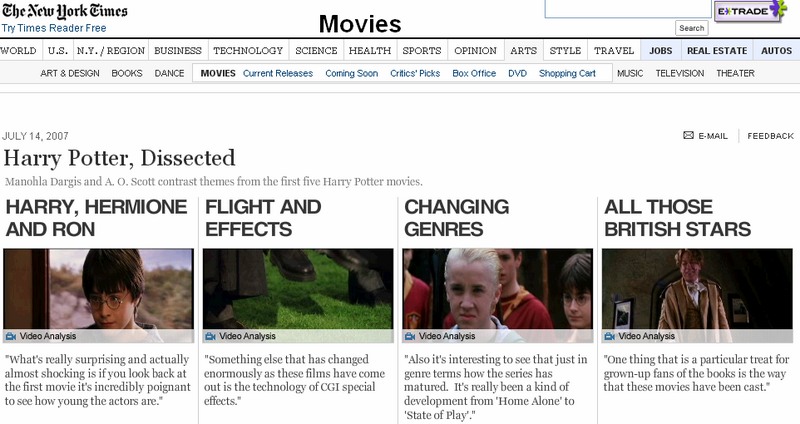
Well, the New York Times now has a feature which explores the Harry Potter movie series from four perspectives: 1) Harry, Hermione and Ron; 2) Flight and Effects; 3) Changing Genres; and 4) All Those British Stars.

Check it out. It's interesting.

Today I went back to look at the first four films so I can decide which is my favorite. (A bit too much partying after the movie, so it was a stay home day.)

The Order of the Phoenix was good, but it ranks fifth for me in the series. The other four were better. It's still definitely worth a go see because of the throw down at the end in 3D.

Read More...

Sphere: Related Content

Thursday, June 21, 2007

B.S. - Hacker claims Harry Potter's alleged ending on Web

Update: July 19, 2007 @ 6:36pm

Now how did I miss this bit of news?

New Harry Potter Book Leaked Onto Bit Torrent

Honestly, like I say later in this post, I think there are going to be tons of "leaks".

However, some are quite dangerous to your computer and bit torrent can be. The release date is so close that it pretty much defeats the whole purpose.

BTW, I did get a leak of the epilogue and let me just say I'm not telling. Wait until the book is released, but I did smile when I read it. Either way, thanks my elitist Oxford-educated friend ;).

Basically, don't bother with bit torrents. These leaks probably have bad stuff bundled with them and, from what the article says, the scan is low quality too. It just might be a fake. Fake or not, since this book as been on pre-order for months now, I doubt that Perez is right that J.K. Rowling or anyone at Scholastic is "majorly bummed."

If you just have to know, contact this guy: The Voice of Harry Potter Can Keep a Secret

--------------------------------------------

Okay, I wrote a Harry Potter post back in August when JK Rowling said more major characters were set to die in Harry Potter and the Deathly Hallows which is the end of the series. Of course, this set everyone speculating whether it would be Harry or one or both of his friends, Hermione or Ron.

I'm going to be honest here. I got the last Harry Potter book, Harry Potter and the Half-Blood Prince as a gift. A friend had finished it, she was leaving Korea and traveling on. She passed it on to me. I feel bad that I've not yet finished reading it and it has been collecting dust under my bed since late August.*

With that 'Half-Blood Prince unread under my bed' guilt that I've been carrying these last few months, I thought this was an interesting headline: Hacker claims Harry Potter's alleged ending on Web.

I went over to the hacker site to read the alleged ending.

I'm making the following points because the hacker's site says this:

So we make this spoiler to make reading of the upcoming book useless and boring...

It's amazing to see how much people inside the company have copies and drafts of this book.

Curiosity killed the cat.
First, the hacker mentions he used "the easiest" way to hack in was how he got it. I don't think it's "amazing to see" at all.

Now my thing is in a huge money making enterprise like Harry Potter and with full knowledge that people are going to try to hack, steal, bribe and engage in all sorts of deals to get their hands on the top secret ending. If I were in the ranks of the people that matter at Bloomsbury Publishing, I would have some computers with moderate protection, because you can't make it too easy for the hackers. These computers would have decoy copies of the final book saved there.

Has this guy never seen Star Wars: A New Hope? They let them get away in the Millennium Falcon and then tracked them to the rebel base. It was there that the Empire armed with the Death Star tried to destroy them!

Same thing here, except that, as far as I know, the hacker hasn't been blown up.

If I were on this project there would be decoy after decoy set up to put people off the trail. If it was that easy to get it to and there were that many copies floating about, then it's not the real ending.

I'd be amazed that many people have genuine draft copies at all. I think this hacker has been duped.

But if he's correct, then I know who dies. However, I'm still buying and reading the book.

More links:
BBC News: Hacker claims Potter book spoiler
The Money Times: Hacker claims to have Potter plot

-------
*In my defense, it's been a busy year of playing the roles of both grad student and college instructor...now that it's over I think I'll be picking up many things I dropped when school started last August.

Read More...

Sphere: Related Content