Crap That I'll Miss: Fun, Smart and Hilarious Kids
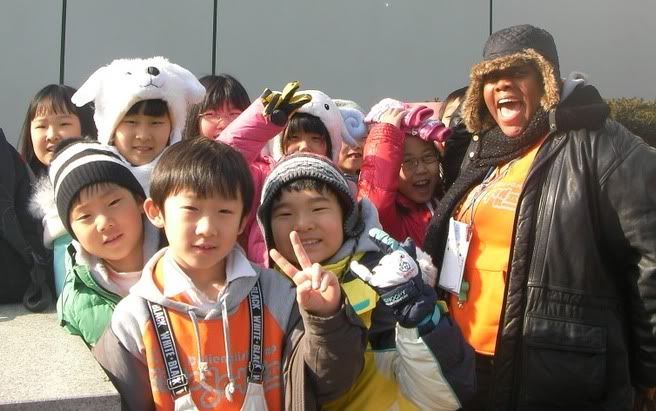 Nothing is perfect and working with children can be a challenge at times. This is particularly so in Korea due to cultural differences and very demanding parents. However, pretty much since I've arrived, I've had tons of fun working at winter or summer English camps. Maybe it's because, in some ways, I'm a kid at heart. I love clowning around with them but also getting serious and seeing them absorb information from me like sponges. Now I'll be 100% honest and also say that I love sending them home at the end of the day because it's truly exhausting too. I discovered that I liked teaching kids when I taught as a substitute teacher in the San Francisco Bay Area.
However, some camp experiences have been better or worse than others. That depends on a number of factors. The most important is the experience level of the management team because a micro-manager can make a camp hell to work at. Unfortunately, there are a lot of micro-managers in Korea. One camp I worked at has a manager so into control that he made teachers sign out for copy paper and locked their classrooms after the kids left to force all the teachers in the library to write their lesson plans and prep for the next day. That was weirdness on a level I'd never seen before and, luckily, haven't seen since. However, I can count the truly unpleasant camps on one hand, so that's not too bad if you calculate 8 years. There was maybe one or two times I elected not to do a camp, so that's around 14 or so of these. Even if the camp is a nightmare on the management side, usually, the pay is decent for a two to three week assignment if you're already in the country. I don't think I'd ever do one if I had to cover my own airfare to get here though. But people are coming here sometimes to get a feel for Korea before deciding to work here for a year or use being in the country for a camp as a way to start looking for an annual position.
The perk for me is changing the type of student I teach from college age young adults to young whip smart kids. There are behavior issues, for sure. But there are behavior issues with college students too. The kids know, just as we do, that these things are temporary and some take advantage of that. However, most of the time the kids are great. I'll miss the few weeks each summer and winter that I spend doing it. This time around it's much more of a challenge because now I'm simultaneously trying to keep up with my writing and interviews. That's truly exhausting.
I also have to say I hope it helps these kids develop a more open perspective to race and people who are different. Prior to being taught by me a lot of these kids have never had much contact, if any, with a black person. Most of these kids are children whose parents are white collar workers, so they have the means and then some. Mostly all have had interaction with foreign teachers and quite a few have lived abroad. It's just the reality is that most teachers here are white and some of them are less than subtle about their views on race.
That's still really weird for me to imagine. As a kid, I remember my first teachers being white and that was no issue. I don't recall gasps or blunt observations of differences. One reason is, probably, as minorities in a white dominated society, whites simply aren't a novelty to a black child in the inner city. I remember being in a class with both black and Hispanic children when I went to schools near my home. When I started going to more integrated schools, it took me no time to develop lasting friendships with my white classmates too. So it still boggles my mind at how Korean culture is so very "us versus them." Here, anyone who isn't northeast Asian (Korean, Chinese, or Japanese) is a novelty. I get it intellectually, but I do wonder sometimes how it feels to be inside a mind like that where everything is either just like you or in stark contrast to you.
It also points to maybe one reason why it just seems so difficult for Koreans to process an interest in and knowledge of their culture by people who aren't ethnically Korean. In conversations with my Korean friends, I point out that the Chinese actually brag about their diversity. They are also neither crestfallen or defensive when you don't like something about China. Also, both the Chinese and Japanese are experts in exporting certain dimensions of their culture. It's an interesting contrast for sure.
I've wandered off the path a bit into cultural-based musing. However, to sum it up, I'll miss the fun, smart and hilarious kids I've had the pleasure to teach while I've been here.