I heard that term for the first time in my International Political Economy course last semester. Now that I've graduated and revealed that I went to Ewha Womans University's GSIS program*, I can also reveal that it was taught by MIT educated Professor Byoung-joo Kim.
That was one great thing about Ewha's GSIS program. They were able to pull in professors with not only academic but also real world experience. Now this isn't a post touting the pluses of Ewha's GSIS program, but that was the strongest one for me because, believe me, the department also has its issues.
So let's get to the topic. I chose to use the term "peasant egalitarianism" because it covers the post-Korean War South Korean mentality. The country was decimated. It was also split and families are to this day still separated. The rich were poor and the poor were also poor. In a very fundamental way, South Korea had a rebuild from nothing. What weaved its way into that was egalitarianism.
This definition on Wiki sums it up more succiently than I can manage:
Egalitarianism (derived from the French word égal, meaning equal or level) is a political doctrine that holds that all people should be treated as equals from birth. Generally it applies to being held equal under the law, the church, and society at large. In actual practice, one may be considered an egalitarian in most areas listed above, even if not subscribing to equality in every possible area of individual difference.
Layer egalitarianism on a nation destroyed by war where everyone is poor and you've got your peasants.
On top of that South Korea, as we all know, has had the aid and support of the United States which is still here. The US shared technology, helped rebuild the infrastructure, opened its borders and schools to South Koreans and commited its military to the defense of the South Korea. Of course, the UN was here as well as other nations (so no need to comment to point that out...thanks.) I mention this aid because this is a crucial point because this is where South Korea was smart. You can easily see a society where the leaders would divert all that aid to benefit themselves. South Korea has had it's scandals but has been pretty lucky overall it seems in that respect. That money that would have otherwise been committed to its defense was spent on creating a vibrant economy. One thing that is essential to that is education and one thing that shocked and impressed me when I arrived here was the huge number of colleges and universities in small or remote areas. Koreans have an advantage when it comes to their language:
hangul Koreans call their alphabet Hangul. Like English, the letters of the Hangul alphabet represent individual sounds or phonemes. Hangul was invented by King Sejong of the Choson Dynasty, and introduced to the public in 1443 in Hun-Min-Jeong-Eum. King Sejong believed that Koreans needed an easy-to-learn system for writing their own language. Before King Sejong deigned the Hangul, Koreans had either written in the Chinese language or had written Korean using Chinese characters to represent the Korean sounds in a complex system, Idu. The alphabet originally contained 28 letters composed of 11 vowels and 17 consonants.
This means that anyone can read Korean. People don't believe me when I tell them it's easy to learn because they imagine it's like Chinese where the letter is based on a character. You know "this is a man sitting under a tree" and that means ..." Well, hangul isn't like that. It's an alphabet. It's just put together from different angles.
What that means is there is almost no illiteracy here. Mix into that a high respect for education, a society that was smart and actually channelled its resources into education and you get what I saw this morning.
 I was en route to work on the subway and I got the coveted end of the row seat. In my car was a newspaper delevery man who had a hand trolley stacked full of papers to drop off to the kiosks you see on the streets here in Seoul. Clearly, taking advantage of his job perk: free papers. That man was standing there reading a paper.
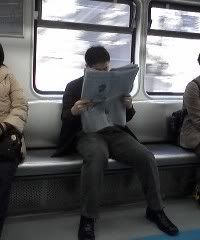
A few seats away was a man dressed as if he was on his way to work was sitting down also reading a morning paper. Now I didn't stop and ask them about themselves. The man with the trolley could very well be one of the many highly trained workers that were displaced during the Asian Financial Crisis. I've met a few who are now taxi drivers or shop owners. That guy reading the paper could have been en route to yet another job interview. However, assuming I'm right about these two men. That's cool.
Of course, the big benefit to ethnically homogenious cultures is no ethnic problems. The problems that Koreans have are with other groups. Yes, there are problems within Korean society but they have an impressive sense of unity. That, along with Confucianism makes it easier for them to take one for the team. The massive economic development they've seen is definitely attributable in many ways to the group unity they have.
Now this struck me as great because there are only a few countries where I'd say education is truly accessible to all. This hits me so because my father was illiterate. The US at the time of his youth was still very much incredibly racist and economically divided not only in its beliefs but in its system and laws. In rural Georgia with a family with 12 other siblings he had to work. That's where economics factors in. I'd like to think that in the modern US a family that large would HAVE to send their children to school or home school them to the state's satisfaction. Going to school wasn't an option for my father.
I'd say race factors into it because it becomes an issue when the children not receiving an education are white but not so much when the children are black. Hence you have a poor family doing the best they can and using all they have at their disposal, including their children, to make ends meet. You can argue that the US still has tons of racial and economic issues. I'd agree, but I'm one generation from people who had it much worse than I'll ever have. To not acknowledge that would be disrespectful to them and to the people who worked so hard to make things better for me.
It also means that in a foreign culture I can see the similarities and differences from another point of view. I do think it's because I'm a minority in my home country as well as here. So certain things are the same and I know those things aren't the same for a good number of my co-workers and acquaintances here. In many ways, this is the first time ever they've dealt with being different or have faced overwhelmingly negative versus positive stereotypes. Now that's not the case for all, but I hope you get my point---it's general, there are always exceptions.
But to bring that generality home here is a story. This weekend I had a discussion with some other foreigners here over various cuts of meat. I said that the cuts of meats most definitely correlate to the struggle a group has had. Black and Koreans have had it hard. Therefore, in both soul food and Korean kitchens you've got animal intestines on the menu: chitterlings int the soul food restarants and 곱창, gobchang, in Korean ones. Now pointing out economic differences and how that factors into other aspects of life makes some people uncomfortable. It didn't surprise me when the white American woman at the table HAD to shot that down because, well, the French also eat intestines. I didn't have the energy to explain that bouchons is also working class food. Also, hello, the French Revolution was very much a class struggle! Hence the French and their motto "Liberté, Egalité, Fraternité". The French also have their fair share of economic and class differences today. However, it was something not worth bringing up when you're faced with a white American not willing to acknowledge certain privileges. A friendly dinner is really not the time for a history lesson even when you know the person is wrong.
So, with that said, when I see these positive societal differences. I'm happy to see a nation where the blue collar workers read the paper just as the white collar workers do. Granted, South Korea has a way to go on many issues from women's rights to race and even religion, but when it comes to access to basic education it's pretty fair. For me, that's significant because if my dad knew what was in the paper it was because I or my mom read it to him.
_____________________________
*Why? Let's just say I didn't blend in when running around campus. Now that I'm no longer running around campus if you're going to stalk me, well, you have to find me. With, at least, 7 or 8 international studies programs taught in English in or near Seoul someone was going to have to their work cut out for them.
Read More...
Summary only...
Sphere: Related Content