Showing posts with label NY Times. Show all posts

Sunday, July 27, 2008

Finally...I Can Talk About This

Matt Gross, the Frugal Traveler, for the NY Times was here a few months ago. At the time Joe over ZenKimchi called me up and asked me to suggest a restaurant for him to take Matt to.

I'm not a foodie and, if you read my blog, you KNOW, I don't bother blogging about food. There are people with much better palettes, a deeper interest and who are just better writers than I am on food.

However, I do know what I like. I suggested we go eat 안동 찜닭, Andong jjim dalk, because I fell in love with this dish when I lived in the Daegu area. Basically, it's chicken with clear noodles, potatoes, veggies and chunks of pepper stewed in a very savory and soy-based sauce. It's a great dish to have during the winter months when you want a hearty meal. Dining in Korea is hopelessly social, so it's great to go there with friends and that made it an easy choice for me.

What I didn't know was the article finally came out last week. Since everyone who went with him to this meal were writers, either other journalists or bloggers, he asked us to hold off on writing about it until he'd published his article. No problem.

But now it's out, so I can talk about it.

Here is the link: The Weird, Wild and, Ultimately, Sublime.

I was happy to see the paragraph he wrote about the 찜닭 restaurant:

But such extreme dining is mostly a sideline. More commonly, I ate at restaurants like New Andong Zzimdak, which serves a single dish: boneless chicken pieces sautéed at your table with mung-bean noodles, vegetables, and gochujang, a red-pepper paste that is to Korean cuisine what butter is to French. This is easy food, slightly spicy, with an unexpected sweetness from caramelized gochujang. Like most Korean food, it comes in massive quantities and is meant to be eaten by large groups of friends (mine included Joe McPherson, who blogs about food at ZenKimchi.com), who pour one another beer and soju and snip the long noodles with scissors.
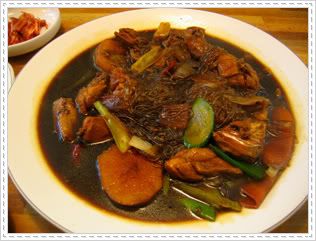
Honestly, his description of 찜닭 isn't quite right but when it came time to talk about the dish, the foodies took the stage and, well ... improvised ;) 1) They bring the dish already cooked to your table. 2) The ingredients Matt lists aren't accurate.

This guy on Flickr has a much more accurate description of what the dish is made of as does the very reliable Wiki on Korea, Galbijim. It most definitely doesn't not have 고추장, gochujang, in it. The spiciness comes from the big chunks of pepper cut into the dish and not from pepper sauce.

Here is a recipe I found on Daum. I can read the ingredient list, but I can't translate it (yeah..."duh" is me.) However, here is the link so you can find a Korean friend to help you out if you're so inclined (it's about 1/2 way down the page.)
간편 안동찜닭

재료:

닭반마리, 감자2개, 양파 3/1개, 청고추1개, 홍고추1개,청양고추2개,다진마늘2/1작은술,

후추약간,참기름1큰술,간장3큰술, 1반컵,설탕2큰술,


만드는법:

1. 닭은 토막내어 세척한후 뜨거우물에 데쳐 찬물에 행구어 물기를 빼논다

2. 감자는 껍질을 제거해 큼직하게 썰어주고 양파도 큼직하게 썰어주고 청고추와 홍고추는

어슷하게 썰어준다

4. 간장에 청양고추를 반으로 잘라서 넣고 물1컵을 넣고 3-4분정도 끓여준다

5. 청양고추를 건져내고 데쳐낸 닭과 감자를 넣어 조려준다

6. 어느정도 졸여지면 다진마늘과 설탕을 넣어서 졸여주고 완성되기 1분전에 양파와

두가지색 고추를 넣어 버무려누고 참기름과 후추를 넣어 마무리한다

Matt ended the article listing two places that I just love: Myeongdong Kyoja, which serves some of the best, 칼국수, kalguksu and kimchee around, and the place we went to for 찜닭, New Andong Zzimdak. (Check out his article for websites and phone numbers.)

I'm glad to see it out because there is some both delicious and sometimes odd food concoctions to be had here in Korea.

Okay, it's very late and I've got a deadline to meet and I've got to be at work tomorrow at 9:20am. That's not extremely early but it is when it's almost 2am and you know you'll be up for, at least, another hour.

Read More...

Sphere: Related Content

Monday, April 7, 2008

Death By Blogging? Oh crap!!!

Here is a NY York Times article that talks about the recent deaths of a few prominent bloggers.

Death by blogging did occur to me when I made a post about the death of Steve Gillard. With all due respect to him, the picture showed a guy who didn't get out to do a daily stroll much less a daily jog.

For my own health, I have to say I watch what I eat, but I've been a bit lax on exercise lately myself. I blame on the arctic winters they have here in Korea. I like exercising outdoors. That's easy to do in Los Angeles or San Francisco. It's much more difficult to do in Seoul when it's freezing. I noticed that after almost four weeks in the States, I came back slimmer. Now I've got to maintain it and I'm already loosing ground. Korea is a place where it's a pain to exercise outdoors. I've found it also a pain to exercise indoors. If I'm in the gym and I've got my headphones on DON'T TALK TO ME! However, I think I'll get back on it because I was talking about roller blading out by the river, so roller blading this weekend it is. I'd like to be a blogger that makes it past 60.

K-bloggers? Should we actually start getting paid for this are we be in for the same fate?

NY Times: In Web World of 24/7 Stress, Writers Blog Till They Drop

SAN FRANCISCO — They work long hours, often to exhaustion. Many are paid by the piece — not garments, but blog posts. This is the digital-era sweatshop. You may know it by a different name: home.

A growing work force of home-office laborers and entrepreneurs, armed with computers and smartphones and wired to the hilt, are toiling under great physical and emotional stress created by the around-the-clock Internet economy that demands a constant stream of news and comment.

Of course, the bloggers can work elsewhere, and they profess a love of the nonstop action and perhaps the chance to create a global media outlet without a major up-front investment. At the same time, some are starting to wonder if something has gone very wrong. In the last few months, two among their ranks have died suddenly.

Two weeks ago in North Lauderdale, Fla., funeral services were held for Russell Shaw, a prolific blogger on technology subjects who died at 60 of a heart attack. In December, another tech blogger, Marc Orchant, died at 50 of a massive coronary. A third, Om Malik, 41, survived a heart attack in December.

Other bloggers complain of weight loss or gain, sleep disorders, exhaustion and other maladies born of the nonstop strain of producing for a news and information cycle that is as always-on as the Internet.

To be sure, there is no official diagnosis of death by blogging, and the premature demise of two people obviously does not qualify as an epidemic. There is also no certainty that the stress of the work contributed to their deaths. But friends and family of the deceased, and fellow information workers, say those deaths have them thinking about the dangers of their work style.

The pressure even gets to those who work for themselves — and are being well-compensated for it.

“I haven’t died yet,” said Michael Arrington, the founder and co-editor of TechCrunch, a popular technology blog. The site has brought in millions in advertising revenue, but there has been a hefty cost. Mr. Arrington says he has gained 30 pounds in the last three years, developed a severe sleeping disorder and turned his home into an office for him and four employees. “At some point, I’ll have a nervous breakdown and be admitted to the hospital, or something else will happen.”

“This is not sustainable,” he said.

It is unclear how many people blog for pay, but there are surely several thousand and maybe even tens of thousands.

The emergence of this class of information worker has paralleled the development of the online economy. Publishing has expanded to the Internet, and advertising has followed.

Even at established companies, the Internet has changed the nature of work, allowing people to set up virtual offices and work from anywhere at any time. That flexibility has a downside, in that workers are always a click away from the burdens of the office. For obsessive information workers, that can mean never leaving the house.

Blogging has been lucrative for some, but those on the lower rungs of the business can earn as little as $10 a post, and in some cases are paid on a sliding bonus scale that rewards success with a demand for even more work.

There are growing legions of online chroniclers, reporting on and reflecting about sports, politics, business, celebrities and every other conceivable niche. Some write for fun, but thousands write for Web publishers — as employees or as contractors — or have started their own online media outlets with profit in mind.

One of the most competitive categories is blogs about technology developments and news. They are in a vicious 24-hour competition to break company news, reveal new products and expose corporate gaffes.

To the victor go the ego points, and, potentially, the advertising. Bloggers for such sites are often paid for each post, though some are paid based on how many people read their material. They build that audience through scoops or volume or both.

Some sites, like those owned by Gawker Media, give bloggers retainers and then bonuses for hitting benchmarks, like if the pages they write are viewed 100,000 times a month. Then the goal is raised, like a sales commission: write more, earn more.

Bloggers at some of the bigger sites say most writers earn about $30,000 a year starting out, and some can make as much as $70,000. A tireless few bloggers reach six figures, and some entrepreneurs in the field have built mini-empires on the Web that are generating hundreds of thousands of dollars a month. Others who are trying to turn blogging into a career say they can end up with just $1,000 a month.

Speed can be of the essence. If a blogger is beaten by a millisecond, someone else’s post on the subject will bring in the audience, the links and the bigger share of the ad revenue.

“There’s no time ever — including when you’re sleeping — when you’re not worried about missing a story,” Mr. Arrington said.

“Wouldn’t it be great if we said no blogger or journalist could write a story between 8 p.m. Pacific time and dawn? Then we could all take a break,” he added. “But that’s never going to happen.”

All that competition puts a premium on staying awake. Matt Buchanan, 22, is the right man for the job. He works for clicks for Gizmodo, a popular Gawker Media site that publishes news about gadgets. Mr. Buchanan lives in a small apartment in Brooklyn, where his bedroom doubles as his office.

He says he sleeps about five hours a night and often does not have time to eat proper meals. But he does stay fueled — by regularly consuming a protein supplement mixed into coffee.

But make no mistake: Mr. Buchanan, a recent graduate of New York University, loves his job. He said he gets paid to write (he will not say how much) while interacting with readers in a global conversation about the latest and greatest products.

“The fact I have a few thousand people a day reading what I write — that’s kind of cool,” he said. And, yes, it is exhausting. Sometimes, he said, “I just want to lie down.”

Sometimes he does rest, inadvertently, falling asleep at the computer.

“If I don’t hear from him, I’ll think: Matt’s passed out again,” said Brian Lam, the editor of Gizmodo. “It’s happened four or five times.”

Mr. Lam, who as a manager has a substantially larger income, works even harder. He is known to pull all-nighters at his own home office in San Francisco — hours spent trying to keep his site organized and competitive. He said he was well equipped for the torture; he used to be a Thai-style boxer.

“I’ve got a background getting punched in the face,” he said. “That’s why I’m good at this job.”

Mr. Lam said he has worried his blogging staff might be burning out, and he urges them to take breaks, even vacations. But he said they face tremendous pressure — external, internal and financial. He said the evolution of the “pay-per-click” economy has put the emphasis on reader traffic and financial return, not journalism.

In the case of Mr. Shaw, it is not clear what role stress played in his death. Ellen Green, who had been dating him for 13 months, said the pressure, though self-imposed, was severe. She said she and Mr. Shaw had been talking a lot about how he could create a healthier lifestyle, particularly after the death of his friend, Mr. Orchant.

“The blogger community is looking at this and saying: ‘Oh no, it happened so fast to two really vital people in the field,’ ” she said. They are wondering, “What does that have to do with me?”

For his part, Mr. Shaw did not die at his desk. He died in a hotel in San Jose, Calif., where he had flown to cover a technology conference. He had written a last e-mail dispatch to his editor at ZDNet: “Have come down with something. Resting now posts to resume later today or tomorrow.”

Read More...

Sphere: Related Content

Saturday, April 5, 2008

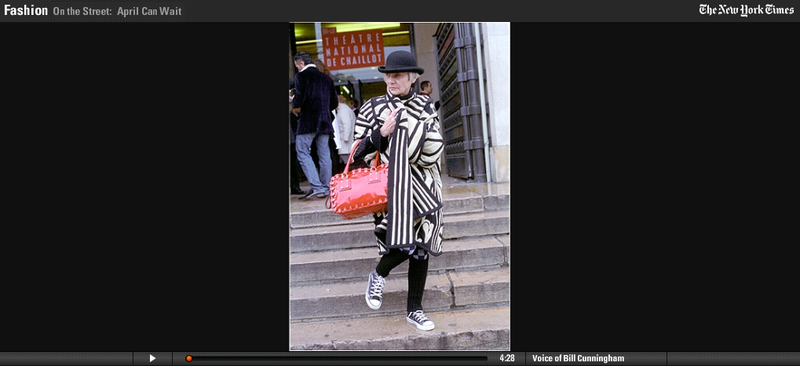
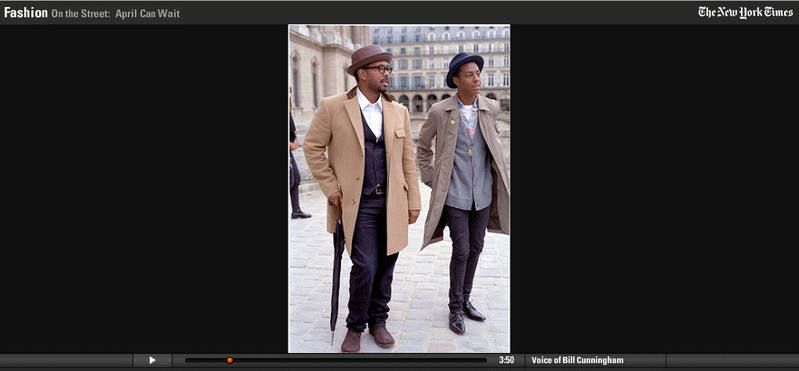
April Can Wait


This was going to go on another blog I write for. However, it never made it.

I love this, so I'm linking it here.

It's a photo essay of the street fashion at Paris' prêt-à-porter fashion week done by Bill Cunningham for the NY Times.

Read More...

Sphere: Related Content