It was a blog about my life and adventures as an expat in Seoul, South Korea. I've been back in the USA for over ten years. However, I still get alerts. I'll respond to comments and deep-six spam comments as needed.
This is a great discovery. Thanks to today's Thrillist NY newsletter: http://www.thrillist.com/maps/nycmugged. With looking for work and going into NYC for interviews, it's a guarantee that I'll seek out a coffee bar/cafe with wi-fi to park, plug-in and surf the want ads. Since Starbucks has wifi, and I've got Boingo wireless. I just plug in the zip code of where I am and let my Blackberry tell me where to go.
However, I'm feeling like I ought to give the smaller and independent spots a chance. I just don't know where they are, and I'm always ending up somewhere that's new to me. That's exciting but that also means I just don't know the layout. The trick is finding out where the hell they are.
This is where NYC Mugged can help a newb. For me, getting coffee or tea is a waste of money if I don't have wifi and a place to plug in the laptop. I'm hoping this will guide me to those spots. If you're not tethered to your laptop like I am, you'll have more of a range. This is a great idea.
So onward with more caffeinated wi-fi Internet surfing!
I was on a bus from NYC to Philly. The bus had wifi but wouldn't let me load the USstream.tv website. Odd. Anyway, here it is for those of us who didn't get to see it.
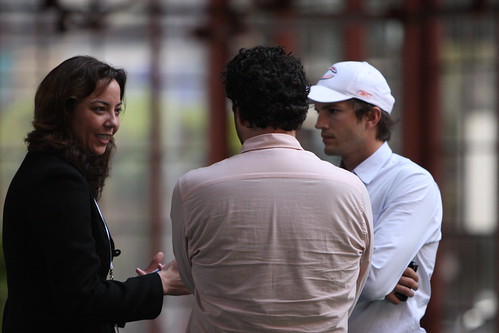
Ashton doing a ding dong ditch. Of course, he had to change it up because you can't just walk up to Ted Turner's front door ;)
Thanks to anyone who followed my lead and added him! It's a victory for new media. Things are changing.
__________________________________
I don't know if you've been following this madness, but a couple of days ago Ashton Kutcher challenged CNN and Ted Turner to a contest. Basically, if he got to 1,000,000 followers on Twitter before CNNbrk (Breaking News), he'd ding, dong, ditch Ted Turner's house.
However, then he added that he'd donate 10,000 nets to prevent malaria. This cause is something that he tweeted about a couple of days before the challenge. That's also when I decided to take him seriously and urge him on and encourage others to follow him too. Also, today, I realized I was following CNNbrk, so I stopped, for now. I'll follow them again when this is all over.
Now in the land that is the Internet there are a lot of haters out there who don't seem to get it. Brian Solis, however, does. For that his post on the topic is well worth posting here.
Ashton and Evan Williams, one of the founders of Twitter will be on Oprah tomorrow. I'll be in Yosemite, so I'm going to miss all of this, but tune in if you're in the States. It ought to be fun to watch.
However, if this is the first you've heard of this, read what Solis has to say.
Also, folks in the K-blogosphere, if you still pay attention to what I write (and I hope some of you do), get on Twitter and follow Ashton. Thanks ;)
It started as a simple and seemingly harmless contest. Who would be the first person on Twitter to reach 1,000,000 followers?
This wasn’t yet another follower push open to just anyone on Twitter however, not even the Weblebrities who helped propel the popular micro community to an emerging, iconic pop culture status; it was (and at the moment, still is) a race between the world’s most visible celebrities and prominent media brands.
It started when Ashton Kutcher, a television and movie star who’s also keenly astute and observant to the promise of new media challenged CNN and its founder, Ted Turner to the race.
It was the match heard round the blogosphere, twitterverse and statusphere.
Shortly thereafter, Britney Spears, Will Smith and a bevy of opportunistic celebrities (and their publicists) and media properties (driven by their PR teams) followed suit. Britney’s team offered chances to win free tickets in exchange for followers. Other celebrities (who shall remain anonymous, DM’d followers to ask for help in spreading the word.)
The competition quickly became a media phenomenon.
Ashton and Twitter Co-Founder Evan Williams are now expected to appear on the Oprah show tomorrow, which will coincide with almost every leading competitor surpassing 1,000,000 followers on the same day. The publicity was enough to inspire Oprah to start tweeting.
Sarah Ross, Ashton Kutcher, TechCrunch50
At the time of this post, CNNbrk was in the lead with 977,02 followers, with Ashton Kutcher following closely with 973,806, and Britney Spears in third with 944,273.
Initially I questioned the exchange. I couldn’t help but feel as though “we the people” on Twitter were merely viewed as pawns in a personal chess match between the elite.
Think about it. If Twitter had 6-7 million users, we’re talking about 1 in every 6 or so users following one of the contenders.
I threw the question out to Twitter, “How do you feel about the race to 1,000,000?”
The response was almost overwhelming in its volume and vigor, spanning across Twitter and Facebook over the course of several hours.
While the publicity for Twitter and the overall medium that is Social Media is incredible and sprawling, I believe that the purpose and deeper meaning of having 1,000,000 followers on Twitter or any social network, will be lost to the fervor that fuels this “contest” – unless we’re comfortable holding the title of “follower” a.k.a. social pauper. I highly doubt that any brand will view this special achievement of having cultivated 1 million followers as an opportunity to “engage” in “conversations” with their communities. Intention is easily assessable by simply viewing the latest tweets via www.twitter.com/username.
But in Ashton’s case, it’s so much deeper. I believe his intentions are genuine.
Should he win, he’s promised to donate 10,000 mosquito nets to help fight malaria. After promising the nets, he then dedicated the nets either way. Using social media to build a platform for self-promotion or a top-down distribution channel for propaganda and messages is, in the spirit of the social web, anti-social. To demonstrate that any individual can earn influence for which to wield freely and graciously in the name of social good is symbolic of the true spirit of Social Media.
In his own words, Kutcher so passionately defines what has inspired many of us over the last several years in our work to help cultivate the foundation for social media and the very people powering its evolution, “So why is this significant? This is a huge statement for Social Media. For one person to actually have the ability to broadcast to as many people as a major media network, sort of signifies the turning of the tide from tradition news outlets to social news outlets. With our video cameras on cell phones, picture cams, blogging, twittering, posting, and Facebooking, we actually become the source of the news, the broadcasters of the news, and the consumers of the news…we have the potential on this day to turn the tide…where social media and social news outlets can become as powerful as the major news outlets. We’re doing that with the help of you. It’s sort of power to the people and I like that, a lot.”
We participate on social networks to express ourselves and share a piece of who we are in the real world, online, to forge relationships with people we respect, trust, and admire and it inspires us to share, learn, and grow together. With every tweet and update, we reveal a bit of what we stand for and what moves us, forming a unique social graph that contextually connects us to others in an irreproducible network. It’s unique to each one of us, and it’s both empowering and powerful.
We become media.
We become influencers.
We are the source of the social seismographs that spark reverberating tremors that represent the potential to create a webwide social effect.
We’re shifting into a rapid-fire culture that moves at Twitter time. Attention is a precious commodity and requires a personalized engagement strategy in order to consistently vie for it. The laws of attraction and relationships management are driven by the ability to create compelling content and transparently connect it to the people whom you believe benefit.
Twitter and the statusphere have become our attention dashboards, the new ecosystem for sharing, discovering, and publishing updates and micro-sized content that reverberates throughout social networks and syndicated profiles, resulting in a formidable network effect of activity. It is the digital curation of relevant content that binds us contextually and through the statusphere we can connect directly to existing contacts, reach new people, and also forge new friendships through the friends of friends effect (FoFs) in the process.
Is having one million followers sustainable? Better yet, is it engaging or welcoming? Can you genuinely listen to and converse with a community that rivals the population of small countries?
Perhaps it doesn’t matter...not anymore. If you are a curator of highly relevant information, thoughts, beliefs, opinions, and motivating substance, then you can potentially flourish into a fountain of inspiration that channels content to the beacons and ambassadors who also represent interconnected human networks. It’s how we communicate now.
Dr. Dunbar, theorized that the size of the human brain allows a stable network of about 148 contacts, which has become known as “the Dunbar number.” In Social Networks however, real world relationships have evolved into something altogether different and perhaps more authoritative. Now, individuals can follow and are followed by thousands or (eventually) millions of "friends" across the Conversation Prism. This is a new breed of personal branding and expert and themed curation tethered to a peer network that exemplifies fandom and creates a platform for peer-to-peer influence. And, we may or may not ever know the people who choose to follow our updates or friend us on these popular and emerging networks. Our human network is defined by reach, not just in one community, but through the syndication of multiple social networks.
For Ashton, reaching one million followers represents the potential of socialized media, the future of information discovery and distribution, and the connectedness of contextual human networks. For the others, collecting followers represents the ability to push information to a faceless list of avatars using a new medium. As followers, we’re simply relegated to subscribers and fans, nothing less, nothing more.
The future of Social Media lies with those who can create, cultivate, and empower individuals to produce and share meaningful content and activity to inspire action, foster education, instigate change and build a more media literate society.
I don't talk about my feelings much. How I feel when it comes to this or that issue, yes, but my emotions, no, not really. That's true of this blog and it's, pretty much, true in real life.
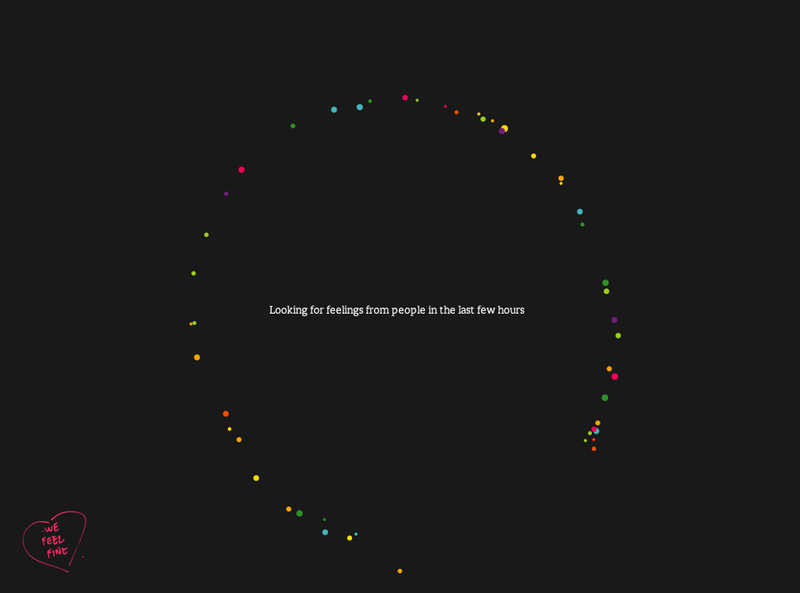
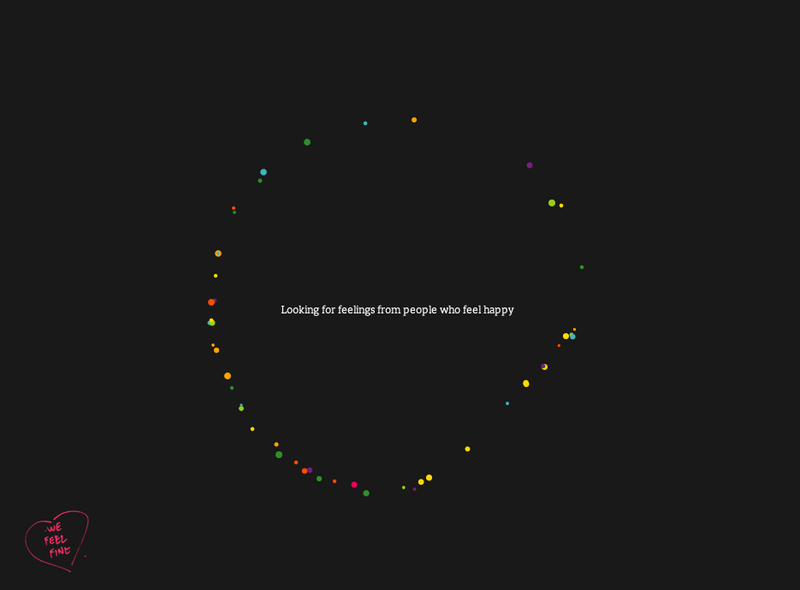
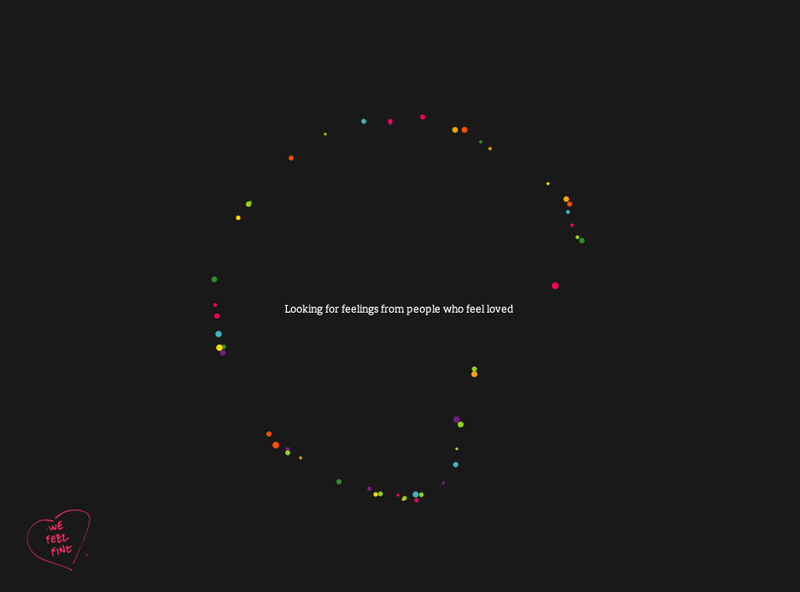
However, I guess I've talked about it enough to be indexed by the search bots and found by We Feel Fine because they contacted me today via email.
Since August 2005, We Feel Fine has been harvesting human feelings from a large number of weblogs. Every few minutes, the system searches the world's newly posted blog entries for occurrences of the phrases "I feel" and "I am feeling". When it finds such a phrase, it records the full sentence, up to the period, and identifies the "feeling" expressed in that sentence (e.g. sad, happy, depressed, etc.). Because blogs are structured in largely standard ways, the age, gender, and geographical location of the author can often be extracted and saved along with the sentence, as can the local weather conditions at the time the sentence was written. All of this information is saved.
That actually made me feel good (and that won't be indexed because it's not written in a way that their system will pick it up.)
Click over and check it out. It's really interesting, not to mention pretty ;)
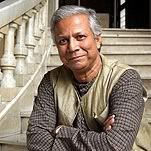
I got turned on to the idea of microfinance by the man who is famous for it, Professor Muhammad Yunis. He won the Noble Peace Prize along with his organization Grameen Bank in 2006. At the time, I was at Ewha Womans University at the Graduate School of International Studies. Right after he won the Noble Peace Prize, he came to Ewha to speak. I, along with other Ewha students and some people from the general public, got to hear his story about about how he made his idea of microfinance a success in his native country of Bangladesh. Being a student, I was lucky enough to ask him a question. I asked him about how he envisioned microfinance working in more developed countries like the States. I asked because I come from a working class background. My father was a blue collar worker and my mom was a housewife. My parents figured out the benefit of credit and never had problems. However, in the neighborhood I grew up in, they're the exception rather than the rule it seemed. As a result, I was a lucky (and spoiled) only child, who didn't want for much. Others in my neighborhood weren't so lucky. As a result of white flight, the neighborhood was a mix of working class families and those on public assistance. The working class families, for the most part, did alright as did some on public assistance, I'm sure.
Just across the street there were many who were struggling with unemployment, drugs and goodness knows what else. My neighborhood went from a pretty calm place to a place where the cops showed up way too often and gang members loitered for a bit too long. My mom was very keen on limiting my exposure to all that was going on at that time, so I can't give you many details. I just know it was about getting to school and getting back home safe and sound without incident. We made it like most families there did. However, it did leave me with a keen sense of haves vs. have-nots even on that small scale.
So, what can be done to help people in those situations? Poverty in a developed country is more nuanced in some ways because those in it are often portrayed as shiftless and lazy. However, I know it's not about being shiftless and lazy. I know some shiftless and lazy trust fund babies too. What is more on point is the issue of really feeling powerless, lacking knowledge and being ill equipped. So how can you help those in poverty who are in developed countries?
Yumis said they were planning to get involved in microfinance in the US and sure enough they have. I'm still half a world away, so there isn't much I can do to help right now. But maybe that email I got from a contact I made when I met Dr. Yunis about Grameen America will still be good when I finally choose to return.
In the meantime, I help where I can. I'm a member of Kiva.org and I've helped two entrepreneurs, one in Ghana and the other in Mexico, get the loans they need to expand their business. I don't have much, but it doesn't take much to help someone with microfinance because these are very small loans. I'm proud to say that I just got an email letting me know that one of the two I loaned to has paid back 14% of her loan. I do hope it helps her rise up out of poverty.
With the economic crisis, everyone is concerned about their finances. However, put it in perspective. Languishing over the diminished value of their 401Ks is probably an issue they never wrestle with. It's simply about getting enough money to fund a small business, so they can make a living. Just a few dollars can help someone and, I think, it's worth it.
Even if lending to someone in need is beyond your means right now, you can still get involved in fighting poverty.
Here is a list of what one person can do from the Blog Action Day website: What Can One Person Do?
Here is the accompanying video. The video is tinged with religion, but you can be an atheist or agnostic and recognize that collective action is needed to help eradicate poverty:
Last year the topic was the environment and my take on it was Koreans needed to be more proactive when it came to environmental issues. I got on that because the topic of Korea's economic development came up constantly in class when I was getting my masters here. And I'd hear the "we're a developing country" excuse a lot, but I'd also see no recycling bins for plastics and pretty much no awareness of wasteful behavior: Koreans Can't Afford to Think Poor. Basically, the point was if every developing country gets to lean on that as an excuse, the world is going to get worse before it gets better and is that really a legacy we want to leave?
This year the topic is poverty. I'm in again this year. Unlike last year, I already know my angle because I'm already involved in it.
If you've got a blog, I just want to ask you one question. Are you in?
Last night I had a chance to go to the MySpace Korea launch party. It was held in Hongdae at the aA Design Museum. The space was nice.
The party was nice enough, but what was lacking for me was the reason why MySpace is here in Korea so late in the game.
I've got a MySpace US profile and I use it frequently. However, with social networks like CyWorld and search engines with user-generated content like Naver well established here in South Korea, I'm just wondering what MySpace has to offer in a market that is already pretty saturated.
Here is a NY York Times article that talks about the recent deaths of a few prominent bloggers.
Death by blogging did occur to me when I made a post about the death of Steve Gillard. With all due respect to him, the picture showed a guy who didn't get out to do a daily stroll much less a daily jog.
For my own health, I have to say I watch what I eat, but I've been a bit lax on exercise lately myself. I blame on the arctic winters they have here in Korea. I like exercising outdoors. That's easy to do in Los Angeles or San Francisco. It's much more difficult to do in Seoul when it's freezing. I noticed that after almost four weeks in the States, I came back slimmer. Now I've got to maintain it and I'm already loosing ground. Korea is a place where it's a pain to exercise outdoors. I've found it also a pain to exercise indoors. If I'm in the gym and I've got my headphones on DON'T TALK TO ME! However, I think I'll get back on it because I was talking about roller blading out by the river, so roller blading this weekend it is. I'd like to be a blogger that makes it past 60.
K-bloggers? Should we actually start getting paid for this are we be in for the same fate?
SAN FRANCISCO — They work long hours, often to exhaustion. Many are paid by the piece — not garments, but blog posts. This is the digital-era sweatshop. You may know it by a different name: home.
A growing work force of home-office laborers and entrepreneurs, armed with computers and smartphones and wired to the hilt, are toiling under great physical and emotional stress created by the around-the-clock Internet economy that demands a constant stream of news and comment.
Of course, the bloggers can work elsewhere, and they profess a love of the nonstop action and perhaps the chance to create a global media outlet without a major up-front investment. At the same time, some are starting to wonder if something has gone very wrong. In the last few months, two among their ranks have died suddenly.
Two weeks ago in North Lauderdale, Fla., funeral services were held for Russell Shaw, a prolific blogger on technology subjects who died at 60 of a heart attack. In December, another tech blogger, Marc Orchant, died at 50 of a massive coronary. A third, Om Malik, 41, survived a heart attack in December.
Other bloggers complain of weight loss or gain, sleep disorders, exhaustion and other maladies born of the nonstop strain of producing for a news and information cycle that is as always-on as the Internet. To be sure, there is no official diagnosis of death by blogging, and the premature demise of two people obviously does not qualify as an epidemic. There is also no certainty that the stress of the work contributed to their deaths. But friends and family of the deceased, and fellow information workers, say those deaths have them thinking about the dangers of their work style.
The pressure even gets to those who work for themselves — and are being well-compensated for it.
“I haven’t died yet,” said Michael Arrington, the founder and co-editor of TechCrunch, a popular technology blog. The site has brought in millions in advertising revenue, but there has been a hefty cost. Mr. Arrington says he has gained 30 pounds in the last three years, developed a severe sleeping disorder and turned his home into an office for him and four employees. “At some point, I’ll have a nervous breakdown and be admitted to the hospital, or something else will happen.”
“This is not sustainable,” he said.
It is unclear how many people blog for pay, but there are surely several thousand and maybe even tens of thousands.
The emergence of this class of information worker has paralleled the development of the online economy. Publishing has expanded to the Internet, and advertising has followed.
Even at established companies, the Internet has changed the nature of work, allowing people to set up virtual offices and work from anywhere at any time. That flexibility has a downside, in that workers are always a click away from the burdens of the office. For obsessive information workers, that can mean never leaving the house.
Blogging has been lucrative for some, but those on the lower rungs of the business can earn as little as $10 a post, and in some cases are paid on a sliding bonus scale that rewards success with a demand for even more work.
There are growing legions of online chroniclers, reporting on and reflecting about sports, politics, business, celebrities and every other conceivable niche. Some write for fun, but thousands write for Web publishers — as employees or as contractors — or have started their own online media outlets with profit in mind.
One of the most competitive categories is blogs about technology developments and news. They are in a vicious 24-hour competition to break company news, reveal new products and expose corporate gaffes.
To the victor go the ego points, and, potentially, the advertising. Bloggers for such sites are often paid for each post, though some are paid based on how many people read their material. They build that audience through scoops or volume or both.
Some sites, like those owned by Gawker Media, give bloggers retainers and then bonuses for hitting benchmarks, like if the pages they write are viewed 100,000 times a month. Then the goal is raised, like a sales commission: write more, earn more.
Bloggers at some of the bigger sites say most writers earn about $30,000 a year starting out, and some can make as much as $70,000. A tireless few bloggers reach six figures, and some entrepreneurs in the field have built mini-empires on the Web that are generating hundreds of thousands of dollars a month. Others who are trying to turn blogging into a career say they can end up with just $1,000 a month.
Speed can be of the essence. If a blogger is beaten by a millisecond, someone else’s post on the subject will bring in the audience, the links and the bigger share of the ad revenue.
“There’s no time ever — including when you’re sleeping — when you’re not worried about missing a story,” Mr. Arrington said.
“Wouldn’t it be great if we said no blogger or journalist could write a story between 8 p.m. Pacific time and dawn? Then we could all take a break,” he added. “But that’s never going to happen.”
All that competition puts a premium on staying awake. Matt Buchanan, 22, is the right man for the job. He works for clicks for Gizmodo, a popular Gawker Media site that publishes news about gadgets. Mr. Buchanan lives in a small apartment in Brooklyn, where his bedroom doubles as his office.
He says he sleeps about five hours a night and often does not have time to eat proper meals. But he does stay fueled — by regularly consuming a protein supplement mixed into coffee.
But make no mistake: Mr. Buchanan, a recent graduate of New York University, loves his job. He said he gets paid to write (he will not say how much) while interacting with readers in a global conversation about the latest and greatest products.
“The fact I have a few thousand people a day reading what I write — that’s kind of cool,” he said. And, yes, it is exhausting. Sometimes, he said, “I just want to lie down.”
Sometimes he does rest, inadvertently, falling asleep at the computer.
“If I don’t hear from him, I’ll think: Matt’s passed out again,” said Brian Lam, the editor of Gizmodo. “It’s happened four or five times.”
Mr. Lam, who as a manager has a substantially larger income, works even harder. He is known to pull all-nighters at his own home office in San Francisco — hours spent trying to keep his site organized and competitive. He said he was well equipped for the torture; he used to be a Thai-style boxer.
“I’ve got a background getting punched in the face,” he said. “That’s why I’m good at this job.”
Mr. Lam said he has worried his blogging staff might be burning out, and he urges them to take breaks, even vacations. But he said they face tremendous pressure — external, internal and financial. He said the evolution of the “pay-per-click” economy has put the emphasis on reader traffic and financial return, not journalism.
In the case of Mr. Shaw, it is not clear what role stress played in his death. Ellen Green, who had been dating him for 13 months, said the pressure, though self-imposed, was severe. She said she and Mr. Shaw had been talking a lot about how he could create a healthier lifestyle, particularly after the death of his friend, Mr. Orchant.
“The blogger community is looking at this and saying: ‘Oh no, it happened so fast to two really vital people in the field,’ ” she said. They are wondering, “What does that have to do with me?”
For his part, Mr. Shaw did not die at his desk. He died in a hotel in San Jose, Calif., where he had flown to cover a technology conference. He had written a last e-mail dispatch to his editor at ZDNet: “Have come down with something. Resting now posts to resume later today or tomorrow.”
Ha! Over a year later, 2 Girls 1 Cup has come back to haunt me. This time, there is nothing gross and no gagging. There is only friendly banter in a FB thread. But that thread gave me this link. (thanks Jeff.)
It's a parody of a very popular video on the Internet right now. The video he and his buddy Sherrod Small are making fun of is incredibly gross. I'm NOT posting the link. If you really must see it, email me and I'll give you the direct link. The website everyone says go to is buggy to say the least.
However, I will post the challenge and me, being an idiot, doing the challenge just out of sheer morbid curiousity and guilt from laughing at all the other reaction videos I'd watched.
The challenge:
Me meeting and suffering through the challenge:
And, funny me, okay? ;-)
Just to be clear, this is not be reacting to John and Sherrod's parody. This is me reacting to the 2 girls 1 cup video. Two guys eating frozen yogurt from the same cup...strange, maybe, but that's the point of the parody. However, gag reflex inducing, not.
John and Sherrod, see you in February, and I'm going to kick your asses.
Update 1 (Nov. 10, 2007 @11:57am) Oh, update! Yes, I usually put updates first, but this one I think you have to see only after you're well versed in what this crazy 2 Girls 1 Cup thing is all about.
These two posted a response to John and Sherrod's parody. It's hilarious:
It's been quite a few months since I've done Mercy Links.
The Life of Riley: Olive Riley is a blogger who will be 108 years old on October 20th. I heard about her through an Associated Press video on her recent birthday party. My, my...I can't express how cool it is that our birthdays are in the same month! Happy Birthday Olive!
Black Travels: Honestly, I've not clicked around this site much as I've got my travel needs covered. However, the concept is good and they've got a blog which I do have linked in my sidebar. It's not very active right now, but I hope it will be.
Blog Herald: The Blog Herald was founded by Duncan Riley in March 2003 as a premium source of blog and blogging related news for bloggers. It was the first blog dedicated exclusively to the news of the blogosphere and remains the longest (and largest) standing resource of its kind. (link here.)
Overlawyered - Chronicling the high cost of our legal system: This site has been around since 1999. It covers the inconsitences and high costs of the overly litigious US legal system.
The New America Foundation: Powerful forces -- from rapid technological change to massive demographic shifts, from economic globalization to the rise of new global powers -- are remaking America. Now, more than ever, our nation needs a robust public debate that does justice to the complex challenges and opportunities of this unfolding era. Instead, there is a dearth of new thinking on both sides of the political divide, and a lack of investment in developing the creative young minds most capable of crafting new public policy solutions.
Less Than Four - The Online Community for Amputees: Created by Josh Sundquist, Less Than Four is the premier online community for amputees around the world. People with limb differences gather here to ask questions, find answers and connect with one another.
Update: March 9, 2007 (after a week of a bad cold and two insulin reactions leaving me unconscious, I found something cool on the web.)
I went onto YouTube today and it now says "Final Version". Outside of the change in the tempo of the music, I'm not sure what else has been changed. If you spot something, let me know. I'll leave them both up.
------------------------------
As a blogger, I dig this.
I don't think it needs much more than that for an introduction.
"What Would Tyler Durden Do" is a blog focused on bringing you the latest gossip and news about rich and famous celebrities. And then making fun of them. Why? Because fuck them, that's why.
Bah hahahahaha...I gotta say that I totally agree.
I swear I'm not writing this because John Mayer wrote about this a few days ago. Honestly, I had no idea because I've been simultaneously swamped with both work and school.
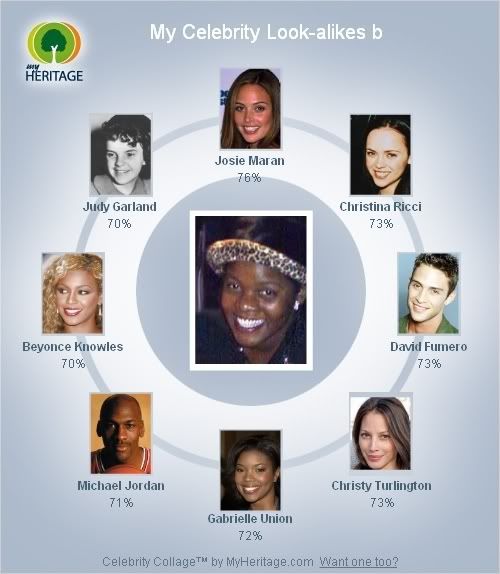
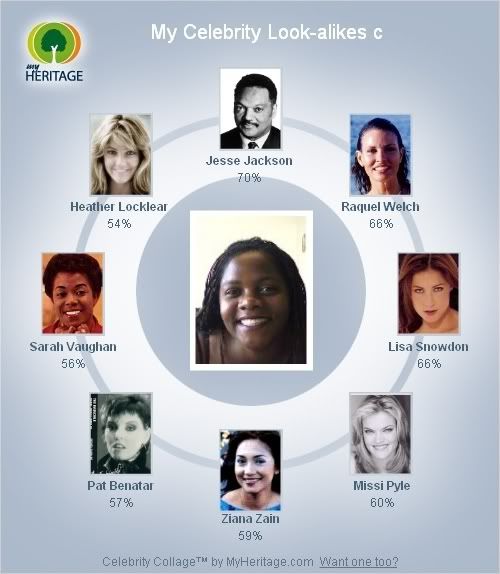
I only just discovered he wrote about it too a day or so ago when I went to his MySpace page. I think what's happening is a lot of MySpace users are converging on the MyHeritage.com site and uploading their pictures to discover what MyHeritage.com claims are their so-called celebrity look alikes. That, in turn, is driving other MySpace users to the cite.
Hence, why he's blogging about it as well as others at virtually the same time.
Okay, with that out of the way, I went a few days ago and ran picture after picture as I've managed to collect quite a few in my time. Plus, playing with that site is much more productive than say studying or working on school projects...not.
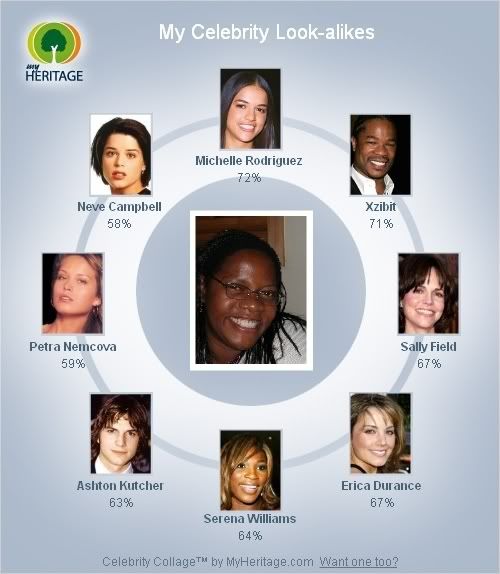
Here are three of my look alike collages:
My take on this is it's more about your pose and your facial expression. Maybe it has something to do with the relative distances of your facial features as certain celebs have come up a few times over. However, it's pretty clear that similar poses and big grins will pull up photos where the celeb is doing the same. I tend to smile broadly in photos.
Mayer's blog post, however, does come in handy for this observation. If you check out his blog, you can see that he's not a big smiler (at least not in the picture he used on MyHeritage.com) and got matched with two photos that had similar, more serious, less smiley shots.
MyHeritage.com has matched me thrice both Keira Knightley and Jamie Lynn Spears...hahahahahaha. Come on, I bear no resemblance whatsoever to either one, but randomness like that is what makes it funny.
I think the closest matches are Xzibit, that guy could be my brother, and Sarah Vaughan.
Try it out for yourself as it's, sometimes ridiculous, but fun.
I wanted to blog this because I like the number 1 thing on her list of things to put a stop to.
1) I will stop accepting friend requests on Yahoo, Orkut, etc. from unknown people. I know, I know, I have made a lot of good friends on communities like these, but it is too much of a strain on the resources to have to weed through all the creeps to get to the "few good (wo)men". So, I am going to give up all the potential good friends I may have made on all these communities and messengers by refusing to friend anyone whom I don't already know, either personally or through debates on some forum or through reading/commenting of blogs.
This resonated with me because I don't know how many times I've been minding my own business online but then I get messages from whoever from wherever wanting me to be friends.
I think she sums it up nicely. Look, it's nothing personal, but considering all the morons you have to sift through online, it's best to "just say no."
Plus, I love the image of chocolates on her template.
I want to try to make a habit of sharing other blogs that entertain me because I find I tend to just bookmark them, yet not share. Hmmmmmm...does that mean I'm selfish? Probably...
I'm an L.A. native who lived in the Land of the Morning Calm, South Korea, for a bit too long. I had a great time while I was there. I have a B.A. and law degree, but I earned a master's in international studies at Ewha Womans University. It was then I discovered that I love writing, thanks to this blog, and the things that grew out of writing it. For those who need to know where Korea is located. Korea is a peninsula that is split into two countries (North Korea and South Korea). It's located in NE Asia between Japan and Taiwan. It's below the eastern coast of China and Russia.
I moved back from NYC in 2011. It was exciting but definitely challenging. I "made" it in NYC and well, as the song says.
I'm back in the SF Bay area now. I have led the charge organizing SFTech4Good Meetup since 2011 and working in the tech industry specializing in community management and customer advocacy.
Leave a comment to contact me. Remember you have to include your email for a reply. (I screen my comments, so I won't publish it to the world, don't worry.)
Spotlight: Billy Joel's Charity Work
-
[image: Billy Joel]
No stranger to playing benefit concerts, Billy Joel was made MusiCares
Person of the Year in 2002 for services to humanity.
Joel estab...