Showing posts with label religion. Show all posts

Monday, March 23, 2009

[Regina Walton's Expat Interviews] Islam in Korea

Yeah, my write up on Islam in Korea finally made it into Monday's paper.

After covering other religions like Christianity, Buddhism, Hinduism, Judaism, this is the fifth and final installment on this series.

Islam in Korea

This is the fifth in a series looking into religion in Korea from a community perspective. The first objective is to give expatriates a springboard from which to develop spiritually. Feature articles will have examined Christianity, Buddhism, Hinduism, Judaism, Islam and Sikhism. - Ed.

When people think of Korea and religion, most assume it's a land of only Buddhists temples and Confucian values. However, as the other articles in this series have shown, other religions are very active here.

Some might be surprised to hear that Islam is present and actively practiced here. One reason is because of the frequent confusion of the terms "Muslim" versus "Arab." Muslim refers to anyone who practices Islam. Muslims can be from any number of nations or regions like Turkey, Iran, Iraq, Pakistan, Malaysia, Indonesia, China, as well as countries in Europe, Africa and the Americas. In contrast, Arab is a term that refers to people from the Arabian peninsula and who speak the Arabic language.

However, someone who is Arab is not necessarily a Muslim.

Photo by Matthew Lamers

Historically, Muslims and Koreans have been in contact for hundreds of years. This contact came through China and via trade. But an active Korean Muslim community started developing in South Korea after the Korean War, due to the presence of Turkish troops who had fought in the war and their presence in the United Nations forces after the armistice.

Since then, the Korean Muslim community has slowly grown.

Originally, this piece was supposed to appear earlier in the series but my interviewee, Haseeb Ahmad Khan, had to travel for a bit of time. He and I touched base earlier this month. Here is what he had to say about Islam not only in Busan, where he lives, but in all of South Korea.

Haseeb is originally from Pakistan, but has lived in South Korea for almost 10 years. He is married to a Korean national and has an export business located in Busan. Haseeb started off the interview by explaining that people who practice Islam have to pray five times a day.

In most cases, he explains that, "They offer their prayers in their offices or their workplaces," because it is too difficult for them to come to the mosque. However, he added that if they are close enough, the mosque is where they ought to pray. Those who cannot, observe their prayers at work. He added that: "On Friday we get together in the mosque."

"Jummah is the Friday prayer," and there are names for the other prayers too. He said there is a social purpose to gathering at the Busan mosque on Fridays.

"The Friday prayer is to unite the people. After the prayer they can unite to make a better community. ... They can talk and they can listen. For example, if someone is sick, they can arrange to go to the hospital - or, if they find out that someone needs help, they can arrange to help."

He explained that both men and women have these meetings. Their prayer rooms, as well as the subsequent meetings, are separate. When asked to describe the people who come to the mosque to pray he said, "(W)e have a few Koreans. We have Indonesians, Malaysians and Uzbeks. We have people from the United States. We have people from 12 to 14 countries."

Why did he become so active in the Muslim community?

"I'm a Muslim. This is our religion. Wherever we go, we have to practice our religion. When I came to Korea, they didn't have a lot of mosques in Korea. Now we have a lot of mosques in Korea. At first, I was in Seoul and people got together at the Itaewon mosque. Then I moved to Busan for work and now I worship in a mosque in Busan."

This also applies to Muslim schools.

"We're trying to open a small school in Busan. ... (For) people who are married ... they have kids to raise and they have to teach them a Muslim education. We have schools in Daegu and Seoul."

In addition, for those who are curious about Islam, Haseeb said that they have services and resources for people who want to learn more.

"Yes, they can come to the mosque. We have - the head of the mosque, an Imam (the Muslim equivalent of a priest) in the mosque. If they want some information we have a library in the mosque.

"They can get these things for free."

In their library, they have reading materials and audio materials that people can borrow and use.

Haseeb was very eager to explain that the Muslim community is very active in helping those seeking information on where to worship. "We have a system where people can ask for a mosque and anyone can tell you where the mosque is. We also have a website for the Busan mosque."

On this site people can find information on Islam in Busan.

"The mosque in Busan is near Dushil Station."

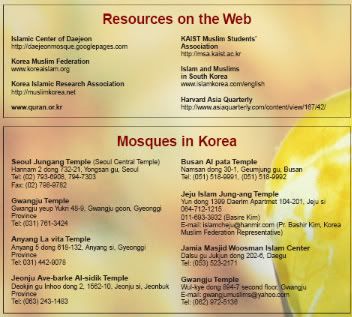
Mosques are now in various locations throughout the country. "We have more than 10 mosques in cities like Gwangju, Busan, Daegu."


Here is the Adobe Acrobat, .pdf, version of the page for you to read, if you like: KH03242009

Read More...

Sphere: Related Content

Monday, February 2, 2009

[Regina Walton's Expat Interviews] Judaism in Korea

My time here is rapidly winding down and I think of these religion pieces as a contribution to the well being of expats living here in Seoul. I say Seoul because, unfortunately, all of my interviewees thus far are Seoul-based and have Seoul-based congregations.

Here is part four: Judaism in Korea

This is the fourth part in a series looking into religion in Korea. The first objective is to give expatriates a springboard from which to develop spiritually. Feature articles have examined Christianity, Buddhism, Hinduism, Judaism and will examine Islam and Sikhism. - Ed.

When you think of religion in Korea, Judaism does not exactly spring to mind.

But over the last decade especially, Seoul has seen demand for Jewish products and food rise, and in 2008 the Chabad House opened in the Itaewon district of Seoul.

This was a significant event for Judaism in Korea. There are quite a few Christian and Muslim services available to foreigners, but there was nothing for Jews.

If you weren't associated with the military and you're Jewish, you had had to arrange for someone to sign you in to a U.S. military on base.

Chabad House opened in Seoul in April 2008, and they offer services to help Jews living in or visiting Seoul.

Like other religions, there are different strains of Judaism: Orthodox, Conservative and Reform. Chabad-Lubavich is Orthodox. It was founded in Russia in the 18th century and is now based in Brooklyn, New York. In the 1950s they started to send shluchim, or missionaries, around the world in order to reach as many Jews as possible. Currently, Chabad-Lubavich has over 3,000 centers worldwide.

I had a chance to meet with Rabbi Osher Litzman at his home to ask him a few questions about Chabad House and how the transition has been for him, his wife and their family.

"Chabad is a home away from home for every Jew, whatever his or her background." When asked what Chabad House provides for people in need, Litzman answered, "You can come talk to a Rabbi, get kosher food, get religious materials for the holidays, participate in events, practice Judaism and learn more. This is all about having one place to come, to feel more connected and to meet other Jews."

Rabbi Osher Litzman (right), from Israel, is the Jewish leader of the Jewish community of Korea. Pierre Cohen-Aknine is originally from France and has been living in Korea for the last 27 years. [Photo by Jung-keun Song]
Litzman then explained the current schedule for Jewish services: "We have services every Friday night, every Saturday morning and afternoon, and on holidays. Sometimes we have services during the weekday as well." The schedule can be found at Chabad of Korea website (jewishkorea.com).

They are also establishing other regular events, like the Tefillin Club, which is a place for men to come, enjoy and relax and have kosher food. They meet on the first Sunday of each month at the Seoul Cigar Club.

They also have a similar gathering for women. The women's gathering is based on the Jewish calendar and is scheduled near Rosh Chodesh, the first day of the Jewish month.

Litzman added that there are plans in the works to create regular activities for children.

So what exactly does "kosher" mean? "Kosher means that the production of the food has been supervised and does not violate Jewish dietary laws," said Litzman.

He then explained that people who are in search of kosher food in Korea are lucky because Costco actually stocks many kosher food items. "(On) kosher (foods) there is a symbol that means that someone inspected the manufacturing process and found it in accordance to Jewish dietary laws ... Korea is blessed with Costco. Costco has many kosher products except for milk, cheese products and meat.

"We produce kosher cheese ourselves, but it is still a problem to obtain kosher meat. We have to find a good solution for that."

When asked to describe Chabad's regular congregation he said, "Every week we find at least one more Jew. Hanukkah was two weeks ago and it was a wonderful time. Many new people came to the event we had in front of the Hamilton Hotel. People saw us building the Menorah."

Right now there isn't a demand for it, but the rabbi did not rule out the possibility of a Chabad House one day opening in a location outside Seoul. "Well, there are not many Jewish people who come here to tour. This is most likely because there are no kosher options here.

"In Beijing, they have a kosher restaurant. In Thailand they have kosher restaurants. All over the world they have kosher restaurants, but not here. We just opened. There are direct flights between Israel and Korea, but I think we've had fewer than ten tourists since we opened."

He explained that most people they work with are here as expatriates. Also, "(we) have business people coming in from all over the world. All of them have said that they would not stay here for the weekend if we were not here."

The response from the Jewish community has been both positive and strong. "The request for us to come was from the community ... Many Jews that live and work here didn't have a place to pray for Yom Kippur."

Now that Chabad is here, Rabbi Litzman can help Jewish families become more observant. "Now people have the opportunity. We have a family that decided to keep kosher. We kosherized their kitchen."

He then went on to describe how Jews in Seoul are now able to follow Jewish traditions more easily now that they are here. "Another (member has decided) to put on the Tefillin, leather boxes which contain biblical verses and are very important for prayer rituals every day - not only one, but a few. Some people bought Tefillin and some people had it before and now they're using it.

We are giving people Mezuzot." Mezuzot are hand-written biblical verses put on doorways that he described as not only Biblically commanded, but also a kind of method Jews use for home security.

"People are getting books and we have lecturers." These lectures usually occur at the same time as the Friday and Saturday services. "We are about to establish a library. We want to open a Jewish library here in Korea. We are requesting donations for books."

In terms of upcoming special events, he mentioned that they will be bringing in rabbis from other locations in Asia and from around the world.

"Korea is the best place to live. You get a taste of everything. You can feel that you live in America sometimes. You have modern technology and a nice subway. (It's) better than New York even.

"Wonderful people live here. We have gotten so much help from so many people and they didn't want a penny."

For more information on kosher meals, synagogue services or classes please go to the Chabad-Lubavich Korea website: jewishkorea.com

For information on the Tefillin Club go to jewishkorea.com/Teffilin.html

Here is an Adobe Acrobat version: KH01162009

Enjoy!

Read More...

Sphere: Related Content

Wednesday, January 21, 2009

[Regina Walton's Expat Interviews] Hinduism in Korea

Here is the third part on religion in Korea.

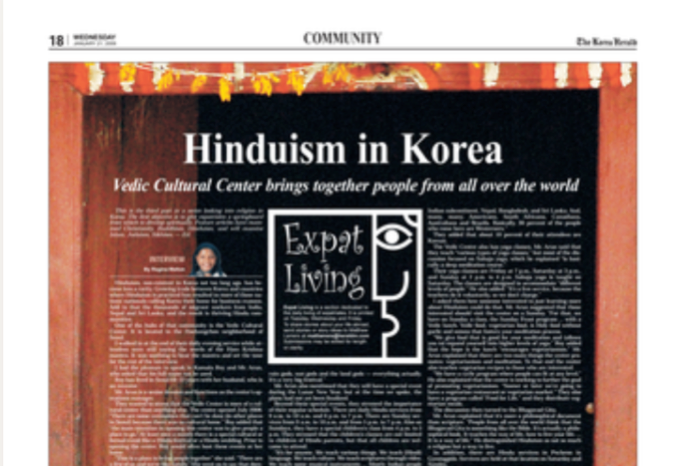
Screengrab of the Article From The Korea Herald

Hinduism in Korea


This is the third part in a series looking into religion in Korea. The first objective is to give expatriates a springboard from which to develop spiritually. Feature articles have examined Christianity, Buddhism, Hinduism, and will examine Islam, Judaism, Sikhism. - Ed.

Hinduism, non-existent in Korea not too long ago, has become less a rarity. Growing trade between Korea and countries where Hinduism is practiced has resulted in more of those nations' nationals calling Korea their home for business reasons. Add to that the thousands of migrant workers from India, Nepal and Sri Lanka, and the result is thriving Hindu communities.

One of the hubs of that community is the Vedic Cultural Center. It is located in the Haebangchon neighborhood of Seoul.

I walked in at the end of their daily evening service while attendees were still saying the words of the Hare Krishna mantra. It was soothing to hear the mantra and set the tone for the rest of the interview.

I had the pleasure to speak to Kamala Roy and Mr. Arun, who asked that his full name not be used.

Roy has lived in Seoul for 12 years with her husband, who is an investor.

Mr. Arun is a senior devotee and functions as the center's operations manager.

They wanted to stress that the Vedic Center is more of a cultural center than anything else. The center opened July 2008. "There are some ceremonies that can't be done (in other places in Seoul) because there was no cultural home." Roy added that "the main intention in opening this center was to give people a place to go." At least once a month there is a special cultural or formal event like a Hindu festival or a Hindu wedding. Prior to opening the center, Roy would often host these events at her home.

"This is a place to bring people together" she said. "There are a few of us and we're like family." She went on to say that doesn't just apply to people from India, but it's also for people from Nepal, Bangladesh, Pakistan and Sri Lanka.

They started off by letting me know about their scheduled Pongal celebration, which happens on Jan. 13, 14 and 15, but the center celebrated it this past weekend on Jan. 18. The celebration is based on the Hindu Lunar Calendar. "It's like our Thanksgiving Day ... This is the season where we get back the harvest to the home. Getting the harvest to the home is like money coming to the home. That's why we give thanks to the rain gods, sun gods and the land gods - everything actually. It's a very big festival."

Mr. Arun also mentioned that they will have a special event during the Lunar New Year, but at the time we spoke, the plans had not yet been finalized.

Beyond these special events, they stressed the importance of their regular schedule. There are daily Hindu services from 9 a.m. to 10 a.m. and 6 p.m. to 7 p.m. There are Sunday services from 9 a.m. to 10 a.m. and from 5 p.m. to 7 p.m. Also on Sundays, they have a special children's class from 4 p.m. to 5 p.m. They stressed that the children's classes are not limited to children of Hindu parents, but that all children are welcome to attend.

"It's for anyone. We teach various things. We teach (Hindi) language. We teach culture. We teach scriptures through video. We teach some musical instruments ... Mostly Indian people come, but people have a wrong notion that it's just for Indians.

"We have Korean children also. ... We've designed a course which changes every weekend so that the children don't get bored." Roy added that they teach language. "Also, we teach them the Indian alphabet because there is Indian school (in Seoul)."

When asked to describe the center's attendee's, Mr. Arun explained that there are people from all over the world who attend. "We have people from India, Pakistan, and basically the Indian subcontinent, Nepal, Bangladesh, and Sri Lanka. And, many, many, Americans, South Africans, Canadians, Australians and Brazils. Basically, 30 percent of the people who come here are Westerners."

They added that about 10 percent of their attendees are Korean.

The Vedic Center also has yoga classes. Mr. Arun said that they teach "various types of yoga classes," but most of the discussion focused on Sahaja yoga, which he explained "is basically a deep meditation course."

Their yoga classes are Friday at 7 p.m., Saturday at 3 p.m., and Sunday at 2 p.m. to 4 p.m. Sahaja yoga is taught on Saturday. The classes are designed to accommodate "different levels of people." He also added: "It's a free service, because the teachers do it voluntarily, so we don't charge."

I asked them how someone interested in just learning more about Hinduism could do that. Mr. Arun suggested that those interested should visit the center on a Sunday. "For that, we have on Sunday a class, the Sunday Feast program ... with a Vedic lunch. Vedic food, vegetarian food, is Holy food without garlic and onions that fosters your meditation process.

"We give food that is good for your meditation and (allows you to) expand yourself into higher levels of yoga." Roy added that the hope is the lunch "encourages vegetarianism." Mr. Arun explained that there are two main things the center promotes: vegetarianism and meditation. To that end the center also teaches vegetarian recipes to those who are interested.

"We have a cyclic program where people can fit at any level." He also explained that the center is working to further the goal of promoting vegetarianism. "Sooner or later we're going to have a vegetarian restaurant or vegetarian market." They also have a program called "Food for Life," and they distribute vegetarian meals.

The discussion then turned to the Bhagavad Gita.

Mr. Arun explained that it's more a philosophical document than scripture. "People from all over the world think that the Bhagavad Gita is something like the Bible. It's actually a philosophical book. It teaches the way of life, how to live your life. ... It is a way of life." He distinguished Hinduism as not so much a religion but a way to live.

In addition, there are Hindu services in Pocheon in Gyeonggido. Services are held at that location on Saturday and Sunday.

You can find more information on The Vedic Center, including contact information at krishnakorea.com, e-mail koreakrishna@gmail.com, phone 010-2448-6441. Please contact the Vedic Cultural Center for information on their Lunar New Year event.


Here is a .pdf.: KH01212009. Enjoy!

Read More...

Sphere: Related Content

Tuesday, January 13, 2009

[Regina Walton's Expat Interviews] Buddhism in Korea

Here is the second in the religion series my editor, Matt Lamers, and I are working on. Even though I'm credited as the writer on this piece, Matt added quite a bit on Cedar Bough's approach and practice of Buddhism.

In the name of full disclosure, Cedar Bough has been a friend of mine pretty much since I arrived in Korea. When I got this column, I told her then I wanted to interview her because what she achieved while being here and what she's working on now is truly impressive. However, I didn't have a chance to talk to her one on one until I was home in L.A. last September.
________________________________

Buddhism in Korea

This is the second part in a series looking into religion in Korea. The first objective is to give expatriates a springboard from which you can develop spiritually. Feature articles will examine Christianity, Buddhism, Islam, Hinduism, Judaism and Sikhism. - Ed.

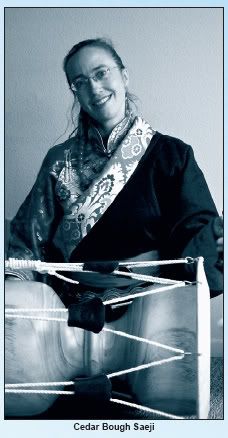
At times being a foreigner in Korea can be a little challenging. There is both an immense language barrier and a cultural barrier. But once you get past the culture shock, both can be overcome. Cedar Bough Saeji is a good example of a foreigner who has successfully managed to immerse herself in both the language and culture of Korea.

One of the ways she did that was through the practice of Buddhism.

"I feel that I became much stronger in my practice after moving to Korea, and specifically I found the Korean Jogye Order's way of practicing Buddhism to meld nicely with the various things in the tradition that I had picked up on," she said.

If you're interested in meeting other Buddhists, but you do not speak Korean fluently, Cedar Bough recommends visiting one of the country's many temples. "There are temples everywhere in Korea; if you go to one, you can expect to meet other Buddhists. You don't need to speak Korean, you just need to be respectful and observe temple etiquette. If you just do that, they'll like you already."

She also talks highly of temple stays. If expats are seriously interested in Buddhism, she recommends going on a temple stay program at a remote temple. She says it's cheap and proper instruction is provided on how to participate in the ceremony and temple etiquette.

"In Seoul there are Dharma talks advertised in the religion section of the newspaper, in English. There are also some temples that are being run by foreign-born abbots, or abbots that speak good English. If you contact the Jogye Order they will put you in touch with everything you need," she said.

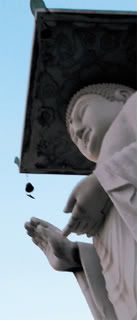
The Buddha stands tall at Bongeunsa, Gangnam-gu, in Seoul.[Photo by Matthew Lamers/The Korea Herald]

What is it about Buddhism that appeals to her?

"Everything, really. My favorite sutra is perhaps that of Vimalakirti, reading it is out of this world - Thurman's translation is supposed to be the best. I like impermanence and reincarnation - I like that I can keep improving myself through multiple lifetimes. I'm not a meditator. A lot of Westerners think of Buddhism and they immediately think of sitting meditation. That's not for me," she said.

"But I love bowing, prostrating, chanting. Right now, working on my Ph.D., I feel very connected to Manjusri. It can be hard to explain but I feel the rightness of Buddhism inside of me as I practice. I took a three month dedicated Buddhist pilgrimage, and I visit a lot of Buddhist sites as part of less Buddhist focused travels - most of the major sites in Asia, actually. It's also important to me that Buddhism does not negate the truth in other doctrines/religions - it is not dogmatic."

Regarding English accessibility, she said you probably won't find good Dharma talks in English near your home, "but there may be a nearby temple. I suggest that you read up on Buddhism at home and go to the temple for the uplifting feeling you get when you start the day with 108 bows."

I met Cedar Bough seven years ago. We were both busy with our own things here but ended up in graduate school at international studies programs across the road from each other. I was at Ewha Womans University and she was at Yonsei University. Now she's in Los Angeles pursuing her doctorate at UCLA.

Cedar Bough first arrived in Korea in 1996. Her reasons for coming to Korea sound similar to others who've come: She wasn't particularly interested in Korea, but had a goal of paying off student loans and a desire to see the world. "I had no special reason to come to Korea. I had no special previous knowledge of Korea or interest in Korea. So, until I showed up, Korea was basically a blank slate for me ... I found that I really loved Korea and I felt like it was my fate to come to Korea and that I had been led to come to Korea for a reason because I felt everything about Korea, even the air, which some people may complain about, even breathing in the air made me feel like I was at home.

"There was a tremendous feeling of comfort in Korea that I felt like I hadn't experienced in other places. So from the moment I arrived in Korea I really knew it was a good place for me to be. Korea has almost always treated me very well, so I have had all these amazing experiences and a lot of stuff has led me to want to stay there."

She left for a year in 2003 and spent time in China. There she was reunited with her then-fiance, now husband, Tibetan musician Karjam Saeji. After spending a year in China, she came back to Korea and enrolled in Yonsei's Graduate School of International Studies. There she earned a master's degree in Korean Studies with a focus on Korean culture, society and religion.

"I realized I really enjoyed academia and that I wanted to perhaps have a future in academia," she said.

However, after Yonsei she took a year off to take a pilgrimage from Eastern Tibet to Lhasa with her husband. Because her Ph. D. focuses on Korean performance arts, when finished, she'll have a doctorate in culture and performance with a focus on Korean folklore.

"Most particularly, I like the Korean mask dance dramas, but all folk performance arts are interesting to me, even court arts are fascinating. Preservation of traditional culture has to be done in the right way so that it's not turned into a reenactment, but is still part of Korean consciousness. I become quite distressed when I see how little younger Koreans - and I can't blame very young Koreans, but college age Korean students - know about Korean traditions. Typical Korean college students may know a little about traditional Korean culture, but maybe they can't even tie the bow on a hanbok."

Cedar Bough is a great example of how an expat can learn more about Korean culture and the language. Her advice to others who want to learn more is pretty straight forward: "In general, if Koreans see a sincere desire to learn about Korean traditions then the people that know about them are very happy to teach foreigners. When you sometimes get a sense that Koreans don't want to teach you about something traditional, it is generally when they've run into the limit of their own knowledge and they're embarrassed. Because how embarrassing is it to have a foreigner interested in something about your own culture that you do not know? So people will shut down and give a foreigner a feeling of being closed out."

She then talked about specific places in Seoul where expats could learn about Korean arts and culture. She said one of the best ways for expats to get a taste is at the National Center for Korean Performing Arts. Twice a year they run free, or low fee, classes that give expats a chance to learn gayageum, or janggu. "It's a good way to get an initial idea if you'd be interested in taking it further. It is free and it is on the weekends. There are actually hagwon for Korean traditional dance and music."

She said city governments run cultural and educational programs. She added that, while there might be a language barrier for a lot of these classes, you can listen, watch, follow along and still learn.

If you're interested in getting deeper into Buddhism, Cedar Bough said that you should stick with the same temple, so that people get used to your presence. "I think that foreigners should know that if you go and practice respectfully in Korea, in the course of only a few visits to a temple ... people will get used to you and welcome you. It will take longer if you skip around and come to different services at different temples, of course. If you live in Seoul, you should go to the 4 a.m. service at Jogyesa at least once. During my M.A. in Seoul and now every summer when I visit Korea for research I go there as often as I can.

"If your own learning has only taken you so far and you really want to go deeper, there are retreats at several temples, including ones run in English, you can get more information at seoulzen.org about those."


Here is a .pdf version of today's page: KH01132009

Read More...

Sphere: Related Content

Tuesday, December 23, 2008

[Regina Walton's Expat Interviews] Christianity in Korea

Unless something significant happens, I'm on my way home in the next couple of months. However, I've wanted to do a series on religion pretty much since I started this column.

The first in this series was published today. My goal is to just give a bit of information on the people who help us out spiritually. I've never been much into the party scene here, which consists of drinking to excess and a so-so bar and club culture. However, most of the major religions are here and have houses of worship.

I've started with Christianity simply because it's the day before Christmas, but we'll cover as many as we can including, but not limited to, Buddhism, Judaism, and Islam.

Christianity in Korea

This is the first part in a series looking into religion in Korea. The first objective is to learn about the lives of the expatriate clergy. The second is to give expatriates a springboard from which to develop spiritually by providing the contact information and service times for their religious services. Feature articles will examine Christianity, Buddhism, Islam, Hinduism, Judaism and Sikhism. -- Ed.

In the expatriate community it's easy to find a group of friends to drink and party with. However, it can be more of a challenge to establish a spiritual sense of belonging.

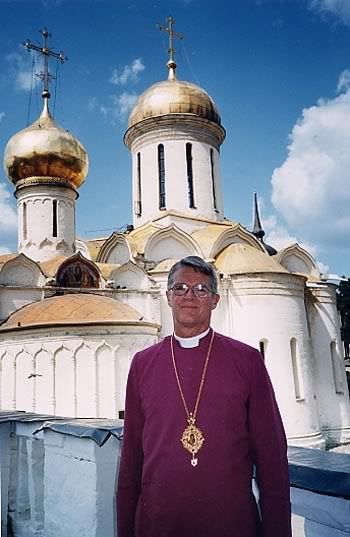
Pastor, missionary, scholar Reverend Paul Mooney English-language Ministry at Seoul Cathedral

Reverend Paul Mooney, from Dublin, Ireland, describes himself as a "city boy and a Dubliner at heart," because he was born and raised there.

He first came to Korea in August, 1980 and stayed until 1982. At that time, he was a theological student doing his missionary training in Korea. He had been studying with a Roman Catholic organization called The Columban Fathers at their school in Ireland -- St. Columbans. During that time, he studied the Korean language at a language institute named Myongdowon, which no longer exists.

When asked when he decided to become a reverend, he quickly corrected the question, saying, "I don't know whether people actually decide to become a reverend or if something decides them to become one."

What brought him to the church?


A crucifix at the Seoul Anglican Cathedral [Photo by Matthew Lamers/The Korea Herald]

"For me, it really goes back to the time I was a teenager and I started to feel some way attracted to becoming a priest, for want of a better word ... specifically a missionary. So I suppose, I've had that kind of leaning since I was about 16.

"For me, the funny thing is, I'm actually living half a mile from where I lived in 1980, and I'm working sort of half a mile from where I studied in 1980."

He explained that he came back to Korea after all these years because in his heart, he is more of a traveler. When he left Korea, he was Chaplin of the Mission to Seafarers in Busan. After he left Busan he was in the same ministry in Brussels, Belgium. After Brussels, he returned to a parish in Ireland.

"What attracted me to come back? Well, I was looking through the job section of the Church Times website one day, and I saw they needed a chaplin for the English congregation in Seoul."

He said he had visited York Cathedral a year or two earlier. "It was somebody that had died and it said 'pastor, missionary, scholar' on his (epitaph). I said 'that's what I want to have on mine.' So this kind of makes that possible to do what I feel is my own calling.

"I knew I was ready. The job was there and the job was open. I came over and interviewed and it worked. I'm very, very happy. It's one of the most satisfying experiences I've had, ministering with the foreign congregation here."

He explained that "the word Anglican basically means English, so Anglican Churches are churches that derive in some way or other from the Church of England.

The Anglican Church is located in downtown Seoul beside the British Embassy, across from City Hall. The services Mooney presides over are in English. The Eucharist service is every Sunday at 9:30 a.m. in the church's crypt chapel, which is downstairs from the main chapel. On Sunday at 5 p.m. there is the Evening Prayer.

The church has a Bible study for adults after the main Eucharist service. He added that the church has Sunday school for children. For readers who are not in Seoul, but are interested in Anglican/Episcopalian services, there are English speaking services in Daejeon. There is also a service in Namyangju in Gyeonggi-do which focuses on migrant workers.

"For a start, it's English speaking. The largest, but there is no majority; I would call U.S., which would be closely followed by Canadians. ... They include people of all possible types that you would find within North America."

He said that includes Korean-Americans, Nigerians and other Africans, Filipinos, Sri Lankans, Australians and Europeans. He said Korean nationals also attend.

"Either Koreans who lived and worked abroad for awhile and who like to still worship in English. Maybe they started coming to the Anglican Church when they lived abroad or went to a similar type of church like a Lutheran Church and just find that they like coming to a liturgical Protestant church. And, from time to time, we have a few Koreans who just like to worship in English. I would think because we're a liturgical Protestant church, which is not really part of the Korean mainstream of Christian religion in Korea, we don't tend to have as many Korean-national worshipers as other English-speaking congregations might have."

He also explained that because his congregation is so spread out, that most events take place on Sunday simply because it's easier for everyone to attend.

For more information on Seoul Cathedral: www.skh.or.kr/cath%27e.htm

Pastor-in-training: David Shaw The Onnuri Bucheon English Ministry, Presbyterian

David from Perth, Western Australia, was born in Nottingham, English which he playfully describes as "Robin Hood territory."

He has lived in Korea for almost five years. "I'm a reverend in training, but doing the job. I've done two out of three years in a master's of divinity course here in Korea.

"I'm going to a school called Torch Trinity Graduate School of Theology. I took a year off because I had to marry a beautiful woman. I'm going back next year to finish my study and training," he told Expat Living.

Similar to Reverend Mooney, Shaw described his entry into ministry as not so much a choice, but more as a calling. "When I was about 21, 22 (years old) I went on a short-term mission trip to Africa. We went to Malawi.

"A little thing happened before we left. I was asked to preach before we left. After the service a man came up to me. Never seen him before, never seen him since. And he said, 'God has a word from the Bible for you.' I'm a conservative Baptist. I don't believe in people coming up to me with the whole 'God's word' thing. But he took me to a passage of scripture in 2nd Timothy that basically said 'do the work of an evangelist and a pastor. That's where you're going.' That freaked me out because basically I wanted to be a physical education teacher.

"I didn't think much of it, but later in the same evening, a woman -- a deacon in our church -- came up to me and she said 'God has a word for you.'

"She opened her Bible and gave me the same, identical verses from the Bible."

In his own words, he said he was freaked out, but chalked it up to coincidence.

He said a week later he was boarding the plane and his youth pastor, who didn't know what had happened a week before, had written a Bible verse for every person going on this mission trip. She gave him the piece of paper and it was the same verse.

"For me, I look back on that day as the day when God confirmed his call to ministry. So I did a Jonah and ran the opposite way. I continued to pursue phys-ed teaching, including coming to Korea. And, five years later, I find myself having ministered for two years. So I didn't choose it, it came to me."

He went on to describe his church. He said he works at a church called Onnuri English Ministry in Bucheon. Onnuri is a campus church. They have campuses in Seoul, Seobingo and one in Yangjae.

"I happen to work in Bucheon. We have a congregation of about 30 people. On a good week we can hit 40 or 50. (It's) mostly foreigners, although some Koreans come as well."

Onnuri is a church with about 40,000 members.

"Onnuri is certainly the biggest English ministry in Korea. It has the biggest resources for people who need help with maybe counseling or special needs or Korean lessons. They're the best resource to help people where they're at."

All of the churches have a small group ministry or Bible studies for people seeking those kinds of spiritual activities.

When asked to distinguish his church, he focused on the "core beliefs" that Christians have in common. He believes if those core beliefs are practiced, for example, Trinitarian God and virgin birth, then they're a Christian church.

The service is in Bucheon is near the Sangdong Home Plus in Bucheon. You can learn more about Onnuri's Bucheon English service at oembucheon.com and the Seoul Onnuri Churches at onnurienglish.org

Go to ttgst.ac.kr for more information on the Torch Trinity Graduate School of Theology.

By Regina Walton /Expat Interviews

Regina Walton can be reached through her blog http://expatjane.blogspot.com

English language services

Seoul Anglican Cathedral

Sunday at 9:30 a.m.

www.skh.or.kr/cath%27e.htm

(02) 730-6611

Onnuri Bucheon English Ministry, Presbyterian

For information, including service times and contact information, see oembucheon.com for Onnuri Bucheon and onnurienglish.org for Onnuri Seoul

Jubilee Church

Inter-denominational, English ministry in the Gangnam

Sunday service at 10 a.m. and 1:30 p.m. (Children's Ministry at 10 a.m. only);

Morning prayer from Tuesday to Friday at 7a.m.

Wednesday night service from 8 p.m.

Phone: (02) 569-2293-4

Daeduk Hanbit Presbyterian Church

English service is at 12 p.m. Sunday

Sunday Bible study at 1:15 p.m.

Phone: (042)-863-0725

Seoul Union Church

Evangelical and ecumenical church

Located near Foreigner's Cemetery Park, north of the Yanghwa Bridge

Phone: (02) 333-7393

Somang Presbyterian Church

English service at 1:30 p.m. Sundays

Offers English Sunday school

Phone: (02) 512-9191~6

Community of Christ

Sunday services at 11:00 a.m. English translation is available.

Non-denominational

Advanced English discussion club meets weekly

Located near Yonsei University

Phone: (02) 334-7912

Yongsan Baptist Church

Sunday school at 9:45 a.m. and English worship at 11 a.m. and 6 p.m.

Nursery care available

Bible study at 9:40 Sunday morning

Located near the Crown Hotel in Yongsan.

Phone pastor Bill Ecton (02) 796-0284

Youngnak Presbyterian Church

English worship on Sunday at 10 a.m. at the Service Building

At 3 p.m. in the Mission Chapel

Located in Jung-gu, Seoul

Phone 2280-0228 or 011-613-5896

Website: www.myiwe.com

Yeouido Full Gospel Church

For full schedule, go to www.yfgc.com

Located in on Yeouido Island, Seoul

Hannam International Church

Celebrates Mass in the Franciscan Chapel at Hannam-dong

English Mass at 9 a.m. and 11 a.m.

French Mass Saturdays at 6 p.m.

German Mass Sundays at 10 a.m.

Italian Mass Sundays at 11:30 a.m.

Spanish Mass Sundays at 12:15 p.m.

Phone: (02) 793-2070

Hyewha-dong Catholic Church

Mass every Sunday at 1:30 p.m.

Phone: (02) 764-0221

Myong-dong Cathedral

Sunday Mass at 9 a.m. preceded by confession in English.

Phone: (02) 774-3890

Yongsan Chapel Community

Mass at Memorial Chapel at 5 p.m. Saturdays and 12 p.m. Sundays.

Phone: (02) 7915-8176

South Post Chapel Mass at 8 a.m. and Catholic religious education at 9:30 a.m. Sundays Phone: (02) 7918-4044

St. Paul Orthodox Church, Seoul

Irregular English service

Phone: (02) 362-7005

English Bible study in Apgujeong

Mostly native English speakers, some Koreans

Near subway station

Phone: 011-359-1317

At 3 p.m. on Saturday afternoon
Here is the .pdf version of the article: KH12242008

Read More...

Sphere: Related Content

Sunday, October 28, 2007

Much More Than Good Timing

I've always been one to tell people to pay attention to their sixth sense. Saturday night was another night of no sleep. So there I was early Sunday morning up and hungry for some food. I decided that I would get up, run out and grab a bite to eat and then come home to finally sleep. However, when early morning comes around I shift into awake mode because I usually I'm an early riser. I made myself do a brisk morning walk to the restaurant, picked up my order and in the back of my mind the whole time was the thought that I should get myself to church. That thought was nagging me the whole time and, sure enough, I had more than enough time once I got my food to hail a taxi to speed me to church.

I was attending regularly up until my last semester and stopped because between work, classes, reading, studying, researching my thesis online and writing it, I literally had no time. I worked during the week. I studied in the evening in my office and, on the weekends, I'd get up, grab breakfast and head straight to the library of Sogang University to to research, read and study.

My family is, predictably, of Southern Baptist faith as my whole family comes from rural Georgia. Now you can love me or hate me for what I'm going to say, but I never jibed much with that tradition. I found it to be overly simplistic in its view of the world and even as a preschooler I was asking questions that would send my aunts into a panic. That led to me being a very vocal atheist by the time I reached high school. My mom, cut from a more tolerant cloth, would indulge my debates with her but would always fall back on her faith. You can't really debate faith. You either have it or you don't. I didn't and she did. Simple enough and we both left our debates with a mutual respect of the other which is something I rarely see these days when it comes to religious discussions and debate.

Anyway, I took that perspective with me to university. However, it had softened to agnosticism because if it was unreasonable for more reverent believers to tell me I was going to hell, it was also unreasonable of me to insist there was no hell for them to go to. Because, honestly, a lot of "Christians" seem to not headed straight to the Pearly Gates but instead in the opposite direction.

What it boils down to was I realized I just didn't know. When I was an undergrad in UCLA's Department of Philosophy, Marilyn McCord Adams was there. Reverend Professor Marilyn McCord Adams is a major heavyweight in religious philosophy. That I could appreciate even if I was still trying to figure out where I stood. I knew it was a great thing to have someone with her achievements and depth of knowledge in my department. I'd pop into her office and peppered her with the same questions I'd ask my mom. She too answered me with a quiet and dignified confidence but also with the weight of her studies behind her.

Unfortunately, my parents passed away. It didn't help when I got simplistic explainations from my family. I know they were trying to console me. However, a less than sophisticated read on life's mysteries wasn't something I had the patience to sit through when I'd just lost both parents. It didn't help that I'd honed my skills under some great philosophical thinkers. After a few deft cuts of the verbal sword through their arguments, I said as much and it stopped. I emailed Rev. Prof. Adams about five years ago on my loss, and she replied with a depth of analysis and good advice that most people lack. That directed me in positive direction.

I eventually softened my stance on religion as time went by. I had too many close calls and too many fortuitous moments that "chance" seemed to be a less than accurate or honest way to describe the timing. However, I had a big problem with the high level of intolerance flowing from a lot of the churches out there and felt that I could only go to a with more progressive than not views on the issues of women and homosexuality. That narrows it down to very few denominations. You're welcome to express your views on the topic in the comments, but I stand firm on not patronizing a church that ostracizes an entire community of people. So, in keeping with my views, I started going to the English service at the Anglican-Episcopal Seoul Cathedral. As I said, eventually school demands became so great that I had to stop going or risk flunking out of my last semester.

I went back yesterday and the guest was none other than the former presiding Bishop of the Episcopal Church in the USA, Right Reverend Frank T. Griswold. He's famous for supporting the election ofRight Reverend V. Gene Robinson as the Bishop of New Hampshire. The controversy is the fact that Robinson is openly gay.

Honestly, it was great just to have a service delivered by someone who had my accent for a change. Later had lunch with Bishop Griswold. I got to speak to him on topics ranging from Rev. Prof. Adams, gays in the church and my own personal history.

Here is a quote from him in the NY Times:

To Bishop Griswold, the uniqueness of the Anglican Communion rests in great part in its willingness to accommodate divergent views. But people are so upset over this issue because it is about sexuality, he said.

"Sexuality is a free-ranging force that can overwhelm reason and is therefore dangerous," he said. "Some people feel that if sexuality isn't carefully circumscribed, it will subvert all sorts of things."

Bishop Griswold, who says he has read the Bible twice a day for years, said the passages about homosexuality referred to certain behaviors, not to what he called "patterns of affection."

He recounted that his understanding of homosexuality was affected in the 1960's by a couple in his Pennsylvania parish. One man had multiple sclerosis, and his companion's selflessness in caring for him convinced Bishop Griswold that such love did not contradict biblical teachings.

"In the Gospels, Jesus says, 'I have many more things to say to you but you cannot bear them now,' which suggests to me that God's truth is always unfolding," he said. "If we can accept that there are new truths that science brings us, or new discoveries in medicine, why is it when it comes to sexuality, there is no new truth?"

Bishop Griswold added: "A number of those most upset about our seemingly ignoring Scripture, though they are solidly heterosexual, have enjoyed the mercy of the church in the case of their own divorce and remarriage, which is something Jesus commented on."
You can agree or disagree with that. Honestly, this will be the first blog where if I get comments that disagree I won't bother to reply. Don't get me wrong because rude or insulting comments won't get published, period. But disagree all you want because I know that many do. As we all know, people have had religious debates for centuries. I'm not going to spend a century debating this. My view on it is clear. I'm sure I'll always have religious and spiritual views that alter with time and experience. As my last vicar, Rev. Webb, wrote to me:
It is indeed good to hear that you aren't grounded in theological or spiritual certainty - such people scare me!
Needless to say, I'm very happy to that I went to church yesterday. I had no idea he'd be there. That's much more than mere good timing, I'm sure.

If you're not familar with the current schism and debate going on in the Anglican-Episcopal church here are some links that discuss what's going on.

NY Times: Episcopal Head Defends Choice Of Gay Bishop
CBS News: New Gay Episcopal Bishop Furor
Times Online: Worldwide Anglican church facing split over gay bishop
David A. Tait, Ph.D., Rogers State University (an Adobe Acrobat document): The Illusion of Inclusion: Why the homosexuality crisis in the Episcopal Church is not just about sex.

Just 'cause, I'm posting a link to a post from the "A Religious Liberal Blog" because he agrees with me ;)

Also, here is a nice piece written in the Yale Alumni Magazine about Rev. Prof. Adams before she moved on to Oxford: The Queen's Professor

Read More...

Sphere: Related Content

Saturday, September 15, 2007

MuchoSucko.com: Be More Like Jesus

This summary is not available. Please click here to view the post.

Read More...

Sphere: Related Content

Tuesday, July 31, 2007

Repost: 'My personal view on the current hostage crisis' from the Marmot's Hole

I've really wanted to chime in on the Korean hostage crisis in Afghanistan, but I've stayed away from it simply because it's ongoing and my views are pretty matter-of-fact and sterile. I'm really about not stirring up what is already a very emotional situation for many Koreans. Also, I've heard that those who have strong opinions like me have been taking it too far saying things like maybe they should die or that the government shouldn't try to get them out. That's silliness even if you disagree with them going there.

The talk has been so tough that people have asked Korean bloggers to just back off of the harsh talk. I think the dialogue should happen because Koreans need to do it. It's a democracy and people have a right to their opinions whether you like it or not. However, as it's not my country this is not a topic that I'm comfortable opining about until it's all settled. Here is a piece from Time.com on it: Korean Missionaries Under Fire

With that said, there is a balanced opinion on it at The Marmot's Hole. I'll just repost it here in full. I'll turn comments off 'cause if you have something to say, you should take it there, but maybe this will give some insight into the questions about why people would willingly go into a war zone.

My personal view on the current hostage crisis

A lot has been said regarding the hostage crisis, among them the irresponsibility of the 23 that went on the so called medical mission to Afghanistan. Now why would 23 men and mostly women decide to go on a mission which most of them, despite the somewhat insane pictures taken at the airport, knew would be akin to a suicide mission?

Fortunately, I didn’t have to go far to find an answer, because based on my own personal experiences with Korean Christians, it wasn’t difficult to figure everything out.

Now I have to add that not all Korean Christians are like this, but the Korean Christians who are level headed are in the minority. Unfortunately the majority have the following tendencies;

1. The need to convert everyone around them.

This seems to be the case with almost every Korean Christian that I have gotten to know. The first question is usually “Do you go to church?” If the answer is “No”, then the sales pitch begins with lobbying on why I should believe in God and Jesus Christ, which leads to pushing me to go to church (”Are you free on Sunday? Be here by this time”) and eventually leads to comments like “why aren’t you coming to church?” or “attending the church is good for your future” or “if you attend our church then there are girls waiting in line to date you.” Some like our CIO take a more direct approach, by gathering his reports and saying “I order you to go to church with me” and in a Korean company, if your boss orders you, you don’t have much of a choice.

Personally, if I want to believe in a religion and follow its teachings, I would rather do it without people ordering/pushing me to believe in that particular religion, and what really angers me, is the Korean Christians’ penchant to ignore the wishes of the person whom they are trying to convert.

This is in contrast to American Mormon missionaries whom I had an opportunity to meet during my college years. They were eager to show me the Mormon beliefs and teachings, but at the same time, they were willing to step back and let me decide on my own. At the end, it was nice talking to them, but I decided that the Mormon church wasn’t for me, and the missionaries respected my decision.

Which brings me to this story. One of my college hubae, was an active member of a certain church with an Ancient Egyptian sounding name, and saw me talking to the Mormon missionaries. He asked me if I was planning to become a Mormon. I answered no. He sighed with relief and said that I had made a good decision. He also added that out of curiosity, he had read the Book of Mormon, and that there was a nasty odor from the hand that touched the Book, and from this he concluded that the Mormon church was not a proper church, and that it will decay.

At the same time he said that I should join his church, because his church was the true church. Yeah right.

2. The desire to be a recognized among the congregation.

Inside the church, there is a sort of pecking order. On one side are the church veterans, who have considerable influence inside the church, hold officer positions, and are well known among the congregation. On the other side are the less well-known members, who hold junior or no positions in the church. The not so well-known members aspire to be become the part of the well-know group and thus gain higher positions and influence in the church.

The reason? Some Koreans do go to church because they believe in God and Jesus Christ, but there are some Koreans who go to church as a means to an end. To them a church is a place to meet people, who might help them get lucrative contracts, jobs, plus help them out during rough times. In order to create the above mentioned network, one has to gain recognition and influence, by becoming an officer of the church.

In Korean churches, whether or not a member rises into a higher position is not judged by whether or not his or her religious beliefs and convictions are strong, but by the amount of activities that he or she has participated. This includes overseas volunteer work such as the one that the 23 were involved in Afghanistan. And from what I’ve heard from Korean churchgoers, participants of this type of work get the most points.

This means junior members feel that they have to volunteer for such work.

So now we have the two big factors that led to the 23 to embark on their fateful mission to Afghanistan. The desire to convert Muslim Afghanis to Christians, regardless of the fact that the Afghanis may not be interested in converting to Christianity, and the endless line of “volunteers” to carry out the mission.

But one may ask, why Afghanistan out of all places? Well I don’t think Afghanistan is the only country that has become practice ground for the Korean Christians. If one were to go to the Emirates and Korean Air waiting lounges at Dubai International Airport, it’s easy to notice a huge group of Korean Christians going back to Seoul, after completing their mission. And from the looks of it, they are probably transiting from countries in South West Asia and Africa. I don’t know about the other countries, but I think Afghanistan was selected because of the fact that the central government is weak, which means that the “volunteers” can go to a certain village and do their stuff without worrying about the local police. And also, because the majority of the local population is not well off. Provide them with good medical service, they get friendly with you and may be willing to listen to what you have to say. Which makes it easier to say a few words about the merits of Christianity.

Also, the fact that there was no security when the group were on their bus can be explained. They probably didn’t ask for security not because they were irresponsible, but probably because if they did, it was a matter of time before the Afghan police figured out what they were doing, which means being put on the next plane to Dubai.

As I mentioned above, the 23 members have been criticized for embarking on their foolhardy mission. But IMO, the responsibility of the entire fiasco should also rest on the shoulders of the church elders, who may have taken part in the planning and recruiting of “volunteers” for this ill-fated mission.

Read More...

Sphere: Related Content

Monday, April 2, 2007

The God Debate

I heard about this while studying for Quantitative Analysis, so maybe it's God's way of saying "take a study break, kid."

I come from a very Christian family. At least, Christian in that they all claim to be Christians.

I, however, took a more circuitous route to religion. I was a philosophy major in university. I remember peppering Marilyn McCord Adams, who was a professor at UCLA at the time, with questions about religion. I didn't believe at the time, but I had and still have immense respect for her as she was one in the first ordained female priests in the Episcopalian Church. I would also engage my mother in lengthy debates about religion and Christianity as she believed too. I think it's why I'm truly confused when people can't debate and be civil no matter what the topic.

Anyway, I stayed away from being an atheist as I reasoned that it was a bullheaded position. I just didn't know. I was fine with admitting that I didn't know.

Here in Korea there are A LOT of Christians. They coexist with Buddhists. Both are about 26% of the population and everyone seems to be fairly happy. There are some stories of conflict, but they're fairly rare. Korean Christians are cut from a very conservative cloth, so it makes the discussion of God and belief something that just doesn't happen much here. I have had the discussion with other foreigners but not with Koreans.

So, maybe this is a good way to get the discussion going. Newsweek has a feature where Sam Harris and Rick Warren discuss: The God Debate. I truly believe that you have to question your belief before you can really claim to believe. Then again, maybe that was just my particular route.

Just so you know, I've stepped back from agnosticism, and I attend church regularly these days.

The debate is about ten pages long and if you've had this debate before on a deep level, it might be a bit dull, but it's interesting.

Enjoy!

Read More...

Sphere: Related Content