Showing posts with label international hub?. Show all posts

Wednesday, May 21, 2008

How much for a cafe mocha?

I blogged about this last October.

Again, Seoul is ranked high when it comes to consumer prices. What's funny is a lot of people think you can roll into Seoul and get things on the cheap.

Okay, low-quality knockoff DVDs? Sure. But, as the article notes, a cup of coffee from one of the international chains doesn't come cheap. That's the same for quite a few things here.

I've never expected, however, to get international goods here that weren't more expensive than back home. What's interesting is when the prices of things that you'd think would be less expensive like rice, a national staple, are more expensive. That's due to a lot of things from politics to nationalism and economics.

However, the issue is without other things to balance it out like the culture, ease of doing business, openness to foreigners, etc. it's hard to see what South Korea is seriously doing to increase its level of international competitiveness. This is particularly so when other countries in this region are also upping their game to attract foreigners and the investment and businesses that come with them.


Koreans Pay Among World's Highest Prices, Survey Shows


The coffee at Starbucks in Seoul is more expensive than in 11 major cities around the world, relative to overall price levels. That's according to the Korea Consumer Agency, which on Tuesday released the results of a price comparison of seven items -- coffee, golf green fees, imported canned beer, snack cookies, cosmetics, books, and orange juice -- between Seoul and other cities in North America, Asia and Europe.


◆ Coffee, beer costlier in Seoul

A cup of Cafe Americano sells for W3,300 (US$1=W1,045) at Starbucks in Seoul, while the same drink sells for W2,280 in U.S. and Canadian cities -- meaning Koreans pay a full W1,000 more. "When compared arithmetically, Seoul turned out to have the highest prices except for European cities where prices have risen with the recent rally of the euro," the KCA said. Prices generally tend to be higher in countries that have strong currencies, but comparing by purchasing power parity (PPP) removes that factor. Based on PPP, Seoul had the highest coffee prices among the 12 surveyed cities.

By PPP, the price of a 355 ml can of imported Budweiser beer was also highest in Seoul. Compared arithmetically, the beer, which sells for W800 in China, costs nearly double in Korea at W1,500. In imported cosmetics, Korea ranks eighth in the price of lipstick based on the simple market exchange rate, but highest based on PPP. Korea ranks seventh in the price of snack cookies based on the simple exchange rate, but the relative price is higher than in other major Asian nations.

◆ Why are prices so high in Korea?

The price differences between Korea and other countries are determined by various factors, such as government policies, taxes, logistics expenses, labor productivity, and prices of raw materials. Jang Soo-tae, an official at the KCA, said, "High prices are determined by structural factors, including complicated distribution systems, high tax rates, and excessive government regulations, and natural factors, including economic causes of high costs and low efficiency, poor land conditions and lack of resources."

The high coffee prices, for example, are the result of a "high cost structure, including high shop rents and a 5 percent royalty, and the consumer trend for foreign-style coffee shops," Jang explained. As for imported beer, that product suffers a tax-price ratio of 53 percent in Korean, much higher than in the U.S. (14 percent), Germany (15 percent), and France (18 percent).

The KCA pledged to look out for unfair trade practices for surveyed items that cost much more in Korea, and it will also urge government agencies to overhaul the high tax system. But high prices are not limited to the items on the survey. "In addition to the seven items surveyed, there are many others whose prices are higher than in other countries," said Park Sang-yong, a professor of business administration at Yonsei University. "It's dangerous to make a hasty decision, but the government needs to take fundamental measures to address issues such as monopolies and oligopolies, and taxation."

◆ Taxes inflate wine prices

Wine is one such item that was not on the survey but is generally much pricier in Korea than elsewhere. For example, a bottle of Mouton Rothschild 2004, a special-grade French wine that was imported recently, sells for W970,000 on average at Korean wine shops. But the same wine costs 39,900 yen (about W400,000) at Enoteca, a wine shop in Tokyo -- nearly half the price.

Wine in Korea costs nearly double than in Japan because Korean importers seek higher profit margins, but also because the two countries apply very different tax rates. Korean importers pay a 15 percent import tariff, a 30 percent liquor tax, a 10 percent education tax, and a 10 percent value-added tax on wine. That means the more expensive your wine, the more tax you pay. In contrast, Japan imposes a flat tax rate on all wines, whether they cost W1 million or W10,000 a bottle. Hong Kong, meanwhile, imposes almost no taxes on imported wine. Korea levies high taxes to protect local wines, typically the traditional Korean style. But many people are calling for an overhaul of the tax system since imported wine has become so popular.

More links:
Chosun Ilbo: Seoul Prices Remain Exorbitant
The Economist: Big Mac Index

Read More...

Sphere: Related Content

Sunday, January 20, 2008

Commentary on "Korea -- A Desert Island in the Globalized World?"


This is an interesting article from the Chosun Ilbo. It talks about the problems foreigners have living here in Korea.

Korea -- A Desert Island in the Globalized World?


"Is Korea still an isolated country? Many have been calling for a "global Korea" over the last decade, stressing that globalization is the only way for survival. The number of foreigners living in the country exceeded the 1 million mark last year, but many of them say Korea lags far behind Singapore or Japan. There is plenty of inconvenience in their everyday life here, from basic communication and asking for directions to applying for credit cards and using the Internet. They also say Koreans still have little regard for the feeling of foreigners.

John (25), a Canadian English teacher in Seoul, has a problem with, of all things, his mobile phone. Despite plenty of battery power, his mobile phone goes dead a lot because he is on a pre-paid plan. In Korea, it is difficult for foreigners to subscribe to normal, post-paid plans, apparently because service providers fear they could scram without paying their bills.

Michael (42), an American who has taught English at Hankuk University of Foreign Studies for three years, has a similar problem. Last year, he went to an airline office to buy a flight ticket for the Christmas holidays carrying W3.5 million (US$1=W936) in his backpack -- and with Korea’s small-denomination banknotes that’s a lot of paper -- because he could not get a credit card. "I tried to apply to two banks for a credit card. But the only reply I got from their clerks was, 'No, sorry.' They neither attempted to explain to me why they were not issuing a credit card nor gave me any brochures in English."

Foreigners in Korea complain that it is very difficult to get ID numbers to use in the basic service sectors, including financing, the Internet, and communications. Most foreigners carry alien registration cards and numbers provided by the Korean government. But they are no use in everyday life, which makes it much more difficult to book train tickets, buy movie tickets in advance, or make online payments.

Korean websites use strict criteria for foreigners who wish to subscribe to their services -- and there are no set standards either. It is possible for foreigners registered with the Immigration Office of the Justice Ministry to apply for services on portal sites such as Naver and Empas with their ID numbers. But they are required to send copies of their alien registration cards by fax if they want to use services on CyWorld or CGV. And errors frequently occur even on Naver during the subscription process.

Banking is another headache. Even if a bank decides to issue credit cards to foreigners, services differ greatly depending, it seems, on the individual clerks who deal with them. One clerk at a call center of Kookmin Bank, the country's largest bank, said, "If you carry a professor's visa but don't have a third guarantor, you have to give proof of a salary of over W50 million a year." But another clerk said, "If you carry a professor's visa, you don't need proof of income."

What is the situation in other Asian countries like Japan and Hong Kong? In Japan, foreigners can immediately subscribe to mobile phone services and medical insurance if they carry an alien registration card. They are not discriminated against in terms and conditions or benefits from such services. Most portal sites in Japan like “livedoor.com”, the most popular site among Japanese netizens, only require foreigners to present basic information such as names and addresses, without asking for ID numbers.

In Hong Kong, foreigners also have little trouble subscribing to mobile phone and credit card services, even if they don't have third guarantors or make security deposits. Major banks in Hong Kong, such as HSBC, Standard Chartered and Heng Sheng Bank, allow foreigners to apply for credit cards three months after they open accounts -- on the same terms and conditions as local residents. Foreigners can also apply for housing loans after verifying their credit status, including income, just like local residents.

In Singapore, foreigners with employment passes, are not discriminated against in applying for mobile phone or credit card services. If they have employment passes and bank accounts, they can apply for bank loans. Ryan (32), a Canadian English teacher who arrived in Korea two years ago after living in Japan for three years, said, "Foreigners experience more inconvenience in Korea than in Japan because Korea has no universal standards. It seems Korea hasn’t even set its own standards yet, let alone using global standards.""

It's pretty much true. Now I got lucky very early on and I have a cell phone account in my name with LG Telecom. That was only because a friend of mine lucked upon a shop that only required your alien registration card and proof that you were a professor rather than an English teacher at a hagwon. He was tenacious and just kept going to shop after shop until he found a shop that would issue him a cell phone account. Therefore, I benefited when he told me about it, and I went up to the city where he was teaching to get my own account.

It's great because I've never had to be dependent on a Korean for a cell phone account or had to do the irritating calling card thing. I think the reasoning behind it might be right that someone employed at a college or university as a professor isn't going to skip the country. However, if I'm an honest hagwon teacher, I think it sucks that I have to suffer for the actions of foreigners who skip the country because those foreigners are almost always reacting to unscrupulous employment practices. It's frequent that teachers deal with dilemmas like not being paid or having the employer simply make rules up as they go along rather than obeying the contract terms. In that situation, I think call it a day here too.

I know that the Korean Rail system had a GREAT reservation system in place that worked in both English and Korean. I had a reservation card. I used it all the time. If the English page was down, my Korean is good enough that I could hop on the Korean site and make a reservation there. I accumulated points, and eventually got free train tickets now and then. But then someone decided to change it and the current system they have is not foreigner friendly. They completely skipped having an English, Chinese and Japanese option. I can use it, but it's not worth stumbling through as I live in Seoul and rarely leave the city these days. I just don't take the train now. However, should I have to, now it's back to going to the train station to get a ticket and then doubling back to get on my train or waiting around in the train station to catch my train. That sucks.

It's also true that we can't register for Korean websites with the ID numbers we have. Okay, technically, you can. But you have to submit all sorts of information to get access and I'm not going to bother with that. I'll just stick with Google, thank you very much. It's irritating. I have a friend who says it's going to change and under President-elect Lee, it just might, but for now it takes a lot of effort for a foreigner to get a Cyworld account, so screw it. I know part of it is because of the legal rules here. You can't say something bad about a person in Korea even if it's true. So if you have a real name system where your account is tied to your government issued ID, you're easy to find. It cuts the anonymous posting of stuff online right out.

I have an LG Telecom account, but I can't register on their website with my government issued number because the system doesn't recognize the ID number format foreigners get. That was irritating when I made a reservation for a US mobile phone for my upcoming trip. The representative told me I'd get 50% off the daily rental rate if I reserved online. This is going to be a three week trip, so 50% off adds up. I told her that, as a foreigner, I can't even register on the website. However, living here for awhile has taught me that objecting initially usually gets you nowhere in a situation like this. Instead, I tried to do the online reservation just to say I tried it, 'cause I knew I was going to call back. Of course, it didn't work. I called back later in the week and the representative just gave me the discount. But really, it would be nice just to hop online and do it.

Also, it's true about credit cards. The rules change depending on who you're dealing with. I've had two Korean credit cards before, but I cancelled both as it was just too much of a pain to deal with. My American issued cards work here just fine. However, now I have a Korean credit card from Samsung. They're great. Now they have a support line specifically for foreigners who have Samsung cards.

The general belief is you'll never get a Korean issued credit card or, if you do, you had to sacrifice your first-born to get it ;-) What's funny is the Samsung representative chased me down to issue me one. I think that was because she is on commission as I think she chased down all the foreign professors at my job. I kept avoiding her because I didn't want another Korean credit card. But she found me, I signed up and it has made my life easier. I'd had a Samsung card a few years ago and that experience was a nightmare. Since settling that first Samsung card account, however, it seems they made a lot of positive changes.

It will be particularly good when I go on vacation. This is because due to bank scams run by Korean-speaking Chinese-Koreans, the banking system here stopped issuing international ATM cards. So you can be abroad and it can be your payday but good luck trying to withdraw money. However, that doesn't apply to my credit card it seems. So, in theory, should I need it I can draw funds from my bank account in an indirect manner. Before you say "you can't do that", well, you might be right, but I did withdraw money using that card on a US military base via a Bank of America ATM recently. I never use my US ATM card and simply forgot the passcode...ooops. In that way, the Samsung card saved me 'cause I needed US dollars immediately. It's a way around another stupid rule which penalizes all foreigners for the acts of a select few.

That's the crux of the problem in Korea - simplistic and one dimensional thinking. It's probably because Korea is a society that is homogenious, everyone is the same, one size fits all solutions do solve or, at least, mask the problem, and systems like that ARE easier to manage. But it leads to bad decisions when you're dealing with a diverse foreign population. If there is a bank scam by foreigners, all foreigners suffer. If an English teacher who works in Korea is revealed to go to SE Asia on sex holidays to pursue underage boys, then the visa laws change to penalize all English teachers. There are tons more examples, but it's still very much the case that many everyday things here just don't compete with other countries. There are frequent, over-the-top, reactions when stories like this happen. There is also the problem of someone just making it up as they go along. I've had a few times where I went somewhere to sign up for a point card at a store and have the clerk say I couldn't because I was a foreigner. Um, not true and then I whip out my Happy Point card, my LG Telecom card, my OK Cashback card, etc. (These are cards that either offer you discounts, upgrades or point accumulations for free stuff later on. They're really great as the Happy Point card has gotten me free cups of coffee I don't know how many times at this point.)

Anyway, there is no training or sensitivity when dealing with foreigners in those situations, so you have to switch to stubborn to get what you want. And, no I'm not lonely and I don't want to date or marry a Korean to get these basic things.

It's getting better, slowly. I think it might improve exponentially when the former mayor of Seoul, President-elect Lee takes office as he's very pro-investment and seems to know that making things easier for the foreigners makes business easier to do.

I've found my way around a lot of these problems. I've got my LG Telecom cell phone account, I've got my Korean credit card, I can make an appointment for immigration in a flash and blow in and out of that office in an hour or less. However, that's not the case for most foreigners and, until it is, Korea is going to rank lower in terms of livability in comparison to other Asian countries.

I interviewed someone today who has a very upbeat outlook on the possiblity of this changing. I'm a bit more cynical. However, because of the changes I've seen since I've been here, positive change just might happen quicker than I expect. I hope so because I've come to the point where I root for Korea's success too.

Read More...

Sphere: Related Content

Sunday, November 25, 2007

Repost: The Metropolitician - Holla Back, Seoul Division?

I'm doing a lot of reposts from other blogs lately. One it's because I'm spread pretty thin right now with life: my thyroid treatment is has turned a corner and is going well, and I'm almost back to my old self but for the thyroid disease ass I've packed on. Also, I'm doing a lot of writing, so there just isn't a lot of time.

However, this post I actually wrote part of, so I don't consider it a repost and more of a collaboration.

I did repost Mike's blog on his arrest. This was essentially because he called the cops on a Korean man who was drunk and disorderly. This man both verbally and physically assaulted Mike. When the cops showed up, the Korean claimed that Mike was verbally and physically harassing HIM, so the cops took Mike in. The man went too as they had to take his statement, but he wasn't booked.

Well, he followed up with this post, A Few More Words About This and a Very Modest Proposal, which essentially calls for people to document these incidents. Someone seemed not to be sure what he asked, so I chimed in with a comment to clarify. That comment got stuck in the spam folder for the blog (really irritating). Anyway, I guess there is some TypePad spam comment glitch thing. So not being able to override it, he just made it a new blog. I'm there along with some troubling pictures of a foreign woman who was followed home by a Korean man. He broke in and beat the daylights out of her. Also, another woman commented on her experiences here with both the sober and drunken ajosshis (ajosshis = Korean men old enough to be married).


"Holla Back, Seoul Division"?

I've had two posts not make it through the spam filter and their owners contact me and email them in. They also happened to be interesting, as well as supportive of me. I can't control the spam filter on Typepad, and have had my own comments not make it through, at which point, since I am the owner of the blog, I just published them as a post. So I'll do the same here.

These two posts are also from two women in Korea, who channel well the frustrating experiences that foreign women feel here, in a society whose laws are designed to basically cater to the social and sexual freedoms of Korean men. In this way, so do Korean women experience these fears and frustrations – as well as real physical dangers – as foreign women do; the only difference is that foreign women may have a bit of extra leverage as foreigners, or additional options, which often include just leaving Korea.

 News 200711 News1195021391 89850 1 MAs to the commenter who seemed so ready to doubt unless hearing from the proverbial horse's mouth, I can't speak for MissKoco or why she chooses/chose not to blog out her horrible experience for all the world to see. Perhaps, though, I'll venture to guess, it's because of comment sections just like the one see here? "What were you wearing? Were you looking at him in a way that wasn't respectful of Korean culture? Why did you push him, since according to Korean custom a woman who...blah blah...? You don't like it, just leave" and all kinds of other helpful, rogue gallery commentary. Not too hard to imagine why especially women aren't telling their story.

And on the other hand, it's easy to see why only foreign women could or would, if anyone does, as in the case of the American law student who had been telling her story in the expat blogosphere for two years now, and seems to be using the Misuda show to get her story out – GOOD FOR HER, and a brilliant move, if that was an ulterior motive for getting on the show. I myself had contacted her about doing a podcast on her experience, but it never panned out. I think she did her story justice a damn sight better than a mere podcast that would be preaching to the choir – put it out there to the people who need to be hearing about this, turning her horrible experience into something that might have some positive effects after the fact.


Jamilla WinterYet, you know what she still has to fight against. She has heard it, too: "You suuuure you didn't bring this on yourself?" If there's any room for doubt, it seems that in Korea, someone's always trying to crowbar into it and yank. Since she was in her house, and he was an intruder, the inevitable question of, "What were you wearing" and "Maybe you gave him a certain look that he misunderstood" couldn't come into it. Even in Korea, saying "Why don't you follow me home and break into my house to rape and perhaps murder me, baby?" won't fly.

So why doesn't MissKoco blog her experience? Doesn't take Dr. Phil to figure come up with a pretty probable and plausible reason, "Whitey." This whole "I'll believe it only when you have audio, video, pictures, and written affidavits from at least 3 witnesses" attitude is tiresome. The pattern is as clear as day, talked about constantly amongst foreigners, and isn't hard to imagine, given the way foreigners are talked about and (mis)represented in the media.

In other words, people choose, in all their particular and peculiar ways, to NOT LET THEIR NEGATIVE EXPERIENCES DEFINE THEM. So, no matter what you think of my blog, to ME, my blog is my way of coping with things so I can get on with the other things I do in my life here. Getting detained/arrested (whatever) became a bearable experience because I was recording it, because I knew I would blog it. It gave me the sense that I would not have to bear it alone. For others, they may want to keep it off their blog because that isn't something they want to make become a public spectacle, since it was enough to bear by oneself, let alone when your sister was visiting the country, which may have (I can imagine) involved its own kind of pain.

When my father died, a far, far more painful experience than anything an ajussi or "Korean society" could ever dish out, I didn't want to see friends, because I didn't want to break down in front if them. I don't like sharing my moments of true weakness, instants of deep and personal pain, which I'm not the type to blog. Hey, that's me. Others can and do. No one's "right" and there are lots of imaginable reasons how and why people react to being violently attacked in Korea, especially those of us who may lack the support systems that many cultural insiders have access to. So, I leave that to MissKoco – and anyone else in her position – to decide to answer. Or not. In the end, that's her choice, not mine. And the only reason you even know about what happened with MissKoco is because I brought it up as part of my own shit, which perhaps wasn't cool, but you wouldn't even have had the privilege to know about otherwise.

My point is – think about all the many, many women who have had horrible experiences to tell, but which society doesn't want to hear, which society actively discourages from being heard. And think about the stories the media salivates in waiting for, which it will publish without the slightest shred of believablity or journalistic integrity, yet STILL pale in comparison with the ones you never, ever hear and aresimply common and everyday occurrences here.

THAT's why all this is fucked up, in the big picture. Commenter "Nightfall" mentioned the famous quote that a society is best judged by how it treats its prisoners. I would broaden that a bit by mentioning how it treats those at its margins.

Here are the two very astute comments that inspired this post:

From ExpatJane, in response to criticism that I brought this upon myself:

“Is he saying it's JUST Korea? I don't think so. Plus, that's not the point. The fact is stuff like this happens a lot in Korea and this is where he and a lot of others who have to put up with this sort of bullshit are.

I've been extremely lucky. Maybe it's because I've got that "fuck with me and die" look down; I mastered it growing up in L.A. because you can get into trouble if you can't step clear of trouble or repel it when you see it coming. However, I hear stories like this and I've had the drunken ajosshi encounters too. Those experiences happened to me my first year. I'm a quick learner and I AVOID them religiously. It's one big reason I simple DON'T go out where I'll risk running into Korean drunks. Even then, I frequently traveled through the Gwanghwamun/Jongno district of Seoul when I headed home in the evenings from Ewha. I avoided the packs of office workers in suits stumbling out of bars.

He's NOT being paranoid - not at all. I've altered my routes and habits to avoid it, so far, I've been very successful.

His proposal was to record this stuff. I started doing that awhile back. If I get some asshole(s) trying to mess with me, it's amazing how quickly it changes when I whip out my phone and start taking pictures of them (with the phone I have now, video.)

HollaBackNYC has been doing it for awhile:
"Holla Back NYC empowers New Yorkers to Holla Back at street harassers.Whether you're commuting, lunching, partying, dancing, walking, chilling, drinking, or sunning, you have the right to feel safe, confident, and sexy, without being the object of some turd's fantasy. So stop walkin' on and Holla Back: Send us pics of street harassers!"

We need a Holla Back Seoul division...ASAP.”

And from a reader whom I'll just refer to as "C" until I hear otherwise, in response to ghost.yoon's comment:

ghost.yoon said
..."However, the more outside influence gets into Korea , the better it will get. I may not know you too well as an individual, but I hope you stay in Korea as long as possible, despite it's failings. It is because of individuals like you, perceptions will change, leading to greater social change overall. After all, part of my own perception of my own people has become influenced by you and your writings." (November 23, 2007 at 04:36 AM)

Well said, ghostie, bloody well said indeed.

Metropol, I have been reading your blog for almost a year. The breadth and depth of your thinking, writing, and photography make your blog always utterly compelling and entertaining reading, but I think this may be the first time I've felt the real need to comment.

I am absolutely ENRAGED at the injustice and absurdity of this incident. And to those "I'VE been in Korea since Dangun was a kid, never happened to ME, blah blah, you're not in smallville anymore, blah blah, must be YOUr fault, blah di blah" commenters I say, good for you, pollyanna. Wish I lived in your nice world.

For my part, I cannot tell you how many times I've been subjected to verbal abuse and sexual harrassment from ajosshis - drunk and sober - in my five years here.

My only recourse in all cases (I'm five foot two and weigh about 110 pounds) has been to pacify the arseholes by smiling and pretending not to understand (as on the several occasions I've been screamed at and threatened with violence for being American and being here, and even though I'm not American I have to grant they WERE right about my being here, yes) or by simply getting the fuck away from them as quickly as possible. The second option (getting the fuck away and quickly) was always the right choice (indeed the only choice) in the cases of sexual harrassment, a sampling of said to wit: the well-dressed 40-something ajosshi parked in his stupid shiny black K-cadillac who politely called out to me as I was walking home late one night and showed me how urgently he liked to masturbate (amazing, I couldn't see any penis to speak of, even though he'd pulled his pants down well far enough); the inevitable random drunk businessmen who would sit themselves down at my table EVERY TIME I ate out alone at night in my friendly old neighborhood of Sadang-dong and who would refuse to leave despite my polite-as-you-can-be protestations because they ALL thought I ought to be grateful for their married-man-on-soju company, and i KNOW they left young female Korean solo diners well alone, because THAT would be sexual harrassment; the man who followed me on the street for MILES, even into the fucking SALON where I had an appointment, and where my hairdresser had to call the peelers; NUMBERLESS taxi drivers who have tried to engage me in sparkling conversation - accompanied by descriptive gestures and leers - about sex and my marital status; then there are the laneway lurkers, and the sneaky subway touchers and feelers...) Oh, I could go on.

NONE of the above was ever warranted or invited on my behalf. I pride myself on being sensitive toward and respectful of cultural difference. I have many good Korean friends. I behave politely and conservatively wherever I go in public in Korea. Yet somehow I still manage to get the ajosshis all worked up. Yeah, go figure.

Michael, the cultural life here would be so impoverished without you and your fantastic blog. Don't give up. And don't listen to the wankers who try to bring you down in this comments section.

We readers need you! hwaiting!

And I need you, too, readers! Much love to those of you who encourage and challenge me in the comments. Seriously, knowing I could get this message out there helped keep me calm and sane through what was truly a ridiculous evening.

And I will continue to strive to keep this blog worth reading and produce stuff worthy of myself as well as this fine culture; the way I see it, the only stuff a Korean would want to really read and keep on reading is stuff that displays a certain honesty about life here, which itself comes from being committed enough to stick around when the going gets...sucky.

That is, my friends, what separates strangers from acquaintances from guests from friends from family. I just happen to place myself somewhere between the last two categories. And I don't judge those who choose to place themselves somewhere else, or who even choose to call it a night and go home. As Too Short once said, "Get in where you fit in." I'd add to that, "Or where you can make a space for yourself if there isn't one."

My main guiding principle is, that while you do, and no matter how many mistakes you make along the way, as long as you're making a sincere effort motivated by goodness, people will understand what you're doing.

No matter what I do, I'll always be an American. I don't look Korean, I'm not a native speaker of this language, I wasn't raised here, nor was I educated here. But as a person living here, I live according to its words, its rules, and its laws. But this society, like many others, is in flux, and some things are ambiguous, conflicting, and downright embarrassing, even ACCORDING TO THE VALUES HELD WITHIN THIS SOCIETY ITSELF, BY ITS FULL MEMBERS.

I continue to navigate my life here, which inherently exists at the margins, which by the very nature of the foreigner's constructed and maintained WEIRDNESS here, which continues to place me in bizarre and surreal situations, no matter how hard I try to stay out of the bad ones and enjoy the interesting experiences that the new ones offer.

But I know that no matter how hard I try, I'll always end up in them sometimes. It's inevitable, it's the law of averages. But I can only try to make the negative experiences into something more positive, and try to use my perspective and experiences as something that members of this society - which I define as any one of the interconnected millions of people living in Korea, regardless of skin color, religion, passport or visa status – can benefit from as I continue to strive to leave this world a better place than I originally found it.

And were it not for the privacy-related laws regarding photography in Korea, an American-style Holla Back! might be a good idea. Perhaps as a clearing house for evidence of all these things happening? As a way of documenting and discouraging, perhaps not on the individual level, but in the aggregate?

THAT would make for an interesting site, and for some interesting copy.


Read More...

Sphere: Related Content

Saturday, November 24, 2007

Repost: seoulsearcher - Corrupt to the Core

Here is a Korean perspective on corruption here in South Korea and how that is fatal to it becoming an international hub. I completely agree.

I took the time to look at some of SeoulSearcher's other posts and they're interesting, so click over and check out what he has to say.

Again, thanks to ZenKimchi for posting this. Otherwise I would have missed it completely.

Corrupt to the Core

Korean newspapers reported the other day that when the father of a tax collector died, more than 100 large wreaths, each costing some 200,000 to 300,000 won (approximately $185-$275), were placed on both sides of the passageway to the funeral home.

Most of the wreaths came from the presidents or owners of small and medium-size companies in the area where the tax collector worked. That was not all. The report went on to say that representatives from those companies and other acquaintances lined up waiting their turns to shake hands with the tax collector, offer condolences and give him white envelops, containing, no doubt, large sums of money.

The line was so long that an envious third-party observer was heard to quip: “why should anyone try and send their child to law or medical school? Tax collectors seem to be doing much better than lawyers or doctors these days.”

What was more amazing was the fact that the tax collector was only a 7th grade government official. That is to say he was pretty much near the bottom of the pile of civil servants rank-wise. And yet, he must have been able to give all those businessmen a big break when he assessed and levied tax on them. The favor obviously was being returned to him on the occasion of his father’s death.

As far as I know, however, there was no follow-up report on the tax collector. The public was merely overawed and marveled at the prowess of the lowly government official, but no one—not even law-enforcement officials or investigative reporters—decided to dig into his job performance to see if there was any wrongdoing.

In any case, if such a low-ranking tax collector could enjoy so much power and influence, one cannot help wondering what would happen to the head of the National Taxation Service under similar circumstances.

As though to illustrate this point, a scandal broke out last month when Jeon Goon-pyo, head of the National Taxation Service was arrested on charges of taking $66,000 in bribes from one of his promotion-seeking deputies.

The very first official duty Jeon performed, according to the press report, was to open a large brown envelope placed on his desk for his eyes only. And he apparently found money in it and pocketed it calmly and matter-of-factly. Later, he denied all charges but resigned from his post anyway.

And then, there are two of President Roh Moo-hyun’s closest aides who had to resign from their posts of presidential secretaries after they were found to have received bribes or abused their power and influence.

To top all those scandals, a chief lawyer of Korea’s giant Samsung business group earlier this month claimed that the conglomerate runs a vast bribery network that covers the administration, the judiciary and the news media. The lawyer, Kim Yong-chul, alleged that he even bribed three high-ranking prosecutors, among others, on behalf of his company. Samsung denied Kim’s allegations and investigations are continuing at this writing.

It is highly ironical that the alleged recipients of the bribes include the man who was appointed prosecutor general by President Roh last month and a former prosecutor whom the President named in August to head the Independent Commission Against Corruption.

Some say those scandals came as a shock to President Roh.

Roh and his followers described themselves as “clean and progressive” politicians. In the 1980s and 90s, they took a “holier-than-thou” attitude, waging a “struggle” against what they claimed were corrupt governments led by the army generals-turned politicians.

Once they grabbed power, however, it turned out that they are not any better—maybe worse—than their predecessors whom they so strenuously and contemptuously accused of being out-and-out corrupt leaders and government officials.

The only thing they have proven, however, is the fact that the whole country and a majority of the people, it would seem, including members of the Roh Administration, are corrupt—corrupt, indeed, to the core.

What’s more important, I am afraid, is that so many of our people have become so morally insensitive that they give and take bribes without the slightest sense of guilt.

Their way of thinking seems to be that everybody is doing it so why shouldn’t I? If you get caught in the process, you are simply unlucky. And if, in the end, you are fined or have to go to jail for a few years, you could still come out ahead financially. So after all is said and done, why not take a chance?

And all this, needless to say, has its roots in insatiable greed.

A vast majority of Koreans seem to worship money rather than God, and corruption has long been an established way of life as corporations, large or small, as well as many ordinary citizens routinely bribe government officials in order to maximize their profits or resolve their difficulties with the law.

Corruption, in fact, is so pervasive that even educators and religious clerics are not immune. Many teachers are said to accept white envelops under the table from the parents of their students while monks and ministers receive personal offerings from their flocks, presumably to put in a good word to the Almighty for them.

When the country was relatively poor in the 1950s and 60s, I thought, officials who wielded power and influence from their positions in government took bribes in order to supplement their very meager salaries. However, the habit, once formed, seemed to die hard. Actually, it never died, even after the country got rich.

Since South Korea became the world’s 12th largest economy in the 1990s, we have constantly and tirelessly talked about turning our cities into various “hubs” for Northeast Asia or even the world. But which foreign investors in their right mind would even think about building their businesses or investing in a country where officials are so corrupt that they have to be bribed every step of the way?(emphasis added)

Right now, with the presidential election less than a month away, voters are trying to select a clean and incorruptible candidate to lead the nation in the next five years. But is it possible to choose such an unblemished and perfect leader while the voters themselves are wallowing in the muddy field of corruption? I doubt it.

We also talk so much about our desire to forge South Korea into a “first-class” nation. But it is obvious that we can never achieve our goal, I’m sorry to say, with the kind of official corruption that is prevalent in third-world countries.

Read More...

Sphere: Related Content

Wednesday, November 21, 2007

My Friend Got Arrested Last Night!

It's been a long day for me. Ironically, I was in the Ewha Womans University neighborhood last night too. I agreed to do a thesis seminar for the grad students at Ewha tomorrow evening and met with one of the organizers last night to bang out some details.

Little did I know that just down the block some friends of mine would end up verbally accosted with racial slurs and eventually arrested when THEY called the police on the drunk messing with them. Yes, arrested.

Again, "international hub" my ass.

I've got to say it doesn't shock me as much as it simply just angers me how screwed up the system is here in some ways. What's infuriating is people sat back and let this man do this. It also only helps to confirm my decision to put one more year in but then wrap it up and get myself home.

Anyway, here is Mike's account of what happened. It's just fucking ridiculous. Again, this one is best with comments off. Head over to the blog he wrote on this to comment.

The Metropolitician's story of his arrest:
I Got Arrested for Calling the Police


STILL SITTING IN DISBELIEF IN FRONT OF MY COMPUTER

I am using all my energy to not go over to the Dark Side once and for all and write off this country completely. Trust me when I say that I sure am glad you can't choke people with your mind, or do other bad things with the Force – cause things would have been pretty gruesome tonight.

You see, I was ARRESTED today, FINGERPRINTED, and CHARGED WITH ASSAULT. It's now 3:15 AM (this wonderful experience started around 10) and I'm mad enough to punch through a concrete wall. Or at least try.


Img 9115 Copy

Me getting fingerprinted. Congratulations! You're a criminal!

Oh, why, oh, why did you get arrested, you ask? Surely, people who get arrested were doing SOMETHING to end up that way, right? I mean, people who end up getting the pleasure of watching the crazed drunk handcuffed to a railing in the holding cell while being fingerprinted aren't usually absolutely free of guilt, right? I must have been a LITTLE bad, right?

That's why I don't think I've ever been more a mixture of humiliated and enraged in all my life. Because not only was I not doing anything at ALL wrong or unlawful, but I was actually just trying to play upstanding citizen, which got me arrested and charged with assault.

How could this be, you ask? Come on, right? Let me tell the story. And I swear on my father's grave – he died a few years ago and I don't like to talk about it much – what I'm telling is the truth. No exaggerations. I am trying hard not to curse and just relay the events as they happened, as I'm trying to turn this into a positive experience, one that I can process and learn something from.

And also, I am doing this in an act of pure blogging in its original form, since I just need to get this out, and blogging this is cathartic; I feel like pulling my hair out and banging on the wall and screaming, but since that does nothing productive, I'm gonna let off that steam in as positive way as possible. And perhaps this will be a cautionary tale as well, and can concretely benefit one of you if you find yourself in a tricky spot.

THE TALE

Three of us – a model, MissKoco, and myself – went to do some shooting in Ewha and Shinchon. We had two video cameras, my DSLR, a couple lenses, and the mammoth flash in tow, along with extra shoes, a bag, and other things to keep everyone's hands heavy. After finishing up in Ewha, we took a cab down to Shinchon, where we disembarked from the cab and got set up to take the final planned shot (me and MissKoco had been planning this little trip for more than a week and even went location scouting to get angles and test shots) near the entrance to Yonsei
University. It was a specific shot we needed and the "money shot" of the evening; things had been going well, and we had gotten all our planned shots, and this was going to be the slam dunk.

The model is lithe and attractive, and she LOOKED like a model, and what she was wearing was definitely striking. People walked around us politely as we were about to get started shooting (taking a couple test shots, actually), assuming that we must have been shooting something important. We were in the middle of discussing/deciding the first pose when suddenly, the drunkest ajussi you ever saw came right up behind us and started accosting us.

I could barely understand much more than "blaargh blaargh Korean girl, blargh bleegh nigger ("깜둥이 새끼") blather blather fucking American ("미국놈") – you know, the standard drunk ajussi talk. Did I attract his attention? Did I give him a funny look? No and no, as I was literally in the middle of a sentence when he appear behind and to my left side, at which point I rolled my eyes and thought, "Not now, of all times..."

So what to do? We just stood there and completely ignored him, hoping he might just wander off. He just continued his harangue. I then (and so did the model) said very firmly "Sir, please leave us alone. We're working." (아저씨, 지금 일하는 중이라소 좀 가주세요.) The firmest the language ever got was "Please leave." (아저씨, 가세요.) I never once cursed, nor did I yell, or otherwise lose it. I am sort of used to this kind of thing, after all.

Now, we could have just left. Just called it a night and just left. In retrospect, I wish we had. But the entire evening's efforts culminated in this final, unifying shot, and we had a deadline – we had barely been able to make time with the model as it was, and this was for something that had to be done that night, or not ever. It was really a peculiar situation.

So, I decided that maybe we should cross the street to the big, well-lit coffee shop – the brand-spanking new "Beans&Berries" –and wait it out. So we decided to cross rather than take a cab and loop around. At the time, this seemed as good an idea as any, and besides, we had the clothes right and all our equipment out. We were really almost done.

Presently, we're standing at the crosswalk, and the guy was trying to grab my bag, grab me, and was feigning hitting me; he reared back like he was going to kick me once, and once grabbed my label, at which point – the first of only two times I touched him – I brushed his hand off me. I did not push him, grab him, or touch him in any other place on his body. I then raised my voice so that all in the area could hear – there were a LOT of people waiting to cross the street – "I'm giving official warning to you to stop touching me." ("공식적으로 경고합니다. 더이상 만지지 마세요") Something like that – and no, I don't talk like that when I'm mad, but is something I'd had this prepared in my head since I have a rule I've talked about on this site before: when in doubt, it's the foreigner's fault. Or, to paraphrase an old southern quip, "When the nigger starts to win, then we all jump in." Anyway, I wanted there to be no question that I, 1) spoke Korean, 2) was trying to evade a fight, and 3) was not the crazy, drunken, violent foreigner everyone seems to think we are, if you believe the newspapers and other rumors and lies.

I must admit, I did want to knock the guy out, and boooy was I tempted; but I didn't, and I never laid a finger on him other than to take his hand off me. Again, no pushes, punches, or anything like that.

So the light changes, and we go into the coffee shop. Of course, the ajussi follows us, but we thought that in the blinding light of day, he'd maybe give up and move on, at which point we could just go right back out and shoot for 10 minutes and we'd be done. Yay, right? Wrong.

We occupy the third table in; there is a young couple at the first, the second is empty. The ajussi comes in, cursing and carrying on, at which point the young couple sitting down tightens up, and a silence falls over the first floor. The two girls are at the table, and MissKoco has decided to order a drink, since she felt bad we were camping out there and causing trouble, even if it wasn't really our fault. We were just thinking: we ran across an old, belligerent drunk, so the best place to go was a well-lit place where there would be less chance of anything happening as well as witnesses if it did. Good idea, right?

Well, our favorite person in the world comes up to our table, at which point I stood up and very forcefully told him to leave us alone and to stop harassing the girls. I also did another one of the "official warning" things, which freaked out a lot of the people and caused some people to come downstairs to look. He tried to grab me again, and I barely even touched him as I brushed it off, mostly just stepping back and avoiding him, actually.

The tall, male employee had come out from behind the counter and was trying to get the ajussi to leave, at which point he just plunked down in the table next to us and continued cursing at me. Fucking American this, dirty nigger that, respect Korea, I lived in America so I know you people, where are you from, American Indian,
et cetera. Oh, it was lovely.

But now, he was just the tired, sleepy drunk guy talking and mumbling to himself. Fine, right? But he wouldn't leave, and even though we were completely avoiding eye contact, and he just continued with his one-man show, I knew he was just going follow us out again if we left. We had a true fan.

So I decided to call the police. Public drunkenness, harrassing people, he tried (albeit feebly) to hit me, and causing a disturbance. And the stench of soju was so rank and rancid that it was clear who was the problematic party, right?

So I called 112 at 10:07 and spoke with the operator for exactly one minute and 20 seconds, explaining that there was a drunk guy here harassing people, that he was harrassing and following us specifically, and our exact location. He hadn't done anything bad to us, nor us to him – I just wanted the police to come, find this guy sitting here drunk with the entire 1st floor of the coffee shop all up in arms, and just escort the guy away. He was being a public nuisance, right? I mean, we could have been any concerned citizen and called the police about a dangerous, threatening, or otherwise potentially harmful character harassing people on the street, right?


Img 9120 Copy

Umm, I called YOU GUYS, remember?

Well, they show us, and I figured I had remained calm, done the right thing, stayed in the light, called the cops, and that the cops would do the Korean thing and be like, "Walk it off, sir and don't let us see you again tonight", and we could take our last shot without fear of being harassed. And I had always calling the cops the better idea than letting myself get mad enough to actually lost it, hit a guy, and get into worse trouble. And remember, "when the nigger starts to win, then we all jump in," anyway. Doesn't matter who started it.

So the cops arrive. They listen to his harangue, filled with racial slurs and expletives, then when we're packing up because we've had our fill for the evening and thought our little friend was in good hands, the cop says *I* have to come down to the station. When I incredulously shot back, "Why?" the cop says that the guy is now saying I kicked him.

Of course, that's complete and utter, brown and drippy horse shit, to put a fine point on it. Not only had I had a huge black camera bag in tow around one shoulder, and an SLR with a huge, honkin' flash in it in my hand outside, which would have made it quite a feat of balance to kick him, he would later assert in the police station (the second stop of the evening, not the first) that I had grabbed him with BOTH HANDS and then kicked him hard in the shin, leaving the blue welt that was there, which only the Lord knows how he got. And the Lord also knows that I couldn't care less, since I certainly didn't give it to him.

And I certainly could not have grabbed him, two-handed style, and given him that kick, even if I had wanted to. To get the kind of bruise he had on his leg, I'd have had to wind up pretty good to get some swing into it, not be all right up on the man. And that would have been as obvious a scuffle as hell, anyway, and hey – WHERE'S MY BRUISE? I did taekwondo for three years - not long enough to be frickin' Jean Claude van Damme, but I did enough sparring to get lots of leg bruises from shin clashes, one of the most common injuries in kick-crazy Taekwondo, but you don't get shin bruises by being up on a guy. You need to clash shins in a kick, both people get bruised, and it fricking HURTS.

In short, I didn't kick SHIT. Didn't hit anybody, either. Didn't push nobody, or even use bad language. I was completely and utterly under control, was trying to defuse the situation the right way, and if anything, just wanted to appear as calm and professional as I could for our model, who wasn't enjoying this one bit, and was supposed to have finished an hour ago at this point.

So I go down to the station, he lies his ass off, saying that 1) he had just come up to us with "good intentions" and was curious about what we were shooting and just wanted to be helpful (I was writhing in my chair at this point, since I was sitting in the same room with him), 2) HE had asked the employees to call the police on ME - which was another bald-faced and confirmable lie, since there are records and witnesses and the shorter young lady at the coffee counter had specifically come up to me and asked if I had indeed called the police, which I answered in the affirmative, 3) that MissKoco had been a white MAN (nice state of inebriation ya got there, bub!) 4) and that I had grabbed and kicked HIM.


Img 9114 Copy

Please...spare my intelligence.


What fascinated me was how no one was taking breathalyzers, and they were listening to his ass still. They were treating his testimony – with no witnesses on his side – as the same as mine! And after he was done, he was just allowed to go home.

Me? I was served papers, made to do the red thumbprint on every page, then taken downstairs where the violent crime unit is to be electronically fingerprinted and made to sign what I think was an official record of my arrest and another form asking me whether I wanted the American consulate (embassy?) notified, on which I checked the "no" box, of course.

What gets me is that, on the word of an ajussi so drunk he can't stand, and in his testimony to the cop, he mentioned he's unemployed, has no cellphone, and lives in a boarding house – I was arrested and booked. And it was just his word against mine (oh, by the way, he said that MissKoco wouldn't be called since she was American and you know, her word just isn't that believable). So he's going to just call the modeland ask her for her version of the story, since she's Korean, and despite the fact that she's technically in my party and would tend to be on my side, her word is more valid because Koreans apparently don't lie.

This makes a whole lotta sense, right? So yes, now I get to worry about 1) whether I will be found guilty or not, 2) get to live with this hanging over my head for weeks or even months, I'm told, 3) don't know if this will affect my visa renewal process when it comes time next year to renew, and 4) if found guilty, I might have to pay THIS GUY and then I'm even more royally screwed, since I will have been convicted of ASSAULT. That looks good these days in the Immigration Office, right?

Lovely. I've followed the law all my life, never been arrested (besides a protest in college in which like 500 kids were "arrested" for like 5 minutes), and never hit anyone outside of a Taekwondo dojang or my little brother (sorry about that, little brother!).

So it's 4:33 in the morning now, and I can't sleep, and am still thinking WHAT THE FU*K?! I avoided the fight, went to the brightly-lit place with lots of people, and called the cops. And now I've been arrested, fingerprinted, and booked!


Img 9111 Copy-1

Welcome to the world of those with criminal records!


And you know what the cop said, in a moment of "let me give you some friendly advice kid" candor?

"You should have just gone home. You shouldn't have called us. Next time, just leave."

Lovely.

And that, kids, is the moral of the story. When you're the foreigner, and you haven't done anything wrong, RUN. Otherwise, all the person has to do it lie, and you're guilty until proven innocent, even if they're a drunk, nearly homeless loser who doesn't even have a single witness to corroborate his lies.

Damn, I'm mad! Damn!

Yeah, this is why I learned the culture and language and came to Korea – to end up arrested, red-thumbed, and booked in a police station in the middle of the night after *I* had called the police on some drunk waste-of-flesh who very well might have gone on to harass OTHER PEOPLE.

The ironic thing? I really wonder if he'll EVEN REMEMBER what happened tonight. I mean, he harrassed us, made a fool of himself, and gave OFFICIAL TESTIMONY while smashed beyond comprehension. He STUMBLED out of the interrogation room. Stumbled!

They just let him walk. And I gotta wait for the judge to rule.

"대~한민국!"

P.S. Just for fun, I recorded the delightful demeanor of this man, who was drunk out of his addle-brained skull and lying so much that I think he either convinced himself that this was the truth, or he just was so shit-faced that he probably tripped over something and bruised himself, then the next thing he remembers, he's standing in front of me, trying to take my camera bag. With me and MissKoco talking, it's partially in English, partly Korean. (Two quick edits in there, made to take out personal names.)

Second, enjoy the special moment he and I were forced to share while I waited to be taken to Seodaemun Police Headquarters – we were stuck looking at each other, twiddling our thumbs. This little gem is all in Korean!

I've also got video of him being a drunk old bag of flesh, but that's for later.

Read More...

Sphere: Related Content

Thursday, November 1, 2007

Korea Leaps in the 2007-2008 Global Competitiveness Index


Here is some good news on South Korea in the economic rankings.

Korea Leaps to 11th Place in Competitiveness Index

Korea jumped 12 rungs to number 11 in the latest annual Global Competitiveness Index released by the World Economic Forum on Wednesday. The WEF said that Korea showed the greatest improvement of the 131 nations on the list. This year's ranking is Korea's best ever since the WEF released the first index in 1996. Previously it saw its ranking fall two years in a row, in 2005 and 2006.

The WEF said that Korea showed strong performance in higher education and training and did fairly well in technological readiness, innovation, macroeconomic stability, and business sophistication. However, it scored low in health, financial market sophistication, and safety/security.
Overall, good show South Korea! Click on the picture above for a link to the 2007-2008 Global Competitiveness Index.

Here are some other links:

JoongAng Daily: Korea’s competitive edge up in annual survey
The Korea Times: Korea’s Competitiveness Ranking Surges to 11th

Read More...

Sphere: Related Content

Wednesday, October 24, 2007

Chosun Ilbo: Korea Tumbles Six Spots in Globalization Index

I've been opining to excess on this topic lately. So just click on the "international hub?" tag if you want to read more of what I think. This time I'll just repost an article I read today at the Chosun Ilbo.

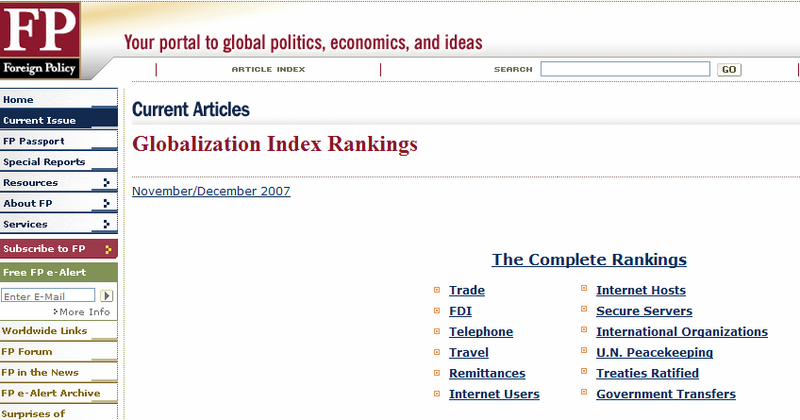
Foreign Policy has released it's 2007 globalization report. Again, Singapore takes the top spot while South Korea slips a few notches. What a surprise...not.

The report: Foreign Policy: The Globalization Index 2007

The news article: Korea Tumbles Six Spots in Globalization Index

Singapore was rated the most globalized country in the world for the third consecutive year, according to the 2007 Globalization Index. Hong Kong placed second in the index, the seventh annual collaboration between Foreign Policy magazine and A.T. Kearney, a consulting firm. The Netherlands ranked third, followed by Switzerland, Ireland and Denmark. Korea dropped six spots to 35th.

The index is based on data from 72 nations that account for 97 percent of the world GDP and 88 percent of the total population. The index measured 12 variables across four categories: economic integration, technological connectivity, political engagement, and personal contact.

Economic integration includes data on trade and foreign direct investment inflows and outflows. Technological connectivity counts the number of Internet users, Internet hosts, and secure servers for encrypted transactions.

Political engagement includes each country's contributions and memberships in international organizations. Personal contact tracks international travel and tourism, international telephone traffic, and cross-border remittances and personal transfers.

The 2007 rankings are based on 2005 data, the latest available.

The nations at the top of list are mostly small. Of the top 10 nations, eight have less than 84,000 sq.km of land and seven have populations of less than eight million.

Experts attribute the successful globalization of smaller nations to the fact that nations with small domestic markets and few natural resources have few choices but to search for breakthroughs in trade and market openings.

The U.S. dropped three spots to seventh place. India and China ranked 66th and 71st. China, which was ranked low because of its small level of international participation, dropped 15 spots since it changed its policy direction from export-driven growth to domestic demand-oriented growth.

India also ranked low because it lags behind other countries in technological connectivity, with only five percent of its population using the Internet.

There are also some other articles related to the topic on the sidebar at the Chosun Ilbo:

UN Concern at 'Ethnocentric' Korea
Foreigners Have a Hard Time in Korea -- Report
What Koreans Really Think About Ethnic Homogeneity
It's About Time Korea Became Colorblind
Korea Expecting 100 Millionth Foreign Visitor
Korea is Still in the Dark on Globalization

An Alternative link to the Globalization Index

Read More...

Sphere: Related Content

Thursday, October 18, 2007

Holes in Korean Education

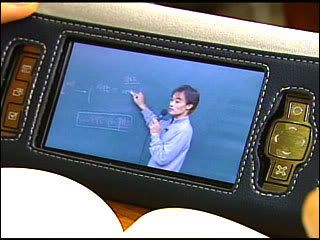
This is an interesting topic. I've been watching CNN's Eye on South Korea reports this week. It's the last day and they've topped it off talking by talking about MegaStudy.

I was having dinner with another foreign friend last night who is studying here. And, believe me, foreigners have a ton of opinions on Koreans and their education system. I've got a few choice views on it myself.

However, I did point out that in spite of the fact that Koreans are still very much plugged into route learning, the fact that their leaders had the good sense to invest into creating a broad education system contributes to the successful export economy we see today. There was a lot they could have done with the funds they didn't have to put to national defense and there could have been massive corrpution beyond the cronyism that was seen during the industrial development years because there was a lot of aid coming to Korea. All in all, there wasn't and that money went to creating a society ready to learn and work to a better future. Now they've got it.

There are tons of various types of colleges and universities which train their population to move into the job market. The fact is all of my Korean classmates who wanted to work or to move on to further studies have. Small cities like Yeosu, where I started my adventures in Korea years ago, usually have 4 to 5 nearby colleges and universities. Another town I lived in had nothing more than a train station, a bus station a few blocks down the road, a few shops in between and a lot of gawking Koreans had at least 5 to 6 colleges and universities within a 30 to 45 minute radius. This has been crucial to Korean's amazing development because it's a reality that the child of working class people can get education. I've seen it and that's the background of the majority of the students I've had since I've been here.

Now these institutions are not creating scholars. What they're doing, however, is training people to become skilled workers to do the job. That's crucial for a country that lacks natural resources. You have to create your edge with your other resources. So for all the criticism that's directed in the general direction of the Korean education system it's managed to get the job done.

With that shout out, however, here comes the critique. When it comes to globalizing Koreans still have quite a ways to go. The economy is shifting from a manufacturing base to a service and research base. No education system is perfect; the US education system certainly isn't in the primary and secondary school levels, but somehow is at the top of the game when it comes to universities.

I was regaled with a story that one of my former professors had no clue where Jamaica was and thought it was somewhere in Africa. The class had to do reports on leadership in their respective countries, but the professor had no concept of the Caribbean region. Even after being corrected she continued to clump the African students with the ones from the Caribbean.

Now Koreans bristle when they're mistaken for Japanese or Chinese, so you'd think there would be the same level of sensitivity when they make the same error. However, I've found that empathy is a hard thing to find in Koreans when it comes to this issue. You'd also think that a "scholar" would have a general idea of the world's geography. Meaning you don't have to know exactly where a country is but it would be nice to think most "educated" people know the difference between the regions where Ghana and Guyana are located. If you know the positions this woman has had in the past and her specialty, the depth of her error becomes even more glaring.

That's one huge hole in the Korean system which leads to blundering errors like the one my former professor made. It's a shame because I guess even in the mind of a Korean who holds a Ph.D. from an American university and whose CV lists some interesting work, all black people except black Americans all must still live in Sub-Saharan Africa. And there is nothing wrong with living in Sub-Saharan Africa, so don't mistake my point. However, in modern times boats sail and planes fly and, believe it or not, they let black people on them from time to time.

The black disapora like the Korean one is all over the world. To not know the difference between Sub-Saharan Africa and the Caribbean is more that just humiliating for her (the story is spreading fast), but it's a clear commentary on how far the Korean education system still has to go to prepare its citizens to shift from making products shipped to foreign lands to actually dealing with foreigners face-to-face.

Maybe the folks at MegaStudy can offer a freebie class to its Korean subscribers to cover world geography and world culture. While they're at it, maybe they can create an English version for the students in the US too. I know I still have cousins who ask me how my life is in Japan, go figure.

Read More...

Sphere: Related Content

Wednesday, October 17, 2007

Even Koreans See Singapore As The Place To Be

Another in my "international hub?" theme.

If its upper income citizens are setting up businesses and establishing residency in Singapore for its high level of development, tax breaks and educational programs, what does Korea offer to expatriates in terms of the same?

I mean, if it's that great (and it is) then you'd expect foreign businesses choosing from Asian nations to set up shop in Singapore. That's supported by the data as Korea fell in the rankings this year in terms of ideal places to do business. Pretty ads and sweeping statements mean nothing without action to truly make Korea a good place for foreign investment and foreign living.

Beyond that, I'll let the article speak for itself.

Tax Breaks, Schools Attract S.Koreans to Singapore

An increasing number of high-income South Koreans are obtaining permanent residency in Singapore to give their children better educational opportunities, take advantage of tax breaks and enjoy post-retirement living. In the past, Koreans who wanted to move overseas looked mostly to the U.S., Canada and Australia, but now it's Singapore in the spotlight.

According to the Bank of Korea, not a single South Korean bought a house in Singapore in 2005, but in 2006 eight did and in the first half of 2007 23 Koreans bought houses in the Southeast Asian city-state, showing a sharp upward trend.

Investment by South Koreans in Singapore has also grown, from S$3.3 million (S$1=US$0.68) last year to S$14.30 million during the first half of this year. The number of Koreans residing in Singapore has swollen to about 13,000, nearly twice as many as three years ago.

To obtain permanent residency in Singapore you can establish a business with an investment of more than S$1 million, or invest more than S$1.5 million in a local venture capital firm, enterprise or foundation. If you invest more than S$2 million, you will be permitted to buy residential property with up to 50 percent of your investment.

The main reason Koreans are interested in Singapore is that it offers better educational opportunities and tax benefits. It's also possible to make successful investments in real estate, since housing prices have risen in the wake of recent development plans for the Sentosa and Marina Bay areas of the country. As Singapore is relatively close to South Korea, it's also easy to travel between the two countries.

Individual South Koreans are looking for foreign countries where they can enjoy tax advantages and educational opportunities, just as businesses are leaving for foreign nations in search of lighter tax burdens and softer investment regulations.

Koreans can still maintain their South Korean citizenship if they obtain only permanent residency in Singapore. Singapore also offers public security, a stable political and economic situation, less racial discrimination than in Europe or the U.S., and a better educational environment where students can learn both English and Chinese.

The immigration trend is further encouraged by the Singaporean government's plan to expand the number of permanent residents it allows in a bid to increase its total population from 4.5 million now to 6.5 million by 2050.

Kim Hoon, 38, is a Korean who obtained permanent residency in Singapore in 2005. "The Singaporean government gives permanent residency to any foreigners who contribute even a little to the Singaporean economy," he said. "Permanent residency is renewed every five years, but you'll have no problem maintaining your status if you have no problems with your work and you pay your taxes."

A growing number of South Koreans are establishing their own businesses or making investments in Singapore to take advantage of tax breaks. One South Korean plastic surgeon plans to establish a joint venture clinic in Singapore next year. "To succeed in Asia, you should advance into Singapore, a medical hub," he said. "And you can win recognition there for the outstanding technology of South Korean surgeons."

The president of a local consulting firm said, "Many South Koreans obtain permanent residency by first establishing corporate bodies in Singapore and then gauge the situation for about a year and a half."

Read More...

Sphere: Related Content

Wednesday, October 10, 2007

Seoul Outdoes London in Consumer Prices


This is an interesting article which confirms what I've noticed living here: the prices are pretty steep for a lot of things.

A lot of reasons are beyond my expertise to comment on. However, what I've noticed with a lot of my Korean friends is they truly think that the more you spend on something, the better it is.

Now that's true, in a general sense. The pair of leather pumps I have on now are maybe mid-price range. (Mid-price range for me being around $70.00 USD). Now I can get pumps at a much cheaper and much more expensive price. The cheaper pumps will probably not last very long. The more expensive pumps will probably last me a bit longer. The ones I have on will probably last me a long time with proper care.

But there are some things that are wasteful habits.


For example, when people move to a new place in they frequently toss the furniture out to get new pieces. There really isn't a regard for recycling or keeping heirlooms. One reason I know is because everything here was essentially destroyed after the Korean War, so there aren't any heirlooms. What that means is furniture gets tossed. You'll see it on the side of the road near recenly vacated apartments or houses. These are usually not broken or well-worn pieces of furniture, but are perfectly good and intact pieces. I found a great second-hand furniture and appliance shop near my apartment and bought an armoire that was essentially new. But for a lot of Koreans I know, that would be unheard of.

To me, that's when it gets silly and that's one reason why retailers are able to charge such high amounts. The reason being a lot of Koreans don't seem to have sense of the value of many consumer items and there is a status to having the latest and most expensive thing to hit the market. Granted, there are a lot of people like this in the States too. But not to the same degree here. Here it's not just capitalism driving it but the culture of hierarchy and status.

Now, like I said, that's one reason in the big cycle of how economics, prices and inflation works. But if there isn't a demand for products at reasonable prices it's actually quite easy to over charge for things that would otherwise be cheaper.

Honestly, it's a good reason for me to not second guess my current plan which is to make this approach to my last year in Korea and move on. There is no value to living here when the cost of living starts exceeding the cost of living back home because there isn't that much more here that's enticing enough to remain.

Seoul Outdoes London in Consumer Prices

The U.K. is notorious for its high prices, especially public transport and eating out in London. The underground costs 4 pounds or some W7,500 in downtown London, and the basic bus fare is 2 pounds - that is three to seven times higher than in Seoul (W1,000 each). The price of a bowl of black bean paste noodle is as much as 5-5.90 pounds. Koreans living in the U.K. seem resigned to the fact. They say if they try to translate pounds into Korean won, they would end up starving to death. But when it comes to commodity prices, the story is different. Meat and vegetables are available at cheaper prices than in Seoul in the supermarkets, and premium brand goods are also much cheaper in London.

◆ Beef four times more expensive in Seoul

Hong Seong-nyeo lives in London and cooks beef once or twice a week. She shops in Tesco’s, where 600 g of best-quality steak costs no more than W15,000 for her family of four. The same amount at E-mart in Seoul costs some W56,000. The price of fresh bacon is a third of the price in Seoul. For W10,000, you can buy only 515 g of good-quality pork in a E-mart in Seoul, but in London it buys 1,620 g. And an organic egg costs W508 in a London Tesco but is W190 more expensive in a Seoul E-mart.

The price of milk is also below W1,000 for 1 liter in a London Tesco, but in a E-mart even the cheapest exceeds W1,200. A box of 600 g Kellogg’s Corn Flakes is W4,350 in Seoul but costs less in London although it comes with 150 g more per packet. Some vegetables like onions and cucumbers are more expensive in London, but comparing the bills of 15 items bought, Seoul was still more than twice as expensive as London -- W143,000 against W64,000. Even excluding beef and pork, London (W46,000) is cheaper than Seoul (W75,000).


◆ Hugo Boss men’s suit W500,000 more expensive in Seoul

At the Shinsegae Department Store in Gangnam, Seoul, Lancome’s eye cream costs W150,000 and Estee Lauder’s W75,000. But the same Lancome eye cream is available at 36 percent cheaper or W96,000 (51.50 pounds) in London’s biggest department store Selfridge’s. The Estee Lauder product is also W15,000 cheaper there. The same goes for men’s cosmetic products. It costs W43,000 to buy a 100 ml bottle of Biotherm lotion in Seoul, but in London a 200 ml bottle costs W7,000 less. And what about Korean girls’ favorite Louis Vuitton bags? The basic Speedy costs W670,000 in Seoul, W90,000 more expensive than in London. A Prada bag is also W300,000 more expensive in Seoul (W1.6 million) than in London (W1.3 million).

A men’s suit in a Hugo Boss store in downtown London was tagged at 600 pounds (W1.12 million), but the same suit was sold at W1.68 million in Seoul. The situation is not much different in outlet stores. In Bicester Village, an outlet mall in northwestern London, men’s polo T-shirts, whose original price is 55 pounds (W102,000), are sold for 19.99 pounds (W37,000). They cost W69,000 at an outlet in Yeoju, Korea. Burberry classic checked shirts for men are offered at one-third of the original price (120 pounds) in the London outlet, but three times as expensive at W208,000 in the Korean one.

Read More...

Sphere: Related Content

Sunday, September 30, 2007

Repost: What the Hell is Wrong With Korea?

This is an interesting one which I think fits in pretty nicely into my "they're nowhere near being an international hub" line of posts.

This one is from Foreign Dispatches blog.

They make it so easy to point and laugh sometimes.

What the Hell is Wrong With Korea?

A fairly ordinary American (or possibly Canadian) girl posts a short and rather boring video on Youtube in which, while rambling on about nothing in particular, she mentions in passing that she dislikes Kimchi and finds the strong smell off-putting: nothing to get even the slightest bit excited about, right? Well, not if you're an oversensitive, ultranationalistic Korean, it isn't ... See the video which has even Korean newspapers up in arms for yourself.


Just read the angry responses to her video to see just how brittle the supposed self-esteem of so many Korean "patriots" really is: it would simply be inconceivable that people from, say, Japan*, the UK, France or Iceland would bat an eyelid if someone confessed to disliking natto, marmite, escargot or hákarl, and the other side of the coin to that overblown nationalism which Koreans are so partial to is a ridiculous oversensitivity to even the most minor perceived slights from the most insignificant of sources. This incident is even more pathetic than the repeated bleatings about that pile of guano Koreans like to call "Dokdo": a nation whose newspapers can work themselves into a blather over the passing comments on kimchi of a single foreign girl barely out of her teens is one with a massive chip on its collective shoulders; I know I'm repeating myself here, but there is something outright pathological about Korean nationalism.

*Note, by the way, the complete lack of angry responses by Japanese viewers to what she has to say about the country's cockroaches - a far less flattering thing to talk about than finding the smell of kimchi off-putting ...

PS: Take a look at the enraged Korean reaction to this kid's review of the near universally-panned "D-War."


One choice example:

Hey nigga! I can't see you boy! where are you? Whole black shit on screen, but sounds like some african boy. Where are you nigga?
Classy, isn't it? But that's what comes with idiotically over-identifying yourself with everything done by anyone who shares a passport with you - you find yourself feeling driven to "defend" even complete dreck by resorting to racial insults. To be fair, though, this time quite a few other Koreans make responses which show that the ultranationalist idiots don't speak for all of Korea.
It's just really sad and because this is a nation with a lot of promise. But if they have to be up in arms anytime someone has something to say about their culture, society or food then they have a lot more developing to do. However, that development needs to be in their society. Why is it that Koreans can level all sorts of criticisms at my country but let someone say they don't like the smell of kimchee or that D-War sucks and their oversensitivity send them into mad rants.

One girl thinks kimchee smells and said something about it on YouTube and almost everyone thinks D-War sucks.

As this is a repost, I've turned comments off. Please, take your feedback over to Foreign Dispatches.

Read More...

Sphere: Related Content

Friday, September 28, 2007

Korea's Corporate Environment Declines

Click on the pic to go to the Doing Business 2008 website

Hehehehehe...yes, I'm getting a mean spirited laugh out of this one.

I guess that I just can't let this one go.

In its quest to become an international hub of some sort, South Korea has managed to drop in the World Bank's ranking of the ease of doing business compared to other countries.

If you make it difficult then people are going to move on. I'm not going to establish a business here if you make it difficult.

Believe me, I had to call the gas company today about my bill. How many times do I have to call to have them delete an old bank account off of my damm bill? After trying to call in the morning I finally got through this afternoon to some utterly unhelpful dink. Knowing this is part of life here, I took a deep breath, found another number and, thankfully, found someone who could help me.

Now it's different as I'm a person calling about a gas bill for my apartment and not a business, but multiply that by a foreign branch of a company and I can't image where that ranks on the "pain in the ass" meter. Basically, it's too high up on the scale to warrant coming to Korea when it's easier to go elsewhere. Things get done here but Koreans seem not to understand that inefficiency will turn a Westerner off in a quick second. Now, I know there are issues back home too, but I'm not talking about the USA right now.

Make things difficult and businesses decide to go elsewhere. That also feeds into if you make living here difficult people will decide to take their businesses to a place where living is easier. It's just that when nations are compared Koreans start wondering why Korea isn't getting a big chunk of foreign direct investment...whatever.

Dang...why is that so hard to get and act on?

Korea's Corporate Environment Declines

Korea's corporate environment has worsened since last year, according to "Doing Business 2008", a report by the World Bank released Tuesday. South Korea fell from no. 23 in 2006 to no. 30 this year in terms of how easy it is to do business here.

Portugal undertook the most effective reforms for a business-friendly environment, the report says. But South Korea implemented no reforms that helped improve the corporate environment.

South Korea ranked 110th in Starting a Business, down nine places from 2006; 131st in Employing Workers, down one place; 64th in Protecting Investors, down two places; 22nd in Simplifying Licenses, down from 16th; 68th in Registering Property, down from 65th; 36th in Getting Credit, down from 32nd; and 11th in Closing a Business, down from 10th in 2006.

According to the report, 10 different stages are needed for a person to start a business in Korea, while it takes 17 days and 16.9 percent of per capita gross national income to start a business in the country. In contrast, the OECD averages six stages, 14.9 days, and 5.1 percent of per capita GNI.

For the second year running, Singapore topped the rankings, followed by New Zealand, the U.S., Hong Kong, Denmark, the U.K., Canada, Ireland, Australia and Iceland.

Honestly, Korea has some really good things going for it. But other countries do too.

Step up Korea, seriously.

Read More...

Sphere: Related Content

Monday, September 24, 2007

Click Over: A brief history of scapegoating English teachers in Korea

I'm all about doing nothing, which means just hanging out or relaxing, or traveling during Chuseok.

However, since I'm typing this on my computer in my apartment, guess what? It's all about hanging out and relaxing this Chuseok holiday.

I met up with ZenKimchi and a pair of other friends yesterday. We had a great meal at a new Viennese restaurant in Itaewon, Chef Meiji. At one point, the conversation went to the perception of teachers in Korea and how, in some ways, it's declined over the years and is just pretty bad.

I wouldn't know about the first part. I came here after the Asian Financial Crisis. While I have had people telling me about how great it was, my internal reaction is "so what? Things change." During that time I was completely focused on other things and, for me, it would have been a longshot to even consider teaching English here.

Things did change for me. My parents died. I was beyond sad. I realized that but for the company credit card, expense account and my field days I didn't like my corporate job. I had nothing to loose, so I quit. Also, during that time I had taken the LSAT and applied to law school. A few months later got into law school and moved to San Francisco. I realized about halfway through I didn't want to be a lawyer either. So, needless to say, things changed, as did my perspective and approach. When I finally arrived in Korea, I was full of a lot of optimism. I think that's what helped me adapt and roll with the negative aspects of being here. Living here is good if you're a cynical Pollyanna like me. That basically means I'm a realist but I'm also able to see those positive aspects of being here too. Sue me. To those who have had bad expat experiences in Korea my apologies, but sometimes I actually like it here moreso than home.

One negative aspect is how Koreans generalize to excess. It's probably because being from a society where everyone looks the same and pride themselves on having such a distinct culture that they see foreigners in the same way, as a monolith. Specifically there is a tendency to scapegoat English teachers here. Honestly, I've got a resume that most Koreans would kill for and I've yet to experience too much discrimination because I'm a teacher. Probably, that's due to the "status" of where I've taught as a university/college instructor. That's not the case for a lot of other English teachers because schools range from hagwons to private businesses to the Korean military. There are different ranks and levels of status that go with all of those positions. And, as I've written about before, there are some "interesting" types here. There are the teachers who can't get a job back home. There are those teachers who slip through the cracks because a lot of schools don't bother to verify credentials. These teachers do hurt the reputation of foreigners, but I know more good teachers who have it together than scary freaks or runaway criminals.

Anyway, here is A brief history of scapegoating English teachers in Korea from the Gusts of Popular Feeling blog. It's long and very detailed, so just click over to read it.

Now it's time for me to go shopping and pick up some dinner. Happy Chuseok everyone.

------------------------------------------------

Here is another - The Hankyoreh: Even born in Korea,‘foreigners’ feel sting of discrimination

Read More...

Sphere: Related Content