Showing posts with label anti-americanism. Show all posts

Monday, September 3, 2007

Trends in Nationalism in South Korea

This is interesting. The Chosun Ilbo has an article titled New Trends in Korean Nationalism. I was really excited and thought I'd read something really good.

However, this is the WORST article I've read on this topic. That's not to say I've read a lot of articles on Korean nationalism, but damn, this sucks ass. I know this stuff and, really, by the fourth paragraph, my eyes were glazing over. On top of it, it's got TYPOS. Damn...just damn.

It's either blog it or save it to blog later and then forget about it.

My goal is to read it and then reinterpret it for the lay person. You can try it too.

THIS is English language journalism in Korea. Shitty, no?

Enjoy...if you can.

New Trends in Korean Nationalism

South Koreans' attitude toward the U.S., as seen in the latest hostage crisis in Afghanistan, was markedly different from the anti-American sentiment vented during the kidnapping and beheading of Kim Sun-il in Iraq in June 2004. Despite some minor protests, the ratification of the Korea-U.S. free trade agreement is proceeding apace, with anti-American, pro-North Korean voices much quieter than they have been.

Several academics say the 20-year-long marriage between the Left and nationalists born in the democratic struggle against authoritarian governments in the 1970s and 1980s is coming to an end. That means farewell to the defensive, registance nationalism produced by Korea’s history in the 20th century. Foreign experts, by contrast, worry that Korean nationalism is becoming more aggressive.

Prof. Kang Won-taek of Soongsil University defines this trend as a transition from Korean nationalism to South Korean or “Republic-of-Korea” nationalism. But Kang says it would be missing the point if we regard it only as a trend of nationalists turning to the Right. According to Kang, this new South Korean nationalism owes something to the advent of a “post-386” generation who are IT- savvy and aware of globalization, and to a change in South Koreans' perception of North Korea and a more realistic understanding of the situation the Korean Peninsula finds itself in.

Prof. Kim Ho-ki, a center-left academic at Yonsei University, says the spectrum is more complex. The Right, he says, is divided into nationalists and post-nationalist or pro-market forces, and so is the Left, while in between there are centrist nationalists and post-nationalists.

The conventional nationalists on the Right stress a patriotic view of history. Rightwing post-nationalists, led by the novelist Bok Geo-il, are backed by businesses that emphasize globalization. The conventional nationalists of the Left are pro-North Korea; leading figures are Baek Nak-cheong, a professor emeritus of Seoul National University, and Kang Man-gil, a former Korea University professor. Over the past 20-odd years, this group has exercised the most powerful influence on intellectuals, their ideology a major influence on the Kim Dae-jung administration.

Leftwing post-nationalists include Prof. Jin Jung-kwon of Chung-Ang University, Prof. Sohn Ho-chul of Sogang University, and Russian-born scholar Park No-ja.

"As far as large social currents are concerned, it's clear that both intellectuals and the general public are now moving from leftwing nationalism to rightwing post-nationalism,” Kim Ho-ki said. “But we’ll need more observation and research to see what the new nationalism will look like."

Prof. Jun Sang-In of Seoul National University’s Graduate School of Public Administration says leftwing nationalism is conspicuously losing its influence among the populace, “decisively because people are disappointed by the leftwing governments of the past decade." Shin Ji-ho, the president of the “new Right” organization Liberty Union, said, "In my view, the Chun Doo-hwan regime played a role in integrating the Left and nationalists into a formidable force. And the Kim Dae-jung and Roh Moo-hyun governments have played the central role in producing a new force based on a combination of post-nationalism and the Right."

So what will it mean if the leading ideology is moving from leftwing nationalism to rightwing post-nationalism? Where will the 386 generation of former student democracy activists, who became the main proponents of leftwing nationalism in politics, turn now? And will the new South Korean nationalism -- the product of a combination of the Right and post-nationalists -- be a sort of patriotic globalism, or will it remain mired in ultra-nationalism and a chauvinism based on the ideas of “pure blood” the UN has recently criticized? The struggle for the intellectual soul of South Korea is on.

Read More...

Sphere: Related Content

Wednesday, July 18, 2007

Skype = Pervert Central?

Obscenity Turns English Students Off Skype

Some subscribers to the Internet chat and telephony service Skype are spreading dirty language and videos, knowledge-hungry users complain. Many Korean students use the Skype messenger program to practice their English conversation. Skype provides services in 28 languages to almost 200 million people in approximately 220 countries. Since launching services in Korea in 2006, Skype has managed to sign up a lot of people. Although other Internet messengers also provide chat services, voice and video calls, Skype allows users to select options for chat partners.

One college student said, "It was good to make foreign friends easily with Skype. I improved my English proficiency by chatting with a French friend." But some strangers are sending her pornographic videos and making obscene jokes through the Skype messenger. “I’ve started to become prejudiced against their countries,” she says. An 18-year-old schoolgirl, who signed up with Skype to practice her English with foreign friends, said, "Most foreigners using the Skype chat service seem to just want to meet girls and make filthy jokes. So I felt bad and deleted the program just two days after installing it."

An official from Auction, which manages the Korean Skype services said, "It’s impossible to monitor every Internet conversation. We are aware of the problems, but we can't take responsibility for them. In the future, we will discuss possible solutions to the problems such as word filtering, throwing abusive people out of chat rooms or making a blacklist.”
I thought this one was interesting. I'm on Skype and, for similar reasons, I rarely use it. If someone I know knows I'm on it or finds me on it and then sets up a time, I'll log on. Otherwise, it's a rare day indeed that you'll see me logged into Skype. I go as far as writing on my profile that if I don't know you don't even bother with adding me as a friend. I do this to just steer clear of boring "conversations" with people I don't know, "conversations" with people who want to learn English (tons there and I've denied every request) and the "talk dirty online" people.

That last category is what has young Ms. Kim all in an uproar.

However, I take issue with foreigners being cast as sexual deviants when there is more than enough of that here too.

Her quote also shows a very low level thought process. She has now judged their countries because she's met a couple of freaks on the Internet?

First, I can go into Skype and change my country, so you can be from anywhere but say you're from Canada or someplace else.

Second, she can use Skype with the knowledge that there are freaks out there and take steps like I have to avoid them online.

Third, I don't hate Korea because of Cho Seung-hui, Woo Bum-kon, Kim Jong-il or his father, Rev. Moon Sung-myung, the scores of Koreans who launched into anti-Americanism over the tragic accident in 2002 where two girls were killed but ignored the fact that North Korea had intentionally killed four South Korean sailors or that drunk Korean adjoshi (older man) who cornered me and made a grab for my breasts on a train mere months after I moved here (no link for that one, but thanks to the train attendant I fetched to get drunk man away from me.)

Fourth, it's just stupid to generalize on such a low level. Maybe it's fair to say Americans tend not to care much about other countries or cultures. It, however, is not fair to say that all Americans are bad people. That seems to be what Ms. Kim is doing regarding whatever countries these foreigners are from (how much do you want to bet that the US is on that list?)

Maybe it's because I come from a country where ALL groups have both good and bad. I'm also aware that people, in general, do this which is why I tense up when there is a crime that makes the news and hope "don't let it be a black person." Of course, sometimes it is and sometimes it isn't. If the person is black, I know that he or she doesn't have any connection to me but people not inclined to thinking too deeply, I'm sure, disagree with me.

I just notice that this is something Koreans do a lot in the context of foreigners. It's clear from how this article was slanted: foreigners = bad sexual deviants (some are, no doubt), Koreans = innocent, hard-working people with a thirst for knowledge (also, some are but some spend loads of time playing computer games).

Now if they're serious about snatching that "hub of Asia" title from Singapore they're going to need to reduce that tendency because, as it stands, there are plenty of other locations in Asia that are more conducive to a better lifestyle and friendlier environment.

Read More...

Sphere: Related Content

Sunday, July 1, 2007

Anti-Americanism: Must We Take It No Matter What?

I went out last night to see Transformers. It was a good movie too.

After the movie a few people wanted to have some drinks and just socialize. We found a place near the theater and settled in. Someone was talking about how the Pentagon loves Michael Bay and is very keen to support his movies by providing him with lots of access and support. It's obvious when you see Bay's movies that this is true.

By this time in the evening the point had come up a couple of times. I'm sitting there thinking "well, yes...it's the logical thing to do as it's free positive PR." So I said that.

That reasonable person or that logical ends result type of theories thinking is pretty much prevalent in legal, economic and other social science studies. The aim is to examine how people behave according to their self-interests.

I went on to say that the US is pretty much the world's only superpower so positive PR is in their interests, uh oh. Clearly those were fighting words and another person questioned me on the US being a superpower.

Now I know that the US is VERY unpopular right now and click around my blog and you'll know that I'm very much a critic of my country's actions and policies right now too. However, my dislike of the current administration doesn't negate history.

What was funny was the person went on the attack and said that I'd been "brainwashed" because she assumed that all my studies had been in the States. Honestly that's one reason I thought getting that degree would strengthen me because how often will you hear the critque that Americans have horrible tunnel vision. Well, in general, that's true but I can't help but notice as an American that there are a whole lot of people who want that American university or grad school degree. (Yes, that's smug defensiveness there, but it's true.)

Anyway, when I told her no I'd not been "brainwashed" and I'd spent the last couple of years studying that stuff here, well, that offensive went silent. To which the next question was how long I'd been here and after I answered, that offensive was busted too. I'm easy to debate with because discussing varying perspectives is interesting. However, I'm hard to argue with because in an argument it's not about an exchange of ideals. To that end, I can usually anticipate the steps someone is going to take - it's mental chess. In the spirit of the movie we'd just seen I'd managed to inspire a small flare up of in the war of idealogy over America and what it represents. However, I wasn't on a flag waving mission as much as it was just logical to me that the US military would support movies that paint it in a positive light. That's particularly true in the current political climate. How is that controversial?

My thing is, look, you can love or hate the US, but the US is a superpower or hegemon. Just look the concept up. For the sake of being complete here is a definition of the concept that I was referring to last night:

...a “superpower” is a country that has the capacity to project dominating power and influence anywhere in the world, and sometimes, in more than one region of the globe at a time, and so may plausibly attain the status of global hegemon.
Now that definition is free of interpretations of whether that is good or bad. And I can completely understand debating the issues and points that superpowers raise. However, I wasn't arguing that the US was a good or bad superpower. Honestly, right now I think it's a pretty bad superpower.

I wasn't arguing about current US policy. I said the US is the world's only superpower and if you know the political concepts, I don't know many who'd argue otherwise. From there, we can come to blows on different issues that dredges up, but the superpower issue is not a debatable issue unless you're dealing with someone who is so biased against the US that they're hard pressed to ever say anything positive about the US.

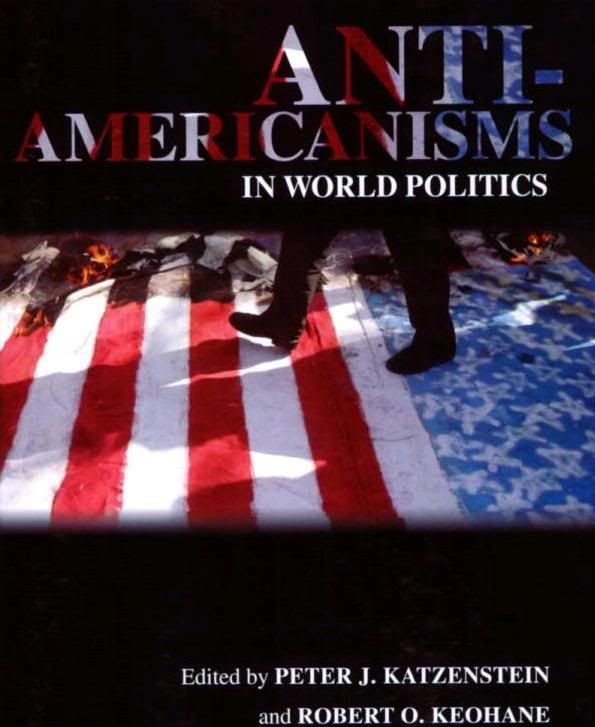
This got me thinking. Last term I checked out a book called. Anti-Americanisms in World Politics edited by Peter J. Katzenstein and Robert O. Keohane which has various essays that discuss the types of anti-Americanism and its impact on the political economy. It was interesting book and I intended to incoporate a chapter on that in my thesis but ran out of time. For just 70 pages I cited over 100 sources and there wasn't room for a section on this within the time constraints I had.

I don't think anyone could argue that anti-Americanism is more than justified, at times. Power corrupts. History has shown us that time and time again. Also, we know that anti-Americanism is going to happen and it's something that scholars who are interested in world politics might look into studying because it impacts the worldwide political economy.

Since I've lived abroad for awhile, I've found this to be true. People can attack the US in your presence and that's fine. That happens many times with people here in Korea for a range of reasons. But if you have critical words for their countries it's okay for them to bristle and get defensive. However, if you react in a similar way when the US is on the chopping block, well, they don't like it. This gets even more tense if, well, you actually know where Ottawa vs. Toronto or Canberra vs. Sydney are and why that's worth knowing.

It's interesting to me because I have a laundry list of complaints about my country, but the US is a superpower. Now that we've established that let's talk about the stuff that flows from that fact because THAT'S much more interesting than haggling over well-defined terms.

Read More...

Sphere: Related Content

Thursday, April 19, 2007

Collective Korean Sorrow and Guilt Over the Virginia Tech Massacre

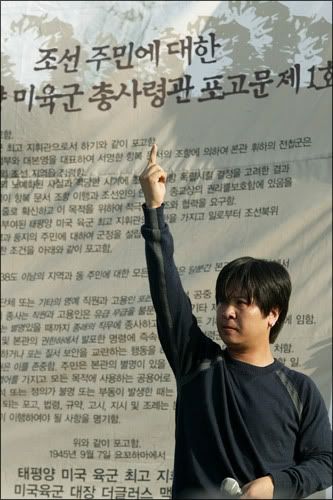
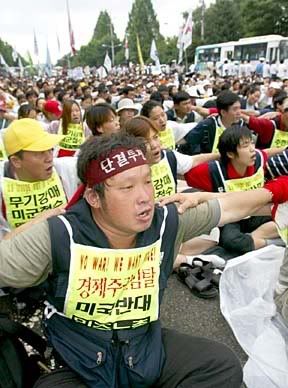
Korean folk singer of “Fucking USA!” - Photo and caption from Legacy of President Roh: Anti-Americanism at Occidentalism.org.

Update, Tuesday, April 24 @ 1:20pm

Here is another article from Time that I read today about the shame his family here in Korea feels. It's too bad. They didn't pull the trigger: A Family's Shame in Korea.

With the outpouring of condolences and the candlelight vigils, it would be nice to see Koreans give Cho's family, who are also victims of this tragic massacre, a similar level of nurturing care.

-------------------------------------

Update, Saturday, April 21 @ 7:15am:

Of course, the debate about sorrow and guilt or maybe more like wounded pride and attempts to erradicate the shame and assumed bad PR that the shooter was Korean rages on.

There is an active blog about it on the Metropolitician's blog and a great comment that was left by Susan. She takes no prisoners:

And I'm pissed off with all of these Korean people apologizing for Cho's actions. What exactly are you sorry about? That he killed thirty-two people? Or are you really sorry that he brought SHAME upon our good name? Those are two different things. And words without actions are meaningless. The candlelight vigils, the trusts in the name of the injured, the tears, the mea culpas, blah blah blah . . . worthless.
Click over and read it.

It's Saturday, April 21 here. A friend told me yesterday that they're planning a candlelight march here in Seoul at 7pm today. While I acknowledge it will be a nice gesture, I also told her it was blantant fakery in light of the virilent anti-Americanism that Koreans expressed just five years ago. It's also a great chance at photo-ops and coverage by the international media. Come on people, we know what this is about.

Basically, it's bullshit. This is very much about saving face and making every attempt to show that Koreans aren't monsters.

Look, we know this. I'm completely dumbfounded that Koreans really thought that Americans would turn en masse on them. However, I know I shouldn't be because that's exactly what Koreans did in 2002 (as referenced below). Believe it or not, but Americans with all of our faults, do understand that Cho, while clearly disturbed, made a choice.

We realize it wasn't Koreans that sat around and drew straws. However, maybe what's behind this is that there IS a huge dislike and maybe even hate still. It's just that Cho pulled the trigger and brought it all to the surface. That's sent Koreans scrambling to try to cover it up rather than acknowledge it.

Just a theory...but, I think, for many it might be truth.

---------------------------------

One, I should be studying for another midterm but don't want to. Read: ExpatJane is procrastinating, big time.

Two, I thought these articles from Time and the Christian Science Monitor are timely due to Cho Seung-hui and the massacre at Virginia Tech.

Three, I think these do a good job of explaining the collective sorrow and guilt that people here in South Korea are feeling and why.

They also highlight what I've seen, first hand, which is the virulent anti-Americanism that I've seen while living here which is the inverse of the collective sorrow and guilt that's being felt now.

Time: South Korea's Collective Guilt

While Americans were grieving and trying to a make sense of Monday’s massacre at Virginia Tech, on the other side of the Pacific, South Koreans were shaking their heads in disbelief that one of their own could unleash the worst massacre in U.S history.

Most Koreans don't regard Cho Seung-Hui as a "typical Korean" since he spent the bulk of his life immersed in American culture. Still, a collective sense of regret and guilt was palpable today due to the strong tendency of Koreans to perceive the tragedy in terms of Korean nationalism, in which the group trumps the individual. "It's a notion of collective responsibility," says Mike Breen, the author of The Koreans. When a Korean does something wonderful, the country rejoices, but when one of its own goes off the rails, like Cho Seung-Hui, there's a collective sense of shame and burden. So much so that South Korea's Ambassador to the U.S., Lee Tae Shik, pledged to fast for 32 days to show his sorrow today. "I can smell a collective sense of guilt," says Lim Jie-Hyun, a history professor at Hangyang University in Seoul. "There is confusion [in Korea] between individual responsibility and national responsibility."

In a country where untold numbers of citizens seem eager to travel, work and live in the United States, many Koreans were dumbfounded when they discovered this morning that the "Asian" campus killer was in fact a 23-year-old South Korean citizen. "I was shocked," says Hong, Sung Pyo, 65, a textile executive in Seoul. "We don't expect Koreans to shoot people, so we feel very ashamed and also worried." Most important, he adds, "we don't want Americans to think all Koreans are this way."

Nor did President Roh Moo Hyun, who sent at least three messages of condolence to the U.S. and gathered aides for an emergency meeting on Wednesday morning, once it became widely known on the peninsula that the shooter was a South Korean student who moved with his struggling parents to the U.S when he was eight years old. Roh reportedly called for the meeting to discuss measures to cope with any possible fallout from the massacre — inadvertently stoking fears that Koreans living and studying abroad could be in for a rough ride. "Koreans still remember the riots in L.A., so we are worried about some revenge against Koreans," says Kim Hye Jin, 29, a web designer in Seoul, referring to Korean-owned businesses that were looted during the 1992 violence. "We are really worried about the image of our country."

Some Koreans even raised the prospect Cho's rampage could possibly inflict damage on U.S-Korea relations, including the recently signed tentative free trade agreement between the two countries.

This kind of nationalistic response can have an opposite effect as well — when the roles are reversed. In 2002, when two U.S soldiers accidentally ran over two schoolgirls with a tank north of Seoul, anti-American sentiment was widespread in Korea. Some restaurants even hung signboards reading "No Americans" rather than "No Soldiers Allowed." For weeks, thousands of Koreans staged protests against American soldiers, while some Korean media even suggested that the girl's deaths could have been deliberate.
The Chirstian Science Monitor: In South Korea, a collective sorrow over Virginia shooting

As news spread that America's worst killing spree was perpetrated by a South Korean who has lived in the US since 1992, reactions among South Koreans have ranged from profound personal shame to a fear of reprisal.

"Because Koreans are also very emotional, Koreans tend to behave more sensitively together than others," says Paik Jin-Hyun, a professor at Seoul National University. "So, one tends not to see the event isolated to an individual but as an ethnic identity."

Koreans are perhaps unique in their sense of a singular national identity, molded through a long history of invasion and occupation, says Yook Dong-In, editor of social issues at The Korea Economic Daily. The heightened sense of having one "blood" or ethnic race has led to a hypersensitivity about foreign perceptions, many experts say.

The collective sense of sorrow and penitance about the killings was reflected in comments by South Korea's ambassador to the United States, Lee Tae Sik, who suggested that Koreans in the US fast for 32 days ? one day for each victim.

Many people noted appreciatively the lack of anti-Korean feelings among Americans. YTN, a South Korean news channel, interviewed a Korean student who has been studying at Virginia Tech on a foreign student visa since 2005. "My Caucasian friend was shocked at first to learn that it was a Korean," said Ha Dong-Woo. "But he instead wanted to protect and take care of us."

Several of the people interviewed added that had an American student living in South Korea killed 32 people, American expatriates would face serious reprisals. To describe such an eventuality, many interviewees used the word nallinada, which can be loosely translated to mean upheaval, disaster, or chaos.

"Anti-Americanism would have become extreme," says Mr. Yook, citing the groundswell of anti-American activism during negotiations for the recently signed free trade agreement between the US and South Korea. The country also saw a protracted uproar after American soldiers hit and killed two young girls while driving a convoy in June 2002. The direct fallout from that accident lasted several months, says Yook, and hard feelings persist today.

One woman, who was interviewed in Seoul on Wednesday, said she is married to a Korean diplomat. Korea's foreign ministry, she said, held late-night meetings to discuss how to protect Korean-Americans from possible reprisals. She was certain that, had an American attacked Koreans, the reprisals would have been swift.

"People will throw rocks at them and tell them 'Yankees go home,' " said the woman, who asked to remain anonymous because her husband is a government official. "People will go even crazier here if exactly the same incident at Virginia Tech happened here but committed by an American."
I've been here for awhile and I was here in 2002 when those two soliders ran over and killed those two middle-school girls by accident. I was really shocked by the incident too. However, I was more shocked by the reactions of South Koreans. I was angered and hurt by the out of control nationalism that I saw. I still have people who try to bring it up as a point against the US. However, I point out things that probably influenced the course of events in the first place like the fact that Korean children are often seen crossing the road into oncoming traffic after they've lifted their arm to signal the vehicle(s) to stop. My theory is that happens here and is a successful way to stop a car because there is a collectivism here that you don't have in the States. You do expect your neighbor to watch your back, as they say. Now, as a foreigner, when I first saw that it shocked me. That might not have happened in the case of the 2002 accident, but you do see people walking with no fear in front of and near moving vehicles all the time.

Also, during that same period the 2002 World Cup hosted by South Korea and Japan was on. I specifically remember that North Korea fired on a South Korean vessel at sea and killed quite a few South Korean sailors.

A violent skirmish between the Koreas navies on the Yellow Sea leaves at least four South Korean sailors dead and at least 19 others injured. An estimated 13 North Korean sailors are killed when the South returns fire. (from Timeline: Tensions on the Korean Peninsula at CNN.com)
Where were the spirited protests over North Korea? That was most definitely intentional, but I saw nothing more than a murmur of sorrow from the public over those four dead sailors.

That's still something I've yet to get over. This is particularly true when you know that the huge amount of progress both in development and economics just would not have been possible if South Korea's security wasn't intact. Probably the most significant reason for that security, whether Koreans or anyone else wants to admit it or not, is because the US military has been stationed here since the end of the Korean War.

I can understand feelings of anti-Americanism at times, but it's often one-sided and very hypocritical here in the Land of the Morning Calm. In Is the Korean Media Race Baiting the Virginia Tech Tragedy? at the ROKdrop blog he tackles this hypocrisy head on
Sorry this [the US] is not Korea where a traffic accident led to assaults on Americans and foreigners on the streets, anti-US hate signs on doors and windows, as well as stabbings and kidnapping of US soldiers with the added addition of being paraded around on national television with no Koreans ever being held accountable for these crimes. When this happens to Koreans in America then we can start talking about racism in the US, but all this talk now just sounds like the media is actually hoping there is a backlash against Koreans so they can turn the subject on racism in America instead of on the shooter.
I hate to say that the undisclosed diplomat's wife is correct. If it had been an American who went beserk and intentionally killed South Koreans at one of their universities, Koreans would be in a collective uproar.

Anti-American demonstrators held a rally ... in front of the U.S. Army's 2nd Infantry Division in Uijongbu, north of Seoul. The protesters' signs read, in part, "Oppose USA. - Photo and caption from Growing anti-Americanismfesters in South Korea at the StarBulletin.com

FYI Link - An interesting analysis of the 2002 protests: Solidarity in South Korean Civil Movement against the U.S. Forces

Read More...

Sphere: Related Content