Thursday, August 31, 2006

Youtube's "Most Devoted Uploader"

This is the second post in a row which has been inspired by The Marmot's Hole. What I'm discovering is there is a mad symbiotic relationship here in the blogosphere. You write something and somehow someone else sees it either by following a link or tripping over it in some way. They like it, or they hate it. They comment or leave a link to what they’ve created. They tell their friends how cool or crazy you are. You go and take a look and, likewise, you like it or hate it, and you link to it. You tell your friends how cool or crazy they are. It pretty much keeps evolving from there. That's a really interesting part of blogging I didn’t really know about until I started doing it.

Anyway, today’s lift from the guys over at The Marmot’s Hole is about Youtube’s most dedicated uploader: Didn’t know this about Youtube

In Will All of Us Get Our 15 Minutes On a YouTube Video? Lee Gomes from the Wall Street Journal discusses the massive impact of Youtube and how he and others have “scraped” the website to get usage data.

What is interesting is the most dedicated uploader is one who wants to focus the eyes of the world on South Korea pop culture. I have to admit that’s damn cool because that's similar to my primary aim which is to tune more folks into the international issues going on here that impact the world. I'm just much more of a talker than a linker.

The most devoted uploader is Christy Leigh Stewart, a 21-year-old college student who lives near Modesto, Calif., and who has so far uploaded nearly 2,000 videos. Nearly all involve Korean pop music, a passion of Ms. Stewart. Indeed, she says the main reason she spends too much time with YouTube is to drive traffic to hwaiting.net, a Korean-oriented Web site she runs with her friend Megan Hansen.
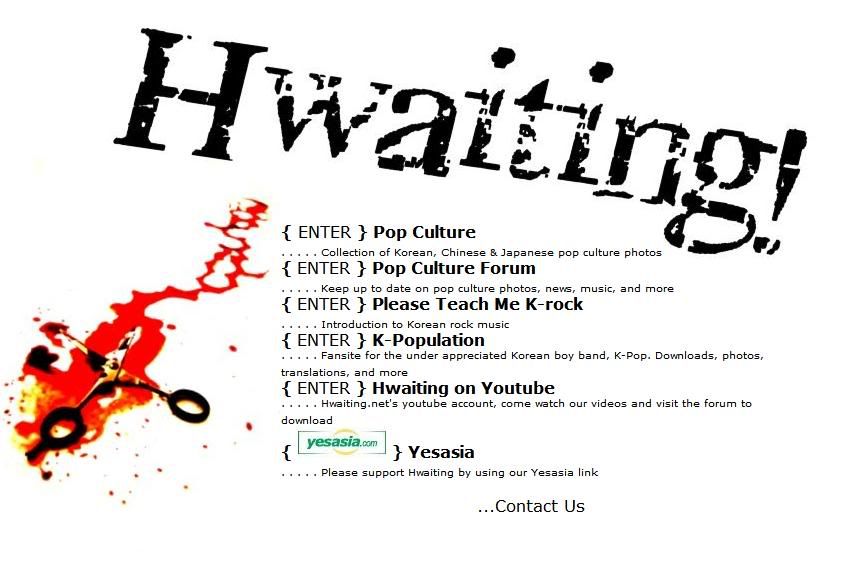
Here is the link to Hwaiting.net which Ive also put in my Korea link list. Go check it out. It's cool.

P.S. Go to The Marmot’s Hole and read the post and the comments to learn what “hwaiting” means and why that’s such a damn good website domain. (The link is above).

Read More...

Sphere: Related Content

Wednesday, August 30, 2006

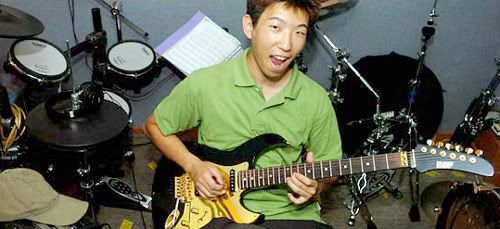
Youtube Neoclassical Guitarist Revealed

Okay, I've been updating and my latest John Mayer post constantly just because new stuff and new gossip keeps coming up. The new gossip is, nightmare inducing, but nonetheless hilarious.

However, it's taken my focus off of South Korea which is unfortunate because Westerners, the bulk of my audience it seems, really need to learn more about the rest of the world. Since I'm here, I'll try to help you out with South Korea and northeast Asia. While I can't promise that I won't update that John Mayer post any further, I will share a bit of information on a Korean musician who is making waves onYoutube.com.

I found this post on The Marmot's Hole: The Real Korean Wave Hits the Internet. For you who don't know what the "Korean Wave" or, 한류, hallyu. 한류 is a cultural phenomena that has swept through Asia. Due to the popularity of certain Korean movies and television shows there has been a huge increase in the interest in Korean pop culture in other Asian countries. That, of course, is good for Korea in many ways as it drives people to purchase Korean made merchandise, makes people want to visit the country and learn the language.

I've experienced the impact of 한류 first hand when I took a Korean language course at my university which was mostly made up of Japanese students. We lunched together frequently and on the last day they all HAD to go to a restaurant nearby that was featured in a Korean movie called 엽기적인 그녀(warning, the link has a spoiler) which although it literally means "My Bizarre Girl" I guess they figured "My Sassy Girl" would generate more interest in the English-speaking market.

I saw the movie and thought it was okay, but the Japanese and others in Asia loved it. That's probably because the cultures are similar in many ways. While I thought the female lead character was annoying, needed counseling and a stint at the Betty Ford Clinic, she was endearing to Korean and Asian audiences who aren't used to feisty female characters. Anyway, that's just to point out that Korean artists are making significant inroads to other cultures.

Which leads me to the linked video. It seems that Youtube has spawned a group of neoclassical musicians who upload their performances for the purpose of learning through feedback. There is one that was uploaded eight months ago which features a guitar virtuoso performing the complex Pachabel Canon. This quote from Web Guitar Wizard Revealed at Last published in the New York Times sums it up fairly well.

...the video drew hordes of seekers with diverse interests and attitudes. Guitar sites, MySpace pages and a Polish video site called Smog linked to it, and viewers thundered to YouTube to watch it. If individual viewings were shipped records, “guitar” would have gone gold almost instantly. Now, with nearly 7.35 million views — and a spot in the site’s 10 most-viewed videos of all time — funtwo’s performance would be platinum many times over. From the perch it’s occupied for months on YouTube's "most discussed" list, it generates a seemingly endless stream of praise (riveting, sick, better than Hendrix), exegesis, criticism, footnotes, skepticism, anger and awe.

The most basic comment is a question: Who is this guy?


Well, here he is: Mr. Jeong-hyun Lim

What I thought was interesting about the New York Times article was this passage.
That educational imperative is a big part of the“Canon Rock” phenomenon. When guitarists upload their renditions, they often ask that viewers be blunt: What are they doing wrong? How can they improve? When I asked Mr. Lim the reason he didn't show his face on his video, he wrote, “Main purpose of my recording is to hear the other’s suggestions about my playing.” He added, “I think play is more significant than appearance. Therefore I want the others to focus on my fingering and sound. Furthermore I know I'm not that handsome.”

Online guitar performances seem to carry a modesty clause, in the same way that hip-hop comes with a boast. Many of the guitarists, like Mr. Chang and Mr. Lim, exhibit a kind of anti-showmanship that seems distinctly Asian. They often praise other musicians, denigrate their own skills and talk about how much more they have to practice. Sometimes an element of flat-out abjection even enters into this act, as though the chief reason to play guitar is to be excoriated by others. As Mr. Lim said, “I am always thinking that I'm not that good player and must improve more than now.”
What interests me about it is the contrast in attitude. I recently participated in a thread on a forum where someone asked about lessons African immigrants could teach African-Americans. I jumped into the thread with the best of intentions saying that was a great idea. I then went on to suggest that we could also stand to learn from other cultures, especially Korean immigrants as the histories are similar. I also added that maybe we ought to acknowledge that African-Americans could stand to maybe step back, be humble and learn from others.

Well, you could have sworn I stepped out and called someone a bitch. I got a reply saying that Koreans aren't humble, they believe they're this or that. I actually thought that was interesting as I've lived here for over half a decade, so unless the person replying has similar experiences I highly doubt that she knows the cultural characteristics of Koreans. I don't claim to have a handle on all the intricacies of Korean culture but I do know that boasting and arrogance isn't seen much here except in select situations. It was bullheaded bitterness on a level I just couldn't handle.

With that said, Mr. Lim awesome job, and I hope that you learned a lot from posting your performance on the web.

Bravo!

Read More...

Sphere: Related Content

Monday, August 28, 2006

Older South Koreans Support the USA - ROK Alliance

I'm a few days behind on this story, but I have a good excuse which I won't share here as it's really doesn't matter. The issue is still brewing here in South Korea (Republic of Korea - ROK). Plus, as both work and school are starting for me next week, this won't be the last story that catches a bit of dust before I get to it.

However, I was clicking around looking for something to read and tripped over this story, S. Koreans Rally in Support Of Alliance, on the Washington Post website. It reports that on August 11th protested gathered at 서울 역, Seoul Station, to protest the pending transfer of military wartime command from the USA to South Korea.

Thousands of South Koreans, including former defense ministers wearing their old military uniforms, rallied Friday in Seoul demanding that the president halt moves to retake wartime command of the country's military from the United States.

"Stop the plot to destroy the Korea-U.S. alliance!" protesters chanted during a rally in front of the city's central train station.

Over their heads flew balloons strung with placards bearing the images of the South Korean and U.S. flags side-by-side.
What's interesting to me is the article pointed out that there is a generational divide here in Korea on this issue. Older Koreans who saw the destruction and division of their country first-hand tend to oppose the push to lessen the US involvement in South Korea. In contrast, younger Koreans, who don't have any memory of the Korean War, tend to support less involvement from the US. It's spearheaded by the 386ers which is short-hand for a generation that is pretty darn impressive.
... clever shorthand for what is the essence of this group. The 3 stands for their age--these people are still in their late 30s (or, at most, early 40s)--absurdly young in a Confucian society to be reaching for power and influence. The 8 is for the 1980s, the tumultuous period when they attended university and the country shifted from dictatorship to democracy. And the 6 is for the 1960s, when they were born--the era when their parents were toiling ceaselessly to industrialize their war-shattered nation.
...

These 386ers are the ones who faced down Korea's military rulers, did hard time in prison for student and labor activism, and fought deep-seated corruption in the country's executive suites and government offices. They're at the vanguard of the country's surprising surge of anti-Americanism, and they insist on a new tone of tolerance in the debate on North Korea. And they have created the most energetic corporate governance movement in Asia. (from Korea's Young Lions on the BusinessWeek.com website)
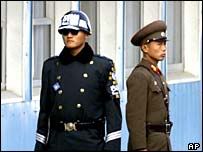
As it stands now the US - South Korea alliance is one where the US is in a tripwire situation. Due to the placement of US troops at 판문점, Panmunjeom, if anything were to happen on the US would immediately be drawn into the conflict. As a US citizen, I'm not really comfortable with that. However, first, I realize that has been the set-up since before I was born. I also realize, most importantly, that it's like that because it's a key deterrent to the North initiating anything along the Demilitarized Zone, DMZ.

If the North started an offensive, not only would South Korean troops be immediately mobilized, but so would US troops. All of the US's firepower on the peninsula and as well as the ones stationed in Japan and in other regions in Asia.

It's just ironic in a culture and society that supposedly looks to it's elders for direction and guidance is, in this case, blantantly igonring what the older generation has to say.
Among those speaking publicly against the plan have been many of the country's former defense ministers, who argue that the command transfer is premature and would unravel the country's alliance with Washington and undercut deterrence against North Korea. (from S. Koreans Rally in Support Of Alliance)
Ultimately, it's an issue the South Korean people will sort out. Good for them that they've built working a democracy that allows them to do it.

Read More...

Sphere: Related Content

Saturday, August 26, 2006

Pack of Wolves Update: My Pen is Like New!

For those of you who tuned in a couple of weeks ago, you know I got quite upset when some ill-mannered cow busted my fountain pen.

I bought a new one and sent the old one in for a repair.

I got it back a few days ago and then took myself on a department store run in Shinsaegae Department Store. I know, bad, but I'd just been traumatized by the dumbest phone call in history. Shopping IS therapy.

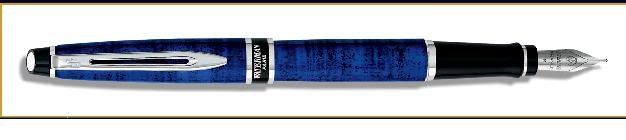
Anyway, here it is, and it's just like new! It cost me a mere 27,000 won (around $25 USD) to get the nib replaced. I love my Waterman fountain pens.

It's a quirk. Deal with it.

The thing that was cool was I learned a new term this week.

I was talking to a Korean friend of mine and he asked me what the pen I was using is called in English. I told him that we call them fountain pens. This took a bit of clarification because he knows I use cartridges, so that whole bottle of ink and suction thing is lost. Anyway, once that was explained he told me that in Korean fountain pens are called 만년필, man nyon pen. "Man", 만, in Korean (from Chinese, btw) is 10,000 and, 년, "nyon" means year.

So it's literally "10,000 year pen." That makes sense because it means long living or long-lasting pen because you don't toss them when they're out of ink; you just add more ink.

Nice, eh?

Read More...

Sphere: Related Content