Rodney Johnson on Background Checks of Employees in Asia
Regular readers know that I posted a few things about the academic fakery that goes on as well as recorded a podcast with Mike over at The Metropolitician on the subject: Podcast 31 - Academic Fakery. Just click on the "education" tag to find them.
I went to the McKinnney Consulting website to read some articles on Korean culture by Professor Horrace Underwood when I decided to click around and see what else was there.
Lucky me. I found an article which tells companies outright that they MUST take the steps to verify a candidate's credentials. Now this is geared to foreign companies looking to do business in Asia. However, with all the stories of people who've been caught lying about their degrees, it's something that Korean employers must do too.
The Importance of Background Checks by Rodney JohnsonAsia is constantly at war with fraud and fakes. From fake pharmaceuticals to fake purses, to food that was not meant for human consumption, counterfeit items and fraudulent claims flood the market and threaten to do serious damage to the legitimate businesses that both sell the real items and buy the fakes.
But fakes are not limited to just physical goods. The marketplace for labor is also infested with fakes - fake people. Job seekers, not limited to any job title, industry, or level, routinely falsify their resumes, and credentials. The high degree of fake resumes and fake claims of education and ability have led to countermeasures, in Asia and elsewhere, designed to lower the risks to employers.
Many Asian countries put a high value on learning that has been verified by some sort of standard, certification, or award. Certifications act as a form of verification or proof of the verity of any claimed skill or ability. As such, Asian employees are required to earn certifications and titles or various sorts in order to secure employment and advancement.
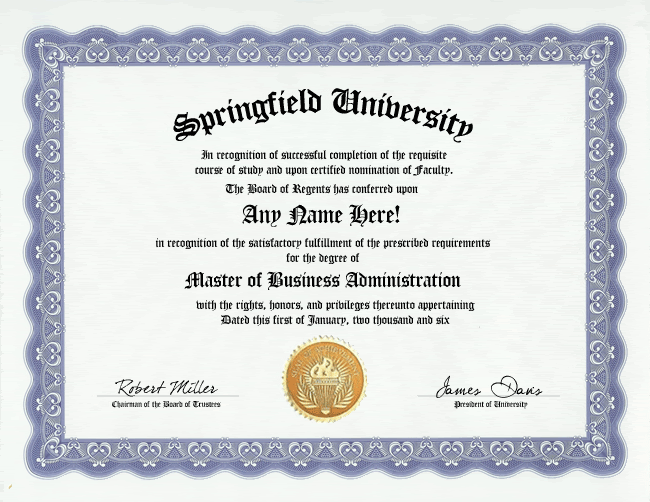
However, using certification as a countermeasure against fakes is only half the battle, and going only as far as requiring certification documents has created a situation where fraudulent claims are even easier to get away with. A fake TOEFL or TOEIC score is now attainable for a few hundred thousand won and a few days wait. The price may be high, but compared to the years of study that might be necessary to reach the higher score through legitimate means, it is a bargain. For a few million won, a fake certificate of graduation from virtually any foreign school one wishes can be produced, along with a fake transcript - though it is not likely to be needed.
The missing half of the battle is having the will to find out if the claimed credentials are, in fact, held. The reason job seekers feel free to cheat, is because they believe, with some justification, that no one will ever attempt to verify their claims. The risk/reward profile of this situation creates a strong incentive to obtain fake credentials – the job seeker has everything to gain and nothing to lose. The current situation has created an environment where it does indeed make sense to cheat.
While evaluating true ability and skills of an applicant through a resume is difficult, finding out whether the certifications and degrees an applicant claims are, in fact, real, is much easier. All that is required is the will and ability to check. The cost/benefit ratio for employers to check the backgrounds of their potential employees in Asia is very good - for the cost of a background check great risk may be averted. While checking references, and educational background, one may find out that a potential employee has a criminal record, or was fired from a previous job in the same industry for a problem that could be especially expensive if repeated in your organization.
Ask those who provide your personnel what kind of background checks they perform. Ensure they are doing all they can to weed out fake credentials and false claims on resumes. Finally, if you can't get the answers you need to feel satisfied that your workforce is the one you think you've got seek outside help.
Background checks are inexpensive and relatively painless compared to the potential problems they can help avoid. In the end, it could be the unseen lurking problems which undo all your hard work – problems that could have been avoided with a little attention paid to the personnel who handle your precious money, brand, and customers.
Johnson sums up what I've been saying all along: it's NOT difficult to check. Those that claim that's the case really need to find a new excuse. The effort required is usually a phone call, email or letter. That's not hard at all.