Showing posts with label economics. Show all posts

Tuesday, December 16, 2008

What's Wrong With This Picture?
Let me say this very clearly. I don't care that much about the Madoff financial scandal that is filling the headlines.

I do care that many non-profits that invested with Madoff can't fund some great causes because the income from this Ponzi scheme is now gone. I do care that people that invested with him have lost their income streams. I do care that some of these people will be forced to put their homes on the market in what is nothing less than a crap economy.

However, what bothers me is how the SEC and others just didn't pick up on something being terribly wrong. Yes, there were investigations, but they didn't keep digging and analyzing when they couldn't figure it out. The SEC has admitted they dropped the ball on this one.

So some experts knew *something* was wrong but couldn't put their finger on it. Granted hindsight is 20/20 but this quote is from someone who advised his clients to not invest:

Jake Walthour, a principal at the hedge fund consulting firm Aksia LLC, said his firm was hired to investigate Madoff's business dealings by a potential investor several years ago.

The probe raised several red flags, he said. Madoff's returns were "abnormally smooth" from month to month and had none of the volatility usually associated with stock investments. It seemed impossible to replicate his investment strategy or verify his track record.

Madoff claimed to be moving as much as $13 billion in and out of the market every month but "no one on the street could verify it or even see his footprints," Walthour said. "That organization was incredibly secretive."

He only issued simple paper reports to investors, not detailed electronic data streams that indicate how those investments are doing. There were few if any outsiders involved in his business. His auditor was a tiny accounting firm in Rockland County that no one had ever heard of before.

"We decided there are several scenarios here, one of which is, this could be a Ponzi scheme," Walthour said. "None of our clients invested."
The problem is a lot of people did invest.

Another interesting insight:
"There's no Duke Endowment [among the list of Madoff investors]," Hedges says. "There's no Harvard management, there's no Yale, there's no Penn, there's no Weyerhauser, no State of Texas or Virginia Retirement system."

The reason is simple, in Hedges' view. Letting Madoff manage your money "wouldn't pass an institutional-quality due diligence process," he says. "Because when you get to page two of your 30-page due diligence questionnaire, you've already tripped eight alarms and said 'I'm out of here.' " In short, in Hedges' opinion, any sophisticated entity that actually did its homework would have seen the warning signs.
What's that saying that everyone is told not to ignore? "If it's too good to be true then it probably is." This was too good to be true, and people allowed themselves to be taken.

Madoff had a reputation as a Wall Street "insider". He was playing a big PR game. You couldn't just get into the fund; you had to be invited. So there was that cachet of both wealth and exclusivity.

What a great scam! He tapped into people's lowest common drives and pimped his reputation as an insider (he also "helped" the SEC with tips on investigating scams.) It appealed to the lowest of human drives. It invokes at least one, if not more of the Cardinal sins: greed and, for sure, some vanity too.

Consistently higher than normal returns that never react to the market? Yeah...whatever. You chumps.

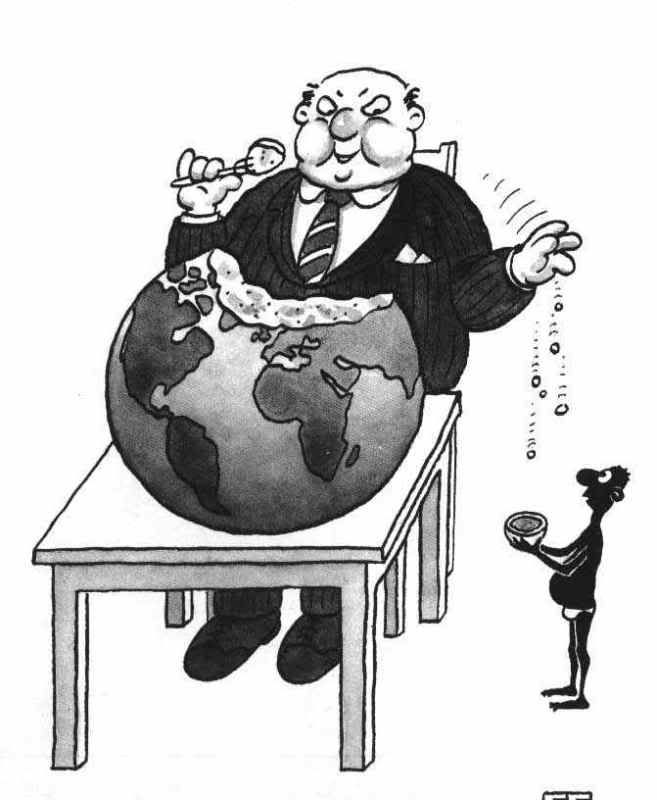
What bothers me is this. This whole trickle down economics bull crap. When things were going well, there wasn't much trickling anywhere. Except for the charities and non-profits, these people were taking this money for themselves. This money wasn't trickling anywhere except into their bank accounts. The only thing that was trickling down was credit too easily granted. The assets, the wealth, the real property all accrued to people who now might get less return on their investments, but, most likely, they're going to keep their homes, their wealth (in comparison to others) and their income stream. That is if they chose spread their investments to hedge against risk. If they invested exclusively with Madoff, they're in a world of financial hurt right now too. I've not lost my sympathy. However, the more I hear about this scam the more it seems that those who were caught by it simply chose not to get some basic answers.

But that's the problem...the hurt. This hurt is what has trickled down. Now that the fall out is negative it's trickle down economics on a massive and worldwide scale! People are loosing their jobs. They're loosing their homes. And, unfortunate et cetera after unfortunate et cetera.

Personally, for now, I'm okay but it's weighing heavy on my thoughts. Do I want to leave Korea now and enter a shrinking job market back home? On the flip side, do I want to stay here and be subject to the swings of the exchange rate? In the long-term I do think things will balance out. However, when I've got to make a firm decision in maybe another week or two, I'm going to have to go with my gut or just flip a coin.

I'm quite upset that the US Congress approved $700 billion to bail Wall Street. But the Senate chose to risk that the auto industry just might fail. Both have been bailed out before, but they make it seem like the auto industry is just the most horrible thing to try to save. Now the Bush can elect to use some of that money to help the auto industry, but the fact that the Congress didn't work overtime to agree to something is just ridiculous. The bankers are doing great. The workers, not so much. The fact that the news is barely commenting on the auto industry now and run this Madoff story every damn hour is also just infuriating.

I don't care that greedy people were invited into an exclusive club and then got ripped off.

Huffington Post: Time to Blame Our Own Greed For the Madoff Mess

Read More...

Sphere: Related Content

Tuesday, April 8, 2008

A Recession in Plastic Surgery...Yeah!

Slate has a good article, Tuck Off by William Saletan, about how the economic crisis back home is causing a recession in elective plastic surgery. Like me, Saletan is elated to hear this news.

I've had my say on plastic surgery and it's not something that interests me much simply beyond how patently dishonest it is yet how damn popular it is. Basically, my respect for my fellow humans is diminished because how can plastic ever be more beautiful than real? People get work done, it's obvious a lot of the time and other people don't care because in the most common sense of the word those people look "good". I still very much think if everyone has the same features that's not very good looking at all. There is one area of the city here where you can see woman after woman pass you with the same set rounded eyes on their otherwise Asian faces. That's just creepy. But okay, I'm just too critical for my own good in this respect.

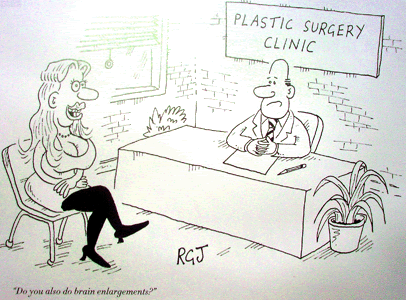
More people need brain enlargements than enlargements of anything else...too bad that can't be done. ;-)

However, what is nice is that the doctors who are hurting for cash are turning back to help people who really need it.
More effectively than any bioethicist, the recession is reminding people that cosmetic work isn't medicine. "While healthcare spending as a whole has traditionally moved independently of the economy—a safe haven—that really isn't the case with plastic surgery," a financial analyst tells the Times. In the new, sobered economy, the paper reports, some cosmetic doctors are diversifying into "reconstructive surgery for cancer patients and others that is covered by insurance." Insurance!

Say what you will about coverage-denying bean counters, but they do enforce the essential priority of urgent procedures over elective ones. In a health-care industry controlled by tight budgets and insurers, you might even see the cream of the med-school crop shift back to the kind of work that keeps people alive. I hope they're well-paid for it, and I hope the next rising tide lifts millions more families into the ranks of the insured. But let's never forget what the bad times taught us about what matters and what doesn't.
That's good to hear. Good there is a silver lining to this economic slump.

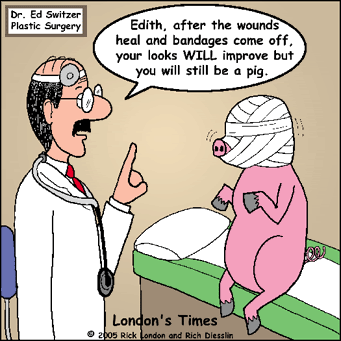
*Images stolen from Plastic Surgery Humour ;-)

Read More...

Sphere: Related Content

Saturday, July 29, 2006

Who Controls the American Media?

You know what? I’m really sick and tired of pundits from both sides firing off about how the media is controlled by the other side.

I realize that due to consolidation there are a few big companies that control a lot of the news agencies. Also, I do think there is a liberal bias in the mainstream media simply because being well-read and well-educated usually makes you more left leaning than not.

However, we know there are many well-educated folks on the right too as well as in between. I consider myself to be snugly situated somewhere in the middle as I have libertarian tendencies on some issues. I’ll also acknowledge that there is a conservative bias in certain other sections of society.

So what?

The fact is there are liberal media outlets like Mother Jones, and, I would even say, the New York Times, considering how much the Bush administration hates them. However, there are also conservative outlets like Fox News and the National Review.

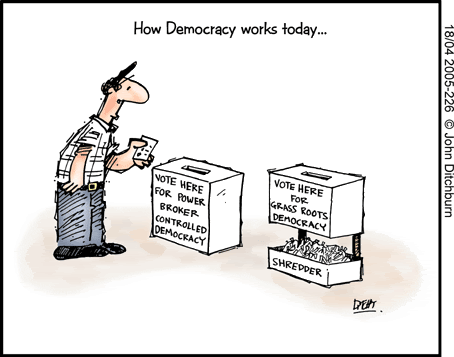
In Paul Krugman’s most recent op-ed piece in the New York Times titled Reign of Error, he goes after what he claims is the Bush administration’s attempt to misinform the public. I agree with him, but I disagree with who is at fault. I’ve linked to the full text at Rozius’ blog, as again, this is a Times Select piece. (BTW, there is a funny cartoon starting off this post, so I suggest you look just to get a laugh).

Krugman starts off by saying this:

Amid everything else that's going wrong in the world, here's one more piece of depressing news: a few days ago the Harris Poll reported that 50 percent of Americans now believe that Iraq had weapons of mass destruction when we invaded, up from 36 percent in February 2005. Meanwhile, 64 percent still believe that Saddam had strong links with Al Qaeda.

At one level, this shouldn't be all that surprising. The people now running America never accept inconvenient truths. Long after facts they don't like have been established, whether it's the absence of any wrongdoing by the Clintons in the Whitewater affair or the absence of W.M.D. in Iraq, the propaganda machine that supports the current administration is still at work, seeking to flush those facts down the memory hole.

I agree with him because I don’t believe there were ever security threatening WMDs in Iraq nor do I believe that Hussein had an alliance with Osama bin Laden and Al Qaeda. Of course, the conservative pundits have come out to chastise Krugman’s piece and also liberals have come out to support him. Just click on the link as I ran a search for “Reign of Error” on Technorati.com and found quite a few links.

However, I differ with him by assigning blame to the “propaganda machine”.

Read some treatises on democracy and you know the onus is on the electorate to stay informed, stay active and keep their politicians as honest as possible. As voters it’s our responsibility to realize that those in power and those who want to be in power just might massage a story so that it reads more in their favor than not. In fact, they might do more than massage a story they might lie outright. Should they be truthful at all times? Yes, but would they be successful in politics as they are now? Probably not.

As voters we need to make ourselves as informed as possible to actually elevate the level of discussion. Now all we get are soundbites, watered down statements, and smear TV ads during elections. We get that because, unfortunately, that’s what the ill-informed American voter responds to.

We’re responsible for this dismal situation.

I’m not sure exactly when it happened as it’s been gradual, but the current political climate is one where you’re left or right, liberal or conservative or red or blue. It’s just stupid and divisive.

People need to get smart and realize that slapping a label on themselves and every view out there throws a bias in the way of having reasoned and effective debates. Read the articles published by both sides, watch Fox News as well as listen to NPR radio. In this day and age we really must become and stay informed. The level of debate in most areas of the American electorate is rudimentary at best. However, these are the debates that rule our policies. We must seek out and demand accurate information in order to reverse the tide in our political system.

Who controls the media? Ultimately, we do, but we're doing a piss poor job of it.

Read More...

Sphere: Related Content

Tuesday, July 25, 2006

Left Behind Economics: I'm Glad Someone Else Has Noticed

A friend of mine sent me "Left Behind Economics" which is a commentary by Paul Krugman. It was published on June 14th in the New York Times, but you have to be a subscriber to access the article on the NYTimes website. Since I'm a student I can access it online through my university's library website. However, the one thing I'm good at is research. I can find just about anything quickly and, usually, for free. I found it for your reading pleasure on another blog called the Economist's View, so here it is.

The title is a play on the concept of trickle down economics which holds that "...to benefit the wealthy is to benefit the middle classes and even the poor."
Essentially, the rich folks and business owners will stimulate the economy and this would yield benefits that would trickle down to people with less money and assets.

First, let me say that I know I’m not an economist. My insights are ancedotal at best. I'm essentially a fledgling political philosopher. My philosophy definitely has a basis in Thomas Hobbes belief that life is "solitary, poor, nasty, brutish and short." However, there are many schools of thought that have progressed past Hobbes’ Leviathan. Currently, I’m captivated by Hedley Bull and the English School but seem to be stepping tentatively into social constructivism. What that means is while I think humans are capable of looking out for their fellow man that, most of the time, they’re looking out for number one.

However, even those not as well trained in economic theory have an opinion or two on the economy. Now I agree that in an ideal world where the better off were actually putting trickle down economics into action that it very well might work. However, those of us who are in the middle or lower classes know that nothing much seems to be trickling down to us. That's exactly what is happening right now because the current US government could care less about passing laws to help start that trickle.

Krugman essentially says the same thing.

I'd like to say that there's a real dialogue taking place about the state of the U.S. economy, but the discussion leaves a lot to be desired. In general, the conversation sounds like this:

Bush supporter: ''Why doesn't President Bush get credit for a great economy? I blame liberal media bias.''

Informed economist: ''But it's not a great economy for most Americans. Many families are actually losing ground, and only a very few affluent people are doing really well.''

Bush supporter: ''Why doesn't President Bush get credit for a great economy? I blame liberal media bias.''

To a large extent, this dialogue of the deaf reflects Upton Sinclair's principle: it's difficult to get a man to understand something when his salary depends on his not understanding it. But there's also an element of genuine incredulity. Many observers, even if they acknowledge the growing concentration of income in the hands of the few, find it hard to believe that this concentration could be proceeding so rapidly as to deny most Americans any gains from economic growth.

Yet newly available data show that that's exactly what happened in 2004.

Edward Lazear believes that economic inequities arise between those with a lot of education and those without it. I think I and a whole host of highly educated people would beg to differ. Good for us, statistics have just come out to back this up as census data shows that the earnings of college graduates actually fell in 2004.

Two economists, Thomas Piketty and Emmanuel Saez, have shown that in 2004 the richest 1 percent of Americans experienced an income increase of 12.5 percent. The other 99 percent’s average income rose only 1.5 percent. Now I’m sure that those of us in that 99 already know this.

Most of the people I went to school with are in the middle to upper middle class; I'm not, but they are. Usually, that’s not a bad place to be. However, the article points out that even the upper middle class or “people richer than 19 out of 20 Americans gained only modestly.” The fact is these economic benefits aren’t trickling down to anyone. Instead, they’re pooling around the feet of those who already have the most.

The next time a friend is going on and on about how there media isn’t talking about this vibrant US economy, you might want to bring up that most you know haven’t seen much of that vibrancy in their own finances. I think Krugman sums it up well.

In short, it’s a great economy if you’re a high-level corporate executive or someone who owns a lot of stock. For most other Americans, economic growth is a spectator sport.

Read More...

Sphere: Related Content