Showing posts with label race. Show all posts

Wednesday, October 17, 2012

Diva Is Code For Bitch - HuffPost Live

Indeed my SEO is strong. (Thanks to Stuart Tracte, a dear friend, for that wonderful quote which totally applies here.)

The HuffPost Live folks found an old blog post of mine from 2006 where I commented at length on the negative stereotypes that come at you when you're a black woman: "I Got a Woman" - Black Women and Negative Stereotypes.

I, along with true blue experts, discussed the implications of the current "feud" between Mariah Carey and Nicki Minjai on the HuffPost Live site today: Diva Is Code For Bitch.

My opinion?  Yes, they're fighting for real BUT the producers knew there was tension and they intentionally let it escalate.  It's not unheard of that shows do this to get press mentions and, hopefully, increase their ratings.

The deeper implications, however, is the dehumanization of black women.  As I wrote in 2006, we're always cast in this role.  That's why there have been many times I've been justifiably mad but I've held back.  Why?  Because black women get mad at every little thing, right?  We're horrible to deal with and will pop off at the slightest provocation, right?  Well, wrong, but with that being the perception it's something you keep in mind when you are upset.  I don't let it silence me to the point that I don't stand up for myself, but the blow back I get is way more intense than what women of other races get.  (Maybe one exception would be the fiery Latina stereotype and how that impacts Latinas.) 

As I brought up during the discussion, you've got tons of examples of women of all races feuding.  Shows like Mob Wives has an all white cast as do some of the Real Housewives shows.  You don't see anyone generalizing from those shows that all white women are argumentative bitches.

Anyway, you can check out the segment below or here at the link.  Enjoy and let's hope my SEO continues to be strong for years to come.


Read More...

Sphere: Related Content

Thursday, July 5, 2012

Stating the obvious: it's demographics you fucktard

Dave Chappelle taken by Travis Jensen
I'm inspired to actually write something today! Yeah!!!

Dave Chappelle is one of my favorite comics. Like seriously, I loved his show, but also understood why enough was enough for him. I've not even folded and watched the "lost" episodes.

Imagine how thrilled I was when I got an email from The Independent on Monday saying that he'd announced two shows for Tuesday night in San Francisco!???

I was thrilled. I also knew the shows would sell out ridiculously fast, so at 2pm I was ready to go. Annnnnnnnnnnnnnnnnnnnnnd...at 2pm other fans and ticket scalpers had gobbled up a big chunk of tickets. What's good about the Ticketfly site is they don't make it too hard to try again AND they encourage you to try again because those carts might empty. That's so much better than Ticketmaster where every single time you want to try again, you also have to reenter a captcha to get through.  It's just hell.  Anyway, sure enough around 20 minutes after 2pm, my luck turned and I got a ticket. I was in!!!

I'll do a quick review: he rocks!  Okay, not enough detail? In all seriousness, his set was totally unscripted. He's a bad closer and said so himself, so it was a few extra minutes watching someone who is a comic genius just flow. For me, it was worth it because you can pay to go to a comedy show with people who are way more prepared but aren't half as good.

The only bad point of the show, which had nothing to do with Chappelle, was some brilliant drunk f$%ker who stopped when he walked past me to point out that I was black, "wow, there is a black person in the audience!" He did this as if I'd not noticed that I was one out of a crowd of people who were mostly anything but black.

I love people who point out the obvious, BTW.
For me, that's a demographic and economic divide. Most black people that I know, including working and educated blacks like myself, are not online at 2pm in the afternoon. I am by nature of what I do. Also, even if we're plugged in we're not that good about checking emails regularly. I know a lot of people who check email once or twice a day. It's still not really that cool to be an Internet geek if you're black. That's changing fast though, and I'm in VERY good company.

I check my email when the number changes. I work with a few tabs open and I can see when I get a new message. Unless I'm busy with work or, let me be honest, even if I'm busy with work, I'll stop for a moment to check the message.

Another point is if you're not a working professional you probably can't just drop $55 plus fees to head to a last minute show. Plus, once the scalpers got their hands on tickets I heard they were going for $200 plus. I really wonder how well they did considering they had just 24 hours to sell those tickets?

So to the dumb guy who pointed out my race, um, yeah and...?

It was nice to be able to do one of these and just tell him to move on.

Read More...

Sphere: Related Content

Wednesday, August 11, 2010

OMG Slate, really? (Not racist but not well thought out either)

Tonight, like most other nights, I was unwinding and goofing off on sites like Twitter and Facebook. Not really a surprise as that's how I make my living now and there are tons of articles and information that rolls across my screen pretty much 24/7.

I follow Emily Bazelon because she's one of the regulars on the Slate Political Gabfest. Emily sent out a retweet (RT). (A RT is just a message that someone decides to repeat to the people who follow them.) 

RT @fmanjoo: How black people use Twitter. My @Slate piece on the latest research on race and microblogging. http://bit.ly/ciIkKw

I've read Slate for years at this point. I know who Farhad Manjaoo is. Also, the title was enticing enough for me to click over. Honestly, I knew it was going to touch upon the hashtags that get really popular in black circles on Twitter. However, this is assumed because Twitter doesn't compile demographic info. Honestly, just because someone puts up a picture of a black person as their Twitter picture, can you really be sure? No.  But I really don't doubt the data that there are a lot of blacks who use Twitter.  On some level, we're having fun with it.

The first thing I see is this image:

from Slate.com
OMFG! Um, okay...what?!!!

In almost all of the articles I read that have a depiction of a Twitter bird, the bird is blue.  However, this article is about black folks, so the bird had to be brown and had to have a baseball cap, right?

I'm not claiming it's racist.  

I'm claiming that it's insensitive and short-sighted.  I do wonder if it wasn't, on some level, intentional.  I mean now a lot more people are clicking over to see what the commotion is all about. They're also linking back to the article. That's good in this brave new Internet world.

I decided to send an @ reply to Farhad.  I was pleasantly surprised that he responded and seem to take a sincere interest in why I was not pleased with the image accompanying his post.

For the sake of completeness, let me post the tweets here in chronological order (as best as I can put them together at 2-something am). His stream is here and mine is on the side if you want to click over and scroll through both pages.
(These first three are in rapid succession.)

Me:

RT @fmanjoo: How black people use Twitter. My @Slate piece on the latest research on race and microblogging. http://bit.ly/ciIkKw

@fmanjoo brown bird and baseball cap? Dude, really? I guess a study focusing on whites will have, oh, wait...they get diverse images.

@fmanjoo Good article though. ;) 

(I didn't want to be too hard, so I balanced the criticism with a compliment. I'd read the article. I know this happens on Twitter. I know it's social scientists doing what they do, so okay. Another social scientist will have a theory on it and have his or her stacks of evidence and analysis to justify their conclusion(s) too. 
The author wrote about it. In the article he acknowledged that this wasn't a complete picture of black activity on Twitter and, for that, I say good job.  I have no interest in broadening my frustration with the image a critique of his writing.  That crosses to bitching because you just want to keep bitching.  It's the image I've got issues with.)

Farhad: 

@ReginaWalton Glad you liked the article. But can you tell me what bothered you about the image? I thought it told the story well.

(Okay, here it goes.)

Me:

@fmanjoo Just wondering if the piece was on NE Asian Twitter users if a yellow bird w/ slanted eyes and a China chop would be on the page?

(I'd already brought up the question of what image would have been used had the topic been about whites and their use of Twitter. If a bird image was chosen, it would have been the standard blue variations that are so common. I'd bet you hard money on it. 
So, okay, let's broaden it to another ethnic group: NE Asians.  Hell, I lived in South Korea for eight years, I think that's a demographic that I can inquire about, right?)

Farhad: 

@ReginaWalton It's tough to depict these topics in a way that doesn't offend everyone and is interesting and aesthetically pleasing.  


(I'm unresponsive and determined to bring this point home.)

Farhad:

@ReginaWalton I understand your criticism, but I wonder what drawing wouldn't be offensive for such a story. 

Me:

@fmanjoo It's the need to put an image that is racially distinct & draws on stereotypes that's irksome. Whites wouldn't get anything similar

Farhad:

@ReginaWalton I see what you're saying. I don't know how we'd have handled it had the story been about another race, but I see your point.

Me:

@fmanjoo i do understand that you can't please them all but it was the first thing I noticed after I clicked over to read it.


@fmanjoo We're sensitive about images depicting us. (Sometimes maybe too much). This seems to happen when the story is about black people.

  
@fmanjoo Thanks for asking me to flesh out my thoughts.

(Then it occurs to me! The perfect image to use? A composite image with a bunch of Twitter photos.  That's easy enough to throw together.  I have it on my Twitter page right now from Twilk.com.  The real photos of the real people who are in this demographic, I think, would have been fair.) 


@fmanjoo oh a suggestion for an image that might have made the cut? A composite image like the one that's my Twitter page background. 

That's where it ended but for sharing a link with him.  However, I think it points to a larger problem.  The lack of black staff at these media companies.  Now, now...I KNOW Slate.com has The Root.  I also know I asked Slate's editor, David Plotz, about why there were rarely any black commentators on Slate's Political Gabfest when they had a live Gabfest here in NYC.  I really do think that Slate.com's staff is well-intentioned and did NOT mean to ruffle anyone's feathers.  

However, the fact is the image did.  I disagree with Farhad's assertion that any image would have gotten push back. (I do think you can't please them all, but that was the case way before the Internet.)  This image was based on a certain image from black American culture.  It's real.  I can walk out of my apartment right now and probably find a young black man with a baseball cap on somewhere in NYC.  

My point is, however, I can also walk out and find a black man in uniform coming home from work.  I can find a black man in a suit leaving a law firm office after putting in a hard day's work.   It reminds me of my father who'd work six days a week at a blue collar dock job and was almost always putting in overtime.  (He gave my mom the checks, trust me, he was clocking some serious overtime.) The image also cuts black women out. I know a lot of women participate in these discussions on Twitter because I'm connected to a couple of women who are always in the hashtag fray when it heats up.  I do sometimes poke my head in when the hashtags heat up and click on it to see who is saying what.  Women are well represented.  (Also, yes, I know women wear baseball caps too but a girl bird would have had long lashes or something indicate it was female.)

It just feels like a lack of awareness of the people who put this together.  Also, with there being very few blacks on staff, I don't think anyone black saw it or, if someone black did see, it they chose to not say anything. (However, I'd hope the environment at Slate is a bit more productive than that.) 

This is laced with a bit of frustration. Honestly, one of my best friends just got an awesome job.  He's also a blond-haired and blue-eyed white male.  I'm ecstatic for him. However, in contrast, I've been back in the States for over a year.  I've gotten a few job interviews, but I support myself now strictly with my freelancing.  

That's great on some level, but I'm still very much underemployed and off of the grid.  That's scary.  It's also really frustrating because I've got the education, the skills and the experience.  It makes me wonder how things would be different if I were a blond-haired and blue-eyed white female. Seeing articles like this doesn't help my perspective either: 1 in Every 4 Blacks is Underemployed, More Black Women Jobless.  It's frustrating because with all I've done, let me get on the subway and you can feel the judgment based on nothing more than me being black, casually dressed and usually having an afro.  

It also reminds me of the much more embarrassing kerfuffle with the release of a book called Love and Consequences in 2008.  Basically, a white woman lied.  She said she was half native American and that she was raised by a black foster family in the neighborhood where I grew up: South Central L.A.  This got her a book contract and enviable media attention just before the book was about to be released.  This set off alarm bells as soon as I heard the premise.  It's hard enough for white couples to adopt black babies. There is no way in hell the system is going to put a white child in the care of a low-income black family in a troubled neighborhood.  No way. I really believe had there been ANY black staff in the decision ranks they would have said as much.

Is it fair to apply that line of thought to this scenario? Maybe. Maybe not. Farhad isn't white.  However, he's also not black. I'm not saying that he can't understand, but I am saying if it was his choice to use that image, he's got to learn.  I had to learn about and understand the particular frustrations my Korean friends have regarding race, so I don't expect anyone who isn't black to know them right off. It's the same with any group, even whites.  Trust me, I've had white friends talk about their perspectives on race and theirs are valuable too.  The issue is the power structure. Which I won't get into as I've written enough.

The problem is usually no one wants to listen when the topic of race comes up because now it is about power.  It takes having an interest, having a dialogue, shutting off the excuses and actually listening versus merely having the dialogue to automatically dismiss what the other person is saying. (On that note this older post: Brilliant: Derailing for Dummies.)  I'm glad Farhad asked.  I'm glad we had a dialogue.  I hope he listened and truly understood my point.

Now it's time for bed.  It's way past my bedtime.

Here is a great blog from the instant vintage blog: ...oh, slate...(Side-Eye).  She's changed the image in question to represent a range of blacks and she'll be adding more.  I've adopted the one with the mortar board for obvious reasons. 


The Black Snob weighs in on the topic here.
 

Read More...

Sphere: Related Content

Saturday, March 27, 2010

Brilliant: Derailing for Dummies


Why, why, why didn't I ever find this when I was swimming in a sea of privileged, smug yet disarmingly bitter expatriates in South Korea?

This is brilliant.  Now, I won't ruin it by giving you too much information.  Plus, it's 12:25am on a Saturday morning, that is, Friday night.  I'm busy.  I'm working.  However, as is many in the USA right now, I'm still a bit too pressed for funds to be out and about wasting my money.

It's pretty funny when it happens to me because the person doing the derailing usually sees me as yet another race card playing whiner.  I say that because never do these conversations come up with long-time friends who know me and my background well.  They know that 1) I'm very much more on the pull yourself up by your bootstraps and forge ahead sort of person and 2) I'm more middle of the road to conservative than not on a few issues.  It's social issues where I'm a card carrying liberal.  Also, my experience speaks to someone who forges ahead in spite of statistics and norms.  If I wasn't, I wouldn't have done half of the stuff I've managed to do so far.  I'd be too busy whining about how the world was racist.  It IS racist in many respects, but I'm going to go on about my business in spite of the dummies out there.

Speaking of dummies...

The name of the site: Derailing for Dummies.

The topic: a guide for privileged people to derail and marginalize the experiences and observations of minorities. (Yes, it's sarcasm.)

It's great!

Here is the intro, but click over for more.
You know how it is. You’re enjoying yourself, kicking back and relaxing at the pub or maybe at the library; or maybe you’re in class or just casually surfing the internet, indulging in a little conversation. The topic of the conversation is about a pertinent contemporary issue, probably something to do with a group of people who fall outside your realm of experience and identity. They’re also probably fairly heavily discriminated against - or so they claim.

The thing is, you’re having a good time, sharing your knowledge about these people and their issues. This knowledge is incontrovertible - it’s been backed up in media representation, books, research and lots and lots of historical events, also your own unassailable sense of being right.

Yet all of a sudden something happens to put a dampener on your sharing of your enviable intellect and incomparable capacity to fully perceive and understand All Things. It’s someone who belongs to the group of people you’re discussing and they’re Not Very Happy with you. Apparently, they claim, you’ve got it all wrong and they’re offended about that. They might be a person of colour, or a queer person. Maybe they’re a woman, or a person with disability. They could even be a trans person or a sex worker. The point is they’re trying to tell you they know better than you about their issues and you know that’s just plain wrong. How could you be wrong?

Don’t worry though! There IS something you can do to nip this potentially awkward and embarrassing situation in the bud. By simply derailing the conversation, dismissing their opinion as false and ridiculing their experience you can be sure that they continue to be marginalised and unheard and you can continue to look like the expert you know you really are, deep down inside!

CONGRATULATIONS, YOU HAVE PRIVILEGE!

Just follow this step-by-step guide to Conversing with Marginalised People™ and in no time at all you will have a fool-proof method of derailing every challenging conversation you may get into, thus reaping the full benefits of every privilege that you have.

The best part is, you don't even have to be a white, heterosexual, cisgendered, cissexual, upper-class male to enjoy the full benefits of derailing conversation! Nope, you can utilise the lesser-recognised tactic of Horizontal Hostility to make sure that, despite being a member of a Marginalised Group™ yourself, you can exercise a privilege another Marginalised Group™ doesn't have in order not to heed their experience!

Read on, and learn, and remember… you don’t have to use these in any particular order! In fact, mixing them up can really keep those Marginalised People™ on their toes! After all, they are pretty much used to hearing this stuff, so you don’t want to get too predictable or they’ll get lazy!
(yep, you know it...code not fixed. There is no "more" to the "read more" link.)

Read More...

Sphere: Related Content

Saturday, March 6, 2010

Chimamanda Adichie: The Danger of a Single Story

This is a great 20 minute video that I got it via email this morning and am finishing up watching it now. I've GOT to share this.

It's Chimamanda Ngozi Adichie, a writer, talking about how the single story robs us all of perspective.

Since it also touches on my previous post, which most people got. There is always the tragic exception who wants to call you racist for talking about how race impacts your experience...alas. I appreciate the intelligence and wide scope of vision of those who did get it.

Please share this.


Code still not fixed. Please skip the "read more" link if you're viewing this on the main blog page. (However, if I keep blogging like this, I just might take the time to fix the code.)

Read More...

Sphere: Related Content

Thursday, March 4, 2010

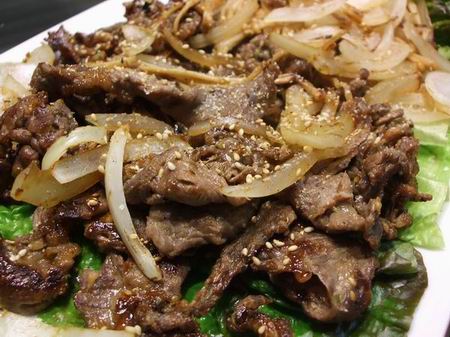
"Get Yo' Bulgogi On..." Really, asshole, I mean really?

 Image from Just Another Blog

If it's not clear from the title, this is a rant.

I've been in NYC since late August. During one very short-term assignment, I discovered a restaurant on 32nd Street. I LOVE it. After living for eight years in South Korea, Korean food IS comfort food for me. NYC is definitely a city you have to adjust to. That means I have bad NYC days, just as I had bad Korea days. Of course, as I spent more time in Korea my bad Korea days were much fewer and further in between. I know the same with happen with NYC. However, right now, I'm very sensitive to the insane amount of mean people here.

I had a bad NYC day on Monday. At the end of the day, I decided to head to my favorite spot on 32nd Street and get some Korean food. As I was walking in, two white men were walking out. One saw me and said, "Get yo' bulgogi on." Now, he very well might have just been saying it in general, but really? It's rare I pass whites in NYC speaking Ebonics unless it's in jest. My initial read was he saw me. It registered to him that a black woman in a Korean restaurant isn't something you see often. Then this smart ass decided to say something funny. However, I chose to just ignore him. I mean really, what if I was wrong and it was just an oddly timed moment?

However, assuming my gut reaction was correct, the irony is 1) I really don't like bulgogi that much and 2) if he knew my history and about my eight years in Korea, he would have just zipped his stupid f%^kin' yap.

There is another element here. That is an element of entitlement. Please explain to me why some whites seem to think they're the only people entitled to experience and like foreign cultures? (Please note I said "some" and not all, so don't wander in the comments saying I'm laying this on all white people...I'm not.) I ran into this while in Korea a lot. I'm running into it here a bit too. However, in the USA, so few people have spent any significant time abroad that it rarely comes up.

I don't know how many times I get the very impressed with themselves Caucasian who happens to have a few visa stamps in their passport and think that entitles them to be a world expert. I might entitle them to being a backpacking in Europe expert or a summer work in Mexico expert, but world expert? Nah. Hell, I'm no world expert. I know NE Asia and, specifically, South Korea. I've traveled to a few places but just because I've spent a few weeks in Paris doesn't make me an expert. How damn hard is that to understand?

Rant over... (and, um, yeah...that code ain't fixed yet, so there is nothing after "read more".)

Read More...

Sphere: Related Content

Friday, November 6, 2009

South Koreans Struggle With Race from the NYTimes

This is a really good article and I don't want to comment on it now.

Read it. Comment. I'll chime in later. Here is a bit of the article and click over for the full article.

South Koreans Struggle With Race

SEOUL — On the evening of July 10, Bonogit Hussain, a 29-year-old Indian man, and Hahn Ji-seon, a female Korean friend, were riding a bus near Seoul when a man in the back began hurling racial and sexist slurs at them.

The situation would be a familiar one to many Korean women who have dated or even — as in Ms. Hahn’s case — simply traveled in the company of a foreign man.

What was different this time, however, was that, once it was reported in the South Korean media, prosecutors sprang into action, charging the man they have identified only as a 31-year-old Mr. Park with contempt, the first time such charges had been applied to an alleged racist offense. Spurred by the case, which is pending in court, rival political parties in Parliament have begun drafting legislation that for the first time would provide a detailed definition of discrimination by race and ethnicity and impose criminal penalties.

For Mr. Hussain, subtle discrimination has been part of daily life for the two and half years he has lived here as a student and then research professor at Sungkonghoe University in Seoul. He says that, even in crowded subways, people tend not sit next to him. In June, he said, he fell asleep on a bus and when it reached the terminal, the driver woke him up by poking him in the thigh with his foot, an extremely offensive gesture in South Korea.

“Things got worse for me this time, because I was with a Korean woman,” Mr. Hussain said in an interview. “Whenever I’ve walked with Ms. Hahn or other Korean women, most of the time I felt hostilities, especially from middle-aged men.”

South Korea, a country where until recently people were taught to take pride in their nation’s “ethnic homogeneity” and where the words “skin color” and “peach” are synonymous, is struggling to embrace a new reality. In just the past seven years, the number of foreign residents has doubled, to 1.2 million, even as the country’s population of 48.7 million is expected to drop sharply in coming decades because of its low birth rate.

Many of the foreigners come here to toil at sea or on farms or in factories, providing cheap labor in jobs shunned by South Koreans. Southeast Asian women marry rural farmers who cannot find South Korean brides. People from English-speaking countries find jobs teaching English in a society obsessed with learning the language from native speakers.

For most South Koreans, globalization has largely meant increasing exports or going abroad to study. But now that it is also bringing an influx of foreigners into a society where 42 percent of respondents in a 2008 survey said they had never once spoken with a foreigner, South Koreans are learning to adjust — often uncomfortably.
Click over for more.

No, there is nothing after the "read more". (accept the code will never be fixed).

Read More...

Sphere: Related Content

Saturday, October 10, 2009

Harry Connick Jr Speaks Up About Jackson Blackface Skit in Australia

THIS is what you're supposed to do when you experience stupid racist crap. You're supposed to speak up.

This is a clip from the Associated Press: Australian TV show apologizes for blackface skit

Connick said he would not have appeared on the show if he'd known about the skit.

"I just want to say, on behalf of my country, I know it was done humorously, but we've spent so much time trying to not make black people look like buffoons, that when we see something like that we take it really to heart," he told Somers after his apology.


I'm glad Harry spoke up. That performance was 100% buffoonery. I don't think it was hateful racism. I think it was a true lack of empathy and understanding. We've got to get more of both for everyone!

It reminded me of this incident from a few years back in Korea: Okay, the Bad Side of Korea: "It's not racist; it's a joke!". As far as I know, excuses were made and an apology? Never.

It's got to come from all sides: an awareness of and sensitivity to how others feel.

I say this because I've been in situations when I was abroad where it was mostly foreigners who where going to town with racist generalizations about Koreans. Look, living anywhere that's different and where it's not your country is HARD at times. However, when I saw that stuff, I called them out as going a bit too far down Racist Lane.

Good job Harry and thanks.

More links:
Analysis: 'Blackface Jacksons' embarrassing to Australia
Harry Connick, Jr. denounces blackface skit in Australia
Harry Connick Jr weirdly unimpressed by Australia's blackface Jackson 5

(code not fixed yet, the "Read More" doesn't lead you anywhere...sorry)

Read More...

Sphere: Related Content

Sunday, July 26, 2009

SNL: Excedrin for Racial Tension Headaches and Chris Rock

Wow. It's been one hell of a week in the news.

I've not blogged about the Gates arrest because my opinion is simple. What on earth was an old and angry 58 yo black man with a cane going to do to a young cop with a gun that would justify charging him with disorderly conduct and taking him in? It's b.s., and it never would have happened if Gates were a 58 yo white man with a cane and a smart mouth.

Plus, everyone has an opinion on it, and there really is no need to join the fray. This post from Gawker pretty much sums up my opinion and they threw in some legal code, so I love them: No, Henry Louis Gates Is Not a 'Railer,' a 'Brawler,' or a 'Common Street Walker'.

With that said racial tension has been the name of the game this week.

I also got a comment on the Presumptuous Racist post I wrote last year from someone by the name of Tae. I didn't publish it, which is rare. However, not for that particular post. There have been two comments that crossed the line.

Wait, there is more the obviously more intelligent and genetically superior Tae stopped by again to spew more verbage. It's somewhat comical because, if I'm so hopelessly inferior, why bother?

I can always tell when someone has wandered in from a Google search, read one post and has decided they know everything about my point of view. Someone who disagrees with me is not offensive but someone who confuses disagreeing with being disagreeable is offensive. Someone who disagrees, even forcefully, will have their comment published, even if in my reply I'll skewer them ;) However, if a comment crosses the line to just a barrage of insults, it's not getting published.

This is my little section of the Internet and those are the rules. It's like going into someone's house, dropping your pants and taking a crap in the middle of their living room. Since I caught this fool unzipping, I avoided any damage. This is my house. I can reply at will and I did.

Someone on an online forum I frequent posted this video to comment on this week's events. I think it's very apropos, so enjoy. It's pretty funny. I added another from Chris Rock follows simply because he's brilliant.

Saturday Night Live - Excedrin for Racial Tension Headaches


Chris Rock on Race (hilarious)...

The most racist people in the world? "Old black men."


For those who cant see the SNL clip, here is the script that I found here:

Indistinguishable Black Woman (played by Queen Latifah): “Do I get stress headaches at work?” Yes, definitely. From the moment I get in, it's “Denise, we need this,” “Denise, we need that,” which is stressful, 'cause my name is Linda. Denise is the other black woman who works here.

By ten a.m., someone in the Copy room makes a joke about Kobe Bryant, and everyone looks at me to make sure it's okay. And I smile like it's okay, but, really, my head and neck are starting to throb.

Then, I spend the rest of the afternoon training my interns and answering their questions, like “Yes, black people use shampoo” and “No, I don't know any good reggae clubs around here” and, “Yes, Condoleezza Rice is very articulate. Why do you sound so surprised?” And, “No, I can't tell you where to buy weed.”

And that's when I reach for Excedrin—new Excedrin for Racial Tension Headaches.

Excedrin RT works fast, taking me from “Oh no you didn't!” to “I wish a motherfucker would.” I like that.

Voiceover: Excedrin Racial Tension Headaches—fast relief for hundreds of years of nagging pain.


(Please ignore the "read more" field below. I've got some renegade HTML code lurking somewhere.)

Read More...

Sphere: Related Content

Monday, June 29, 2009

OMG! BLACK PEOPLE!

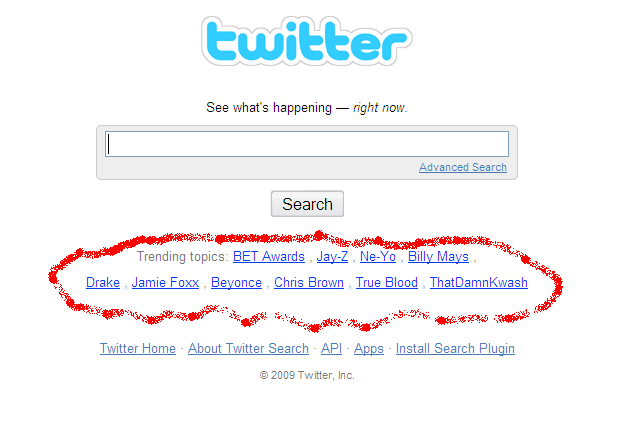
It looks like Twitter's current trending topics have some people on the alert and a bit apprehensive.

Check out this tweet. What's ridiculous is Foolish Julie here isn't alone by any stretch. It shows a complete disconnect with how Michael's death has impacted the black community. I don't watch the BET Awards and only did so because they said it was going to be a MJ tribute. Therefore, guess what? There was a huge number of people watching the show and and we talked about it as it happened.

But riddle me this? Even without that, why is it even an issue that black topics trend on the night of a major black awards show? I guess black folks aren't supposed to actually use the Internet.

Sorry, I have to just say it. These people are just stupid.

The USA is now post-racial? Yeah, okay.

Are they serious?

Well, thank goodness for screen shots and blogs. Because, yes, morons there are black people on Twitter.

Say it isn't so!!!

Posted via web from Regina's posterous

Read More...

Sphere: Related Content

Friday, May 29, 2009

These rumors CAN'T be true...

Bonnie Sweeten, another lying white woman.

Update: June 5, 2009 @ 4:27pm

I found another good analysis on "the black guy did it" liars out there: Top 5 “The Black Guy Did It” Excuses By White Criminals

Update: June 2, 2009 @ 6:34pm

This is a good article that talks about the and other cases:
'Black Man Did it' Hoax Sparks Outrage

Sorry, but why can't they be true?

Okay, let me give you the background first. I'm in the Philadelphia suburbs right now. There is a case involving Bonnie Sweeten. She called 911 claiming that she and her daughter had been abducted by black men on some busy street in a Philadelphia township. She allegedly called from the trunk of the car where she and her daughter had been thrown.

The first question is, um, why didn't anyone see this? This was a busy road.

Can it be another case of a lying white woman?

Um, yes. Because she was found with her daughter at Disneyworld in Orlando, Florida.

They're trying to figure out what drove her to concoct this huge damn lie.

Oh, get this. Before she left she had the brilliant idea to ask her friend if she could use her friend's driver's license. She made up some b.s. story and her friend let her take it. It ends up that she bought air tickets and got through airport security using her friend's identity.

What irks me is the content of her lie. Just like the Jennifer Wilbanks, the runaway bride from a few years ago; Susan Smith, child murder; or Peggy Seltzer, the liar who escalated it to the point where she wrote a memoir, you've got a lie revolving around minorities and crime.

Now the news agencies are running around Philly and interviewing friends and family. Everyone is claiming shock. Everyone is talking about what a great person she is.

You know what? If this woman were black the news agencies wouldn't be taking this angle at all. Friends who were claiming surprise wouldn't even get any camera time. Instead, they'd have analysts talking about the criminal mind or some b.s. like that.

I was watching Bonnie's husband being interviewed on a morning news show this morning. He had the audacity to tell people not to believe the rumors swirling around her. Okay. I understand that he wants her to get a fair shot. But then he went on to say the rumors can't be true.

Sorry, dude, these rumors most definitely CAN be true.

It's just that from what I can see, even if they are, people will still make excuses for her. It's going to be the stress of the economy, a bad childhood, or some mental illness she's suddenly diagnosed with. Another case of a poor white woman simply unable to control her urge to lie and implicate blacks or other minorities while she's at it.

It's irritating to see another case of a blatant liar is getting every benefit of the doubt and given every excuse under the sun. Then when a black woman like myself sees a clear difference in how it's handled and how everyone is struggling to accept that she indeed just might be a bad person, I risk being accused of playing that dreaded race card. You know what? I'm in pretty good company because I'm not the only person upset by this case.

Look, if race still wasn't such a huge factor in so many things out there, I wouldn't mention it. Yes, my country now has a black president. There is progress for sure, but there is so much more than needs to evolve and change.

It would be a done deal if black Bonnie told this lie that she'd be on the fast track to some time in jail. Let's see what's going to happen to white Bonnie.

An AOL news summary of her case: http://news.aol.com/article/mother-daughter-missing-pennsylvania/499825

Some other bloggers on this topic:
PoliceMag: There Should Be a Special Punishment for This Crime (I agree.)
The Field Negro: Next time blame the Mexican guy. You might have more luck. (Ha!)
Essence.com: Stop Demonizing "Black Men" (Mother Faked Kidnapping) (she goes through quite a few former cases of liars capitalizing on race.)

Read More...

Sphere: Related Content

Monday, April 27, 2009

From the Cartoons and Comic Books blog "Lois Lane - I Am Curious (Black)!"

This is a great blog post. I discovered it on Twitter. Thanks to Questlove from The Roots for posting the link.

I won't comment too much on it as it brings the point home all on its own.

However, the point of it is what a lot of people simply refuse to get and acknowledge. It's flat out obvious when you're judged based on your skin color. It happened to me in South Korea, but it wasn't as negative there for me for some reason. I can't articulate the difference, but, for me, there is one.

What's interesting is when it happens to me here in the States. I'm nice and law-abiding. I'm educated and moderately multilingual (acknowledging that I'm not fluent in anything but English but can get by in a few languages at this stage.) I've traveled pretty far and wide and, in general, I'm simply not a threat to anyone. However, I'll be on mass transit and people will choose to stand rather than sit next to me. Sometimes that's because they're only going one stop, but other times, you can't help but notice how quickly they sit down somewhere else on the bus when a seat opens up.

I don't let it stress me, but I do notice it. It's not like it didn't happen when I lived here years ago. It's just that when it does happen, it's pretty obvious what's going on. I also think it's funny to see people reach for their bags when the fact is that I'm ore concerned about the contents of my bag being stolen than snatching someone's bag. I'm the one carrying the Blackberry, iPod and a laptop. It's interesting. Yes, the comic shows the judging comes from both sides. Neither side is 100% innocent in this.

I agree with Millsie, the person who posted it, that it's a goofy story. I'll add that is full of stereotypes. For example, Lois sounds white...um, okay. I know plenty of blacks that do too. However, the point remains.

There is progress, but it's nowhere near fast enough for my liking. Nowhere near.

BTW, it's best to click over to the Cartoons and Comic Books blog. Boo!

I had to reduce the size of the pictures significantly to get the full pages on my blog. So either you can click on each picture one by one or just click over and read them all. Plus, they deserve the traffic for this.

Lois Lane - I Am Curious (Black)!

Posted by Millsie on November 21, 2008

Comic books sometimes try to be important and make a statement about some social issue of the day. This sort of thing was all the rage in the earlier 70s when you had some very good stories such as those in Denny O’Neil and Neal Adams’ Green Lantern/Green Arrow series. This story that I featured is from Lois Lane 109 and was written by Robert Kanigher. It is a well meaning but very goofy story if I may say so myself.


BTW, I have to say that Lois looks hawt as a sista.

Read More...

Sphere: Related Content

Tuesday, January 13, 2009

Crap That I'll Miss: Fun, Smart and Hilarious Kids

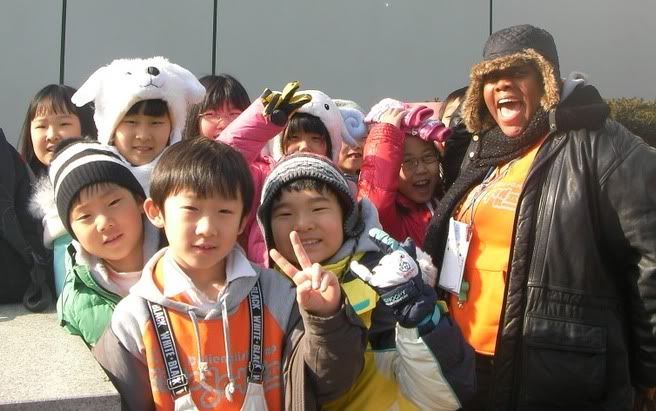
Nothing is perfect and working with children can be a challenge at times. This is particularly so in Korea due to cultural differences and very demanding parents. However, pretty much since I've arrived, I've had tons of fun working at winter or summer English camps. Maybe it's because, in some ways, I'm a kid at heart. I love clowning around with them but also getting serious and seeing them absorb information from me like sponges. Now I'll be 100% honest and also say that I love sending them home at the end of the day because it's truly exhausting too. I discovered that I liked teaching kids when I taught as a substitute teacher in the San Francisco Bay Area.

However, some camp experiences have been better or worse than others. That depends on a number of factors. The most important is the experience level of the management team because a micro-manager can make a camp hell to work at. Unfortunately, there are a lot of micro-managers in Korea. One camp I worked at has a manager so into control that he made teachers sign out for copy paper and locked their classrooms after the kids left to force all the teachers in the library to write their lesson plans and prep for the next day. That was weirdness on a level I'd never seen before and, luckily, haven't seen since. However, I can count the truly unpleasant camps on one hand, so that's not too bad if you calculate 8 years. There was maybe one or two times I elected not to do a camp, so that's around 14 or so of these. Even if the camp is a nightmare on the management side, usually, the pay is decent for a two to three week assignment if you're already in the country. I don't think I'd ever do one if I had to cover my own airfare to get here though. But people are coming here sometimes to get a feel for Korea before deciding to work here for a year or use being in the country for a camp as a way to start looking for an annual position.

The perk for me is changing the type of student I teach from college age young adults to young whip smart kids. There are behavior issues, for sure. But there are behavior issues with college students too. The kids know, just as we do, that these things are temporary and some take advantage of that. However, most of the time the kids are great. I'll miss the few weeks each summer and winter that I spend doing it. This time around it's much more of a challenge because now I'm simultaneously trying to keep up with my writing and interviews. That's truly exhausting.

I also have to say I hope it helps these kids develop a more open perspective to race and people who are different. Prior to being taught by me a lot of these kids have never had much contact, if any, with a black person. Most of these kids are children whose parents are white collar workers, so they have the means and then some. Mostly all have had interaction with foreign teachers and quite a few have lived abroad. It's just the reality is that most teachers here are white and some of them are less than subtle about their views on race.

That's still really weird for me to imagine. As a kid, I remember my first teachers being white and that was no issue. I don't recall gasps or blunt observations of differences. One reason is, probably, as minorities in a white dominated society, whites simply aren't a novelty to a black child in the inner city. I remember being in a class with both black and Hispanic children when I went to schools near my home. When I started going to more integrated schools, it took me no time to develop lasting friendships with my white classmates too. So it still boggles my mind at how Korean culture is so very "us versus them." Here, anyone who isn't northeast Asian (Korean, Chinese, or Japanese) is a novelty. I get it intellectually, but I do wonder sometimes how it feels to be inside a mind like that where everything is either just like you or in stark contrast to you.

It also points to maybe one reason why it just seems so difficult for Koreans to process an interest in and knowledge of their culture by people who aren't ethnically Korean. In conversations with my Korean friends, I point out that the Chinese actually brag about their diversity. They are also neither crestfallen or defensive when you don't like something about China. Also, both the Chinese and Japanese are experts in exporting certain dimensions of their culture. It's an interesting contrast for sure.

I've wandered off the path a bit into cultural-based musing. However, to sum it up, I'll miss the fun, smart and hilarious kids I've had the pleasure to teach while I've been here.

Read More...

Sphere: Related Content

Tuesday, September 16, 2008

For Obama, Race Remains Elephant in the Room

Thanks to Jeff Chang for sending this out. It's most definitely worth reading because it's amazing that this close to election day you still have people hanging so passionately to any anti-Obama sentiment they can get their hands on and talking around one big issue that we all know still is very relevant to many (very silly) people.

Democratic U.S. presidential nominee Sen. Barack Obama
Democratic presidential nominee Barack Obama speaks during a Sept. 4 rally in Lancaster, Pa.

On a swing through Pennsylvania last month, John McCain visited a Manheim Central High School football practice — not to ingratiate himself with the players, who weren't even old enough to vote, but to identify himself with the gritty, down-home, lunch-bucket values of small-town football. "This is a blue-collar town," Manheim's coach said in his introduction of McCain. "We don't have a lot of flashy athletes. We don't come out with a lot of flash." But the coach explained that his team works hard, plays with discipline and comes through in the end. "A lot like John McCain," he said.

If you're familiar with the code words of the sports world, you've probably already guessed that Manheim's players had something else in common with McCain: they were white. On the other hand, athletes who are described as "flashy" almost invariably have something in common with Barack Obama. I'm not saying the coach was trying to inject race into his discussion of flashiness. I'm saying that sometimes we talk about race even when we're not talking about race — in presidential politics as well as sports. Sports announcers have at least made an effort to shed their stereotypes; they occasionally describe black players as "scrappy" or "blue collar," adjectives that used to be reserved for whites. But for political pundits, "working class" or "blue collar" or even "small town" voters still means white; blacks have their own category.

Race is the elephant in the room of the 2008 campaign. In West Virginia's primary, one out of every four Hillary Clinton voters actually admitted to pollsters that race was a factor in their vote; that may be an Appalachian outlier, but even in New Jersey, Pennsylvania and Ohio the figure was a troubling 1 in 10. It's a tribute to America's racial progress that a biracial man born before Jim Crow died could come this close to the presidency, but if you believe that contemporary America is color-blind, you probably also believe the Georgia Congressman who recently called Obama "uppity," then claimed he had no idea it was a traditional Southern slur for blacks who didn't know their place. ("Uppity" often modified the slur everyone knows is a slur.) Blacks are still known as "minorities" because this is still a majority white country, and Obama is just as anxious to avoid running as "the black candidate" as McCain is anxious to avoid running as "the Republican candidate." (See photos of Barack Obama's family tree here.)

This is something to keep in mind now that the Thomas Friedmans and Arianna Huffingtons of the world are imploring Obama to get angry, to shed his above-the-fray cool and fight back against the McCain campaign's silly-season accusations that he's a charismatic chauvinist who wants to teach kindergartners how to have sex. Over the past 18 months, Obama has been attacked as a naive novice, an empty suit, a tax-and-spend liberal, an arugula-grazing élitist and a corrupt ward heeler, but the only attacks that clearly stung him involved the Rev. Jeremiah Wright — attacks that portrayed him as an angry black man under the influence of an even angrier black man.

White America has shown an abundant willingness to support no-demands blacks like Tiger Woods, Oprah Winfrey, Colin Powell and Will Smith, but a race man like Malcolm X would be another story. It was no accident that Bill Clinton tried to pigeonhole Obama in the primaries as another Jesse Jackson, or that Michelle Obama introduced her family at the convention as a new version of the Cosbys (or the Bradys). Obama's opponents want him to look niche, like BET or Chris Rock or the NBA; his challenge is to prove that he's also attractive to the ABC and Dane Cook and MLB crowds. During the primaries, Joe Biden took flak for his dopey description of Obama as "the first mainstream African American who is articulate and bright and clean and a nice-looking guy." Articulate is one of those racially tinged words that sports announcers use to express surprise that a black man can speak proper English, and clean hints at even uglier stereotypes. But the key word in that verbal vomit was mainstream, because it suggested that most blacks aren't. And the media perpetuates that idea by excluding middle-class blacks from their middle-class calculus.

This is touchy stuff, partly because "the race card" is not always, so to speak, a black-and-white issue. New York governor David Paterson recently accused Republicans of using "community organizer" as a subtle racial put-down; that seems hypersensitive to the point of paranoia. Obama was a community organizer, and his opponents should be able to criticize him without being accused of race baiting. But it's tricky when the attacks wander into the neighborhood of racial stereotypes, like the McCain "Celebrity" ad linking Obama to Paris Hilton and Britney Spears, which had a whiff of lock-up-your-women alarmism about the sexual power of black men. The usually somnolent David Gergen lashed out at McCain's ad portraying Obama as the Messiah, calling it a subtle but intentional effort to paint a black man as The Other. "It's the subtext of this campaign; everybody knows that," Gergen said. "As a native of the South, I can tell you, when you see this ad, 'The One,' that's code for, 'He's uppity; he ought to stay in his place.' "

The McCain camp — before its recent forays into the politics of umbrage and grievance — dismissed the ad furor as political correctness run amok. "Have a sense of humor," spokeswoman Nicole Wallace told me. For his part, Obama never accused McCain (or Biden, for that matter) of playing the race card. He wrote eloquently about race in his books, and he spoke eloquently about race during the Wright flap, but he's avoided the subject ever since the McCain campaign accused him of playing the race card, after he suggested that Republicans would try to remind voters that he doesn't look like the Presidents on U.S. currency. I've already reported Obama's negative response to a New Hampshire voter who asked him to launch another Clintonesque national conversation about race: "All that self-flagellation, it's not useful. African Americans get all riled up, and whites get defensive." In a year when generic Democrats are trouncing generic Republicans and polls suggest that the domestic and foreign policies he supports are much more popular than McCain's, it's certainly not useful for Obama.

So Obama is probably wise to ignore the liberals who keep begging him to drop his air of unflappability and start taking Republican scalps. White America already embraces black celebrities, even "flashy" ones. But it has never really warmed up to an angry one.

(See photos of Barack Obama on the campaign trail here.)
(See photos of Barack Obama backstage at the DNC here.)


Read More...

Sphere: Related Content

Monday, September 8, 2008

Repost: Glamour wants to know if you have friends of other races

This is on point and simply interesting for me since I'm in my hometown of L.A. right now. I'm staying a friend's house. Her parents immigrated to the US from Mexico and she was my college roommate. Now she is a doctor as is her husband. I'll be staying at another friends house later in the week who is a black American. I'll also be touching base with quite a few Caucasian and Asian friends of mine while I'm here. So I pretty much laugh when someone asks me if I have friends of another race. Of course, I do.

I'm not naive and I know this is a question that still needs to be discussed. It's just I'm so past it. I went to integrated schools and have had friends of all races since elementary school.

However, while I'mat ease on this point, many aren't.

Maybe by posting and linking this discussion there will eventually be more people who one day will be at ease discussing race.

I'll post and link the discussion here because maybe it can help a few people realize that someone being another race is pretty much irrelevant to friendship.

Glamour wants to know if you have friends of other races

by Carmen Van Kerckhove

The October issue of Glamour magazine, on newsstands now, has a feature story on race and friendship among women. Read the PDF here.

It’s the second in a series of conversations the magazine has been hosting about race, at least partially in response to the controversy last November surrounding a beauty editor’s alleged remarks about black hair styles being “political.” The first installment was about race and beauty, and we gave it a luke-warm review here on Racialicious.

This article is a rehash of a discussion panel I participated in back in May at the Conde Nast headquarters. The audience was made up of Glamour staff, as well as an ethnically diverse group of media, fashion, semi-socialitey types.

Sidenote: I have newfound respect for fashion models after doing the shoot for this article. See that photo where the three of us seem oh so relaxed and casual? Um… in reality we were each perched on a narrow wooden crate, and I was literally straddling Aisha Tyler. Seriously, my crotch was like, all up on her hip, my boob on her arm, and my face on her shoulder. Sooooo… awkward. Especially considering I had met her just an hour earlier.

Anyway, back to the article.

I walked away from the discussion panel in May pleasantly surprised. The discussion was really substantive, and people were not at all shy about exploring topics one wouldn’t ordinarily associate with Glamour magazine. I mean, we talked about white privilege and white supremacy (yes, in those words), about feeling like the token, about being asked to represent your entire race, about feeling used, about feelings of rejection, etc. Not only were the panelists refreshingly forthright, but some of the greatest nuggets actually came from the audience members.

Does the article reflect the depth of that conversation? Unfortunately, no. But I guess that’s what happens when you’re forced to boil down what would have been 20-30 pages worth of text into just a few.

Still, I’m impressed that Glamour is hosting these conversations on race, and doing it in an intelligent manner that does not talk down to the reader. Let’s not forget how mass this magazine is — they’re Cosmo’s no. 1 competitor, with a circulation of over 2 million. That’s a hell of a platform, and I hope it will spark some authentic conversations about race among their readers.

Interestingly enough, the question we kept coming back to during the panel was this: How do you define friendship? Who’s a friend and who’s just an acquaintance? I’m the type who only considers a handful of people in my life to be genuine friends, but other folks have much looser definitions of friendship.

What about you? Do you have friends (real, genuine friends) of other races? If you do, what are some of the challenges to interracial friendship? What are some of the rewards? If you don’t have friends of other races, why not?

Also, since I posted about that daff Glamour editor's comments and this is part of their response to that. I'm all being fair and showing them when they're good as well as bad. This is good.

Read More...

Sphere: Related Content

Tuesday, June 24, 2008

Repost: AC360 - The fallacy of colorblind post-raciality

Carmen Van Kerckhove, founder of New Demographic and the Racialicious blog, breaks it down on the AC360 blog (and, y'all know I've got a crush on Anderson, right? Yeah, yeah...I know the rumors, screw y'all!!! I'm in denial on that.)

Anyway, she talks about this post-racial b.s. that people bandy around. I'm going to turn comments off here because there are comments there. Plus, I don't want to get stuck in a debate on it when it's not a piece that I wrote. However, I do strongly agree with her.

Great post Carmen.


The fallacy of colorblind post-raciality
Posted: 08:15 AM ET

Carmen Van Kerckhove
Co-founder, New Demographic, a consulting firm that addresses race and racism

It has become increasingly fashionable to bandy about the words “post-racial” and “colorblind” when discussing race in America.

Apparently, many Americans have convinced themselves that they even if racism does still exist, they are not part of the problem. When asked the question “If you honestly assessed yourself, would you say that you have at least some feelings of racial prejudice?” in a new Washington Post-ABC News poll, only three in ten respondents answered yes.

The other seven must be afflicted by “colorblindness,” that odd phenomenon that drives people to insist that they “just don’t notice race” and claim that they don’t care whether people are “black, brown, green, or purple.”

Of course, colorblindness and post-raciality are both mythical constructs.

All of us notice variations in skintone, facial features, hair texture, eye color, and the myriad of other phenotypic factors that cause us to draw conclusions as to what race a person is.

Then why do people insist on claiming that they don’t notice color? Often, it’s because they are scared to death of being labeled a racist.

But here’s the thing. Noticing a person’s race doesn’t make you racist. What does make you racist is if you make assumptions about that person’s intellectual, physical, or emotional characteristics based on the race you think the person is.

And unfortunately, too many of us do make those assumptions. We’ve all internalized racist ideas – consciously or subconsciously – from our families, our environments, our media consumption, and more. Until we can understand that and begin to de-program ourselves, we cannot be truly “post-racial.”

Even more importantly, when people proclaim that they’re colorblind, what they’re really implying is that race no longer matters in America. While it’s true that race is not a biological reality, it is a very real social construct that has a profound impact on our lives. Race still matters because racism is alive and well. Pretending otherwise negates the everyday experiences of millions of people of color in this country.

NAACP Chairman Julian Bond said it best when he stated that colorblindness means being “blind to the consequences of being the wrong color in America today.”


Read More...

Sphere: Related Content

Friday, June 20, 2008

Brava!!! Italian Vogue - All Black Model Feature, July 2008

Note: I've shifted updates to the bottom.

Brava! (Okay, I know Steven Meisel is a man so it ought to be "bravo", but it's a magazine targeting women.)

Conspicuous by Their Presence

RACIAL prejudice in the fashion industry has long persisted because of tokenism and lookism. “We already have our black girl,” says a designer to a fashion-show casting agent, declining to see others. Or: “She doesn’t have the right look.” Laziness, paranoia and pedantry may also have something to do with the failure to hire black models for shows and magazine features in any meaningful number, but, hey, that’s just a guess.

A decade ago the thing to deplore was the stereotyping of black models by dressing them in African-inspired clothes (or the Asian girls in kimonos). This at least gave work to minority models, but it also encouraged a Western view of African culture of the many-bangles-many-beads variety.

O.K., so fashion ain’t deep. It looks into a mirror and sees ... itself. The irony in fashion is that it loves change but it can’t actually change anything. It can only reflect a change in the air. But what changes fashion? What would finally move American designers to include more black models on their runways? That 30 percent of the country is nonwhite? That black women spend $20 billion a year on clothes? That an African-American is the presumptive presidential nominee of the Democratic Party?

The answer is the individual eye.

In fashion, one of the most influential eyes belongs to the photographer Steven Meisel. His pictures have caught an America basking in the earnest, self-reflected glow of celebrity and money. He has taken innumerable risks, especially with “Sex,” the 1992 volume he did with Madonna, that have paid off with a career that allows him to do whatever he wants.

And he has almost lovingly photographed some of the world’s beautiful women, tapping into their psyches, connecting with them on a human level, while transforming them into fashion deities.

As the model Veronica Webb, who first worked with Mr. Meisel 20 years ago, said: “Steven knows every single tic, every talent that every girl has. He just pulls it out of them.”

For the July issue of Italian Vogue, Mr. Meisel has photographed only black models. In a reverse of the general pattern of fashion magazines, all the faces are black, and all the feature topics are related to black women in the arts and entertainment. Mr. Meisel was given roughly 100 pages for his pictures. The issue will be on European newsstands next Thursday and in the United States soon after.

Under its editor, Franca Sozzani, Italian Vogue has gained a reputation for being more about art and ideas than commerce. Ms. Sozzani also doesn’t mind controversy.

She said that, as an Italian, she has been intrigued by the American presidential race and Mr. Obama, which was one source of inspiration when she and Mr. Meisel began discussing, in February, the idea of an all-black issue. Also, she was aware of the lack of diversity on the runways in recent years and the debate it fueled last fall in New York, where Bethann Hardison, a former model who ran a successful agency, held two panel discussions on the topic.

Ms. Sozzani said the issue was not a response to criticism that she, too, has under-represented blacks or portrayed them as stereotypes.

“Mine is not a magazine that can be accused of not using black girls,” said Ms. Sozzani, noting that Naomi Campbell has had several covers, and that Liya Kebede and Alek Wek have also had covers.

Having worked at one time with nearly all the models he chose for the black issue — Iman, Ms. Campbell, Tyra Banks, Jourdan Dunn, Ms. Kebede, Ms. Wek, Pat Cleveland, Karen Alexander — Mr. Meisel had his own feelings. “I thought, it’s ridiculous, this discrimination,” said Mr. Meisel, speaking by phone from his home in Los Angeles. “It’s so crazy to live in such a narrow, narrow place. Age, weight, sexuality, race — every kind of prejudice.”

He began casting in March. “I love the history of fashion, obviously, and I love old, and I tried to get as many of the older girls as I could,” he said. Over Ms. Sozzani’s initial objections, he also hired Toccara Jones, a full-figure model, who became known from “America’s Next Top Model.” “I wanted to say something about weight, and I’m never allowed to do that,” he said. “I met Toccara and thought, she’s beautiful. What’s the deal with her? She’s great and she’s sexy.”

If these pictures have a heightened sense of glamour, it probably has something to do with the atmosphere of a Meisel shoot. According to Ms. Webb, “it’s the darkest studio, like a studio at MGM.”

There are fans and reflectors; many assistants. An area is marked “Hair” and another “Makeup.” (Pat McGrath did all the makeup for the issue, and Guido Palau did the hair.) A mirror is placed behind Mr. Meisel, so the model can see herself.

“It’s a dark world,” Ms. Webb said, “and you’re in the spotlight.”

The four pictures that Ms. Campbell was supposed to make turned into 20. She also appears on the fold-out cover, along with Ms. Kebede, Sessilee Lopez and Ms. Dunn. “Franca doesn’t realize what she’s done for people of color,” Ms. Campbell said the other day. “It reminds me of Yves using all the black models.” She was referring to Yves Saint Laurent, who, like Gianni Versace and a handful of other designers, routinely cast minorities.

Mr. Meisel has his own theories about why black models, save for the token few, have disappeared from runways. “Perhaps the designers, perhaps the magazine editors,” he said. “They are the powerful people. And the advertisers. I have asked my advertising clients so many times, ‘Can we use a black girl?’ They say no.” The concern is that consumers will resist the product, he said. “It all comes down to money.”

Ashley Brokaw, an independent casting agent in New York, believes that designers want more diversity in their casts but, she said, “what they want and what the reality is are two different things.” She thinks that agencies don’t spend enough time to groom new models for the catwalk, making it easy for designers to reject them, and then the cycle of new faces is spinning faster and faster.

But it’s also true that designers, in spite of their creative powers, yearn for the approval of insiders. “They are looking around, over their shoulders, asking, ‘Is that cool?’ ” Mr. Meisel said. He agreed that it’s a crazy kind of paranoia. Whether it’s a new model or hip style, he said with a laugh, “It can only be stated by a certain five people and then they go with it.”

What is striking about Mr. Meisel’s pictures, especially a portrait of Ms. Banks in a soft head-wrap and one of Ms. Lopez in a neat brocade turban, is how much beauty and life he was able to extract from them, so that you almost feel you are seeing these women for the first time.

Ms. Hardison hopes that the Italian Vogue issue (to which she contributed) will open people’s eyes in the industry. “They need to see what they’re missing out there,” she said. This week, in its July issue, American Vogue will have an article about the dearth of black models.

Perhaps no individual, though, will know what it means to be included more than Ms. Lopez. Last year, she barely worked. Ms. Brokaw predicts that after insiders see Mr. Meisel’s pictures, she will have a terrific season.

This kind of perplexes and delights Mr. Meisel.

“Here’s this exquisite girl,” he said, addressing no one in particular. “What don’t you get? She’s a beautiful woman. There was no trick to it.”


_____________________________________

Update 1: July 16, 2008 @ 8:42pm

Well, the Italian Vogue finally made it to my favorite bookstore here, Kyobo Bookstore. And, being VERY happy about this issue I bought every different cover ;) However, the cover with Naomi Campbell was MIA. I have a feeling that those got bought up or given away before they made it to the magazine rack. I'll keep searching though.


Here is a wonderful byline from the NYTimes:
Beautiful Is Beautiful (click the link for a great pictorial)

For the July issue of Italian Vogue, Steven Meisel, one of the most influential photographers in fashion, has photographed only black models.
I will be getting an over priced copy of this edition for sure (maybe two). Foreign mags are sold at bookstores in Seoul wrapped so tightly in plastic that you wonder if they ever want you to read the magazine and the foreign mags are so grossly over-priced it's shocking. However, for this edition, I'm giving up the cash. It's worth it just to show my support for Italian Vogue doing that.
_____________________________________

Update 2: August 28, 2008 @ 10:20am

For all the haters that read much more into this Italian Vogue issue than I think was necessary, I learned about a magazine called Trace Magazine that does a "Black Girls Rule" edition once a year.

So, now I want you all to click over, read the post: Trace Magazine - Black Girls Rule and then subscribe to Trace Magazine. If you don't, you're just a negative "can't see anything positive" hypocrite.

Yes, I said it. And have I contacted them to start my subscription? Yes, I have...

_____________________________________

Update 3: September 5, 2008 @ 7:12am

I have no idea but, for some reason, people are searching for information on the All Black Model Italian Vogue issue. Maybe some TV show talked about it.

Anyway, I doubled back to the Google link leading people to me and found another good blog post on it at Make Fetch Happen. So, I'm sharing the love.

Here is a great slideshow of some of the photos from the issue I saw at that blog: Vogue Italia July 2008. However, I'm really hoping that issue sold out and most who wanted to see it, bought it.


Read More...

Sphere: Related Content

Friday, June 13, 2008

Repost: Racialicious - Whose Feminism?

This one is GOOD.

Since I've been spread too thin to get into essay mode, I'll turn you on to this one from Racialicious. Thea Lim hits the tension between feminism and race head on.

No comments here people. It's just a repost, so take them to Racialicious.com.

Whose Feminism?

by Guest Contributor Thea Lim

For the past few months, I’ve felt agitated and short-tempered most of the time. Taking the afternoon off, watching all three of the Bourne movies in a row, unplugging for a long weekend – even the dreaded Talking About My Feelings hasn’t made a dent in the ball of rage that’s been growing steadily in my lungs, my solar plexus and my belly. The rage creates even more rage – and I find myself wondering, why can’t I just freakin’ calm down?

And then I got this note last week from Carmen through the New Demographic newsletter:

A couple of weeks ago I found myself feeling really angry and rundown, but I couldn’t put my finger on what exactly was causing these emotions…This has been a grueling year for people like you and me — folks who are passionate about fighting racism and creating social change. While this election has given many of us cause for hope, it has also brought out a lot of ugliness around us.

I’m a Canadian living in Canada, and due to a hangover from a very short affair with anarchy, I’m fairly suspicious of electoral politics, and sometimes don’t even vote. So when trying to unravel the roots of this ball of rage, the Democratic Primary Race between Hillary Clinton and Barack Obama was not the first place I looked.

But you see, I’m starting to understand what my problem is: I identify as a feminist. And I don’t just mean I read bell hooks from time to time and appreciate the equity undertones of Gilmore Girls. I mean, I really live feminism. I work for an overtly feminist women’s health organisation, my first novel was a work of feminist fiction, and I helped put together the Shameless Magazine blog – online companion to Canada’s only feminist print magazine for teenagers.

I’m also an anti-racist woman of colour.

Last week as I waded through Geraldine Ferraro’s horrible op-ed and yet another listserv conversation about how feminists must support Clinton, I realised that, Canadian or not, for the past few months being an anti-racist person of colour AND a feminist has become a source of heartache, deep sorrow, and yes, pure, seething, rage. Because it feels like feminism, a cause that I have defended and supported for four years, has turned its back on me.

What has hurt me about this far-removed, distant and abstract primary race, is not what Clinton has done – though the racism that marred the end of her campaign sure stings. It is what’s happening at the grassroots level, not at the level of Chris Matthews and CNN, that hurts me. What’s truly gut-wrenching is the message the feminist blogosphere, feminist journalists, and feminist politicians have broadcast, bull-horned and sky-written in response to Clinton’s candidacy.

It’s the assumption that if you are a woman, Hillary speaks for you. It is the assumption that if you are a feminist, you will vote for a woman, no matter who she is, and no matter how little she may represent your experience. It is the assumption that if you are a woman, if you are a feminist, you will agree that gender is the greatest barrier to success in (North) America.

It is the assumption, in short, that if you are a woman, you are a straight, white, middle-class woman.

It is painful enough to be told that race and class don’t matter. It is far more painful to be told that race and class don’t matter by a movement, that by its very definition, knows that gender matters – but today won’t admit that anything else does. At the risk of being dramatic, for the past few months, living as a woman of colour who is also a working feminist – which means every day trudging through emails, blog posts, reports, listservs and conversations that imply (or exply!) that only gender matters – has been a bit like having my extremities cut off one by one.

The primary race brought the divisions between anti-racist feminists and non-anti-racist feminists* to the surface, but the worst thing about this ugly reveal, is that being forced to face a schism that feminism has been unable to brook over and over, could’ve been a chance to work through some of those rifts. Instead it just revealed exactly how unequipped feminism is to deal with race.

As our friend Latoya has mentioned on this here blog many times, white American feminists were shockingly silent on the racism in Clinton’s campaign.**

In her letter “Addressing the wounds between White feminists and feminists of Color,” activist Aishah Shahidah Simmons outlines the grief and anger she felt when White, third wave feminists did not critique the racism in Clinton’s campaign:

The concern for me is that I longed to hear from progressive, anti-racist White feminists who publicly supported Clinton but also publicly took stands against her and her campaign’s racism. I felt and feel many of her supporters (who know the vicious hertories and contemporary realities of the intersections of race and gender in this country) were complicit as she and her campaign fanned the fires of racism, which like sexism, is deeply entrenched into the very fibers of the founding of this country.

My beef with non-anti-racists feminists came from a different angle: when it became clear, after the backlash that met Gloria Steinem’s famous op-ed, that it was not ok to pit gender against race, instead of trying to understand why it was not ok, non-anti-racist feminists simply continued to make the same ridiculous statements that pit gender against race; except added in meaningless disclaimers.

For example, the point that Obama did not have to face racism in the same amounts as Clinton had to face sexism, continued to be made – this time though, it was preceded by “Not that I want to get into whether or not race or gender are bigger barriers.” Listen, if you don’t want to get into whether or not race or gender are bigger barriers, then don’t talk about how gender is a bigger barrier than race.

Come on now, it’s not that complicated.

What I am utterly baffled by, is why a discussion that Clinton has had to deal with distressing amounts of sexism has to be followed by the argument that Obama has not faced racism. Or that racism has actually benefited Obama, because people will vote for him because it’s hip to support black people.

Hillary has been treated badly because she is a woman, period. Why does that fact have to be followed by a snipe about how racism doesn’t really exist anymore? I don’t feel the need to discount the ways Hillary has had a hard time due to sexism, or deny that sexism exists, in order to make a case for the fact that racism exists. It actually makes me physically ill to have to continuously listen to this argument.

Newsflash: an environment that allows sexism to flourish is usually an environment that allows racism to flourish. Feminists, anti-racists – heck, anyone who cares about creating a culture that has less hate – should bolster the argument that sexism exists in our countries WITH the argument that racism exists here too, NOT deny the existence of one or the other – because sexism and racism so often go hand in hand (along with classism, homophobia, ableism…). As a woman of colour, the existence of sexism for me fuels my awareness of racism.

This may seem like an obvious point, but I feel depressingly driven to spell it out: I’m not a woman and a person of colour – I’m simultaneously both. Usually when people are being sexist towards me, they’re also being racist. I would like to fight both racism and sexism. So why is feminism asking me to choose?

It’s not like I’ve never heard anti-racist women of colour say that while they are womanists or mujeristas, they are not feminists, because feminism doesn’t speak for women of colour. It was just that I thought – no, believed!1! – that my feminism, my third-wave-fourth-wave-no-wave feminism was for me and people like me.

I also continue to believe, very deeply, that the revolution ain’t gonna come until we recognise that struggles against sexism, racism, ableism, poverty, homophobia, heteronormativity, classism, consumerism, (etc) are all, at their root, the same struggle. So why shouldn’t anti-racist women of colour also fight for feminism?

Well, the answer turns out, because it hurts too much.

This is not to say that the whole feminist movement is rotten. All over the same blogosphere that posted so much of the racist schlock that made me lose my cookies, feminists – Hey! Feminists who happen to be white! – like Megan Carpentier and Jill at Feministe have written sharp, incredibly clever and fantastic critiques of non-racist feminism. In my non-virtual life, I work alongside many feminists who care about race and class. And I don’t plan to quit my job or distance myself from the feminist projects I helped to create, which I’m still proud of. But as a whole, the loudest incarnation of grassroots feminism today is one that is really starting to hurt my feelings, and that’s making it harder and harder for me to proudly call myself a feminist; or to call myself a feminist at all.

Denial is a common survival tactic. We hold certain truths of our existence at arms’ length for as long as possible, because if we were to truly grasp them, the pain would consume us. This technique doesn’t just apply to physical pain or extreme pain; i.e. to soldiers undergoing torture, to parents who have lost small children, to women whose partners abuse them. It’s a technique that many of us employ to get through our daily lives, because – as Carmen so eloquently noted – sometimes our daily lives can be a little battleground-ish.

For many months I denied, ignored and distanced myself from the fact that something as abstract as a US primary election – and what it revealed about my movement – could be the cause of my angst. The comments sections from feminist blogs I once loved seem like a funny thing to grieve over.

It’s hard to forgive and then move past an Ideology. But that’s what I have to do if I want to turf this ball of rage. And if that doesn’t work, please send donations: I’m gonna need a good therapist.

Read More...

Sphere: Related Content