Showing posts with label pop culture. Show all posts

Tuesday, September 29, 2009

Excellent! "Drinking Like Mad Women" from SlateV


I've never seen Mad Men. Remember I've been away, so cut me some slack. However, I get the concept and, because the show is so good, people talk about it all the time.

However, I regularly listen to Slate's Political Gabfest. A couple of weeks ago Emily Bazelon, a Gabfest co-host and their legal expert, was in the middle of an experiment. She also is an editor for Slate's Double X blog. That blog focuses on news and issues from a women's perspective. Well, they love Mad Men and simply wondered how on Earth the characters on the show got through a full day of productive work drinking the whole time. Therefore, they tried it.

That day Emily had to record the Slate's Political Gabfest. They later titled The Pie-Eyed Gabfest. Emily was amazingly thoughtful and well-spoken. If politics is your thing, check it out: The Pie-Eyed Gabfest (this link is going to try to open iTunes, just so you know.) I was listening to it while running errands, so I was standing in the post office and sitting on the subway giggling. She came off really great. I, in contrast, came off as yet another weirdo laughing to themselves in NYC.

Here is the video covering their Mad Men experiment.


I wonder if they're hiring?

(disregard that "read more" - I've not gone in the fix the code.)

Read More...

Sphere: Related Content

Friday, September 18, 2009

I'm a geek!

Anyone who has stuck around over the years, knows I'm a Star Wars geek: older posts tagged with "Star Wars".

I saw this video on the Metro.co.uk site and had to share it.

In it Darth Vader gets down to MC Hammer's Can't Touch This. Funny...


Okay, I'm in a Starbucks near Grand Central Station and I'm freezing. It's time to head home.

(the code is buggy, still.)

Read More...

Sphere: Related Content

Monday, September 14, 2009

Beyonce At The VMAs: A Class Act

I'm not going to focus on the ridiculousness of what a certain person did. I called him out for his stupidity awhile back in 2006.


Instead, I want to focus on the grace that Beyonce showed by choosing to give Taylor Swift a chance to accept the VMA she was given.


It was a class act Beyonce!

Thank you.

My write up on it for OpenFashion.com: Compassion Is Always In Fashion

Check it out.

David A. Arnold clowning Kanye - funny:


(as had been the case for the last few posts, the code is off and there is nothing after "read more"...)

Read More...

Sphere: Related Content

Tuesday, September 1, 2009

OMG! OMG! What a great Seoul promo!!! Finally!


It looks like after the disastrous Korea Sparkling madness of last year, they've truly listened to the feedback and got it right.

Now, you still have to know who Rain is to care, but you might get curious.

This has what others lacked. A taste of Korea - you hear Korean language and you have English subtitles. Then you get a bit of English at the end. I felt a little bit of homesickness because I'd made Seoul my home for a few years. So a lot of those lights and sights I've walked past at night. I can't say I feel half as safe here in Manhattan, but I did in Seoul and had a blast most of the time too. (Don't take that as a put down of NYC. You probably have to be slightly crazy to feel safe in NYC...)

Check it out: CNN Vignette | Seoul City Promo

Comments are off. Take the discussion there please ;)

(the "read more" link is out of order, it leads you nowhere)

Read More...

Sphere: Related Content

Wednesday, July 8, 2009

Michael Jackson: Pop Culture Fashion Icon

My post on Michael Jackson and fashion over at the WeAreTheMarket.com blog.

I'm turning comments off here, but comments are welcome on the original post at anytime. I'll even make an effort to answer them all the way I do here ;)

Michael Jackson: Pop Culture Fashion Icon

050523_michaeljackson_hmed_3ph2.jpg

When it comes to the world of fashion, both men's and women's, Michael Jackson is fashion icon.

He inspired us to wear loafers and white socks. He inspired us to wear jackets with military details. He inspired us to wear one glittery glove. He inspired a resurgence of aviator glasses too.

You get the picture. We know the looks. You don't need us to list them for you after the jump.

His influence on the world of trends and fashion is simply undeniable.

Additionally, he inspired designers. All you have to do is tune into some of the Twitter streams of those in fashion. Designer Brian Atwood lamented Michael's death as well as Farrah Faucet's passing on Twitter, RIP Farrah and Micahel Jackson...We will remember you both....!! So sad.”

What's great was the symbiotic relationship that Michael had with fashion and that fashion had with Michael.

The best example is the Spring 2009 Balmine collection.

michael_jackson_balmain.jpg

Their military inspired jacket couldn't help but remind you of Michael. Of course, because fashion definitely influences entertainers we saw other celebrities pick up the trend. Now we're seeing a strong 80s-retro feel probably worn best right now by pop diva Rihanna.

However, it's symbiotic in that Michael was a legendary shopper. This year he was photographed wearing pieces from the Balmine collection.

So who inspired whom?

Does it really matter? He drew from the fashion world and they drew from him.

We won't be able to see Michael in the planned bedazzled Swarovski designs for his scheduled “This is It” concert dates. But what we do know is it would have been attention grabbing and influential.

King of Pop, you'll be missed. You'll inspire fashion for years to come.

Rest in Peace, Michael.

Read More...

Sphere: Related Content

Friday, July 3, 2009

Totally Behind the Curve ;)


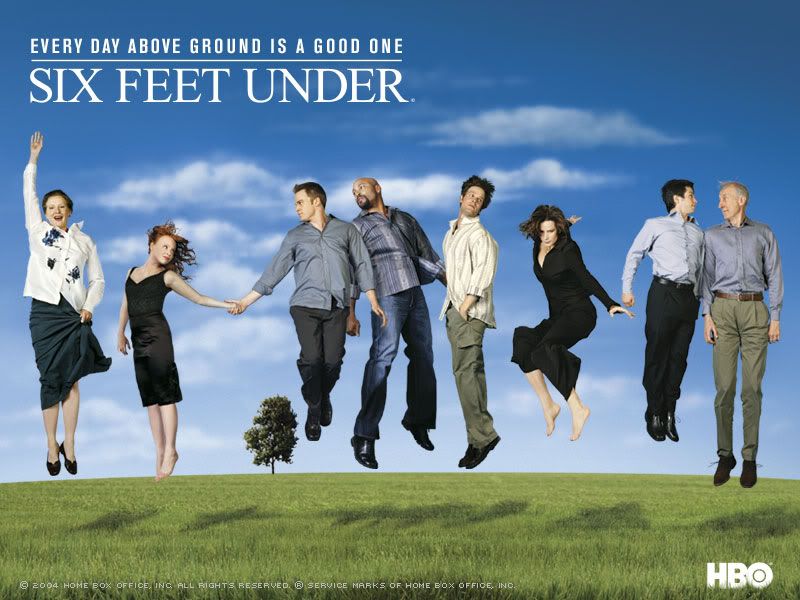
My favorite series ever, Six Feet Under, started and ended while I was living abroad. Initially, I had to download it via IRC. However, I stopped doing that when I quit work to go back to school. I couldn't afford to take a risk I'd ruin my computer when it was necessary for school. I had it in the back of my head that one day I'd get the videos and finish watching the series where I'd left off.

The characters putting Nate into the ground (a green burial).

I discovered that the second half of SFU's last season is on Verizon's FIOS, so I watched them back to back. They killed off my oh-so-troubled Nate by having him finally succumb to his AVM after cheating on his wife. (Wow, really?) I bawled like a newborn baby because, troubled or not, I grew to love the character. His death was sudden and shocking. Having been through two sudden and shocking losses in my own life, I could relate maybe a bit too easily to the story arc.

The final episode I've watched many times over. It's the end of the story and massively therapeutic for me. Claire, played by Lauren Ambrose, is a young woman trying to decide whether to move to NYC to pursue her dream of being a photographer. Of course, I relate as I'm doing something quite similar now. My calling is with something else, but I've been fighting this pull to Manhattan for years. The "can I do this?" questions and anxiety that a big change brings up I can completely relate to.

I'll quote a comment I left on the award-winning LGBT blog, Towleroad. The show covered it all in terms of subject matter, and, rightly so, featured a gay couple prominently in its story line.
"The draw of SFU for me was always the realness I felt. My parents died within five weeks of each other years ago. My mom first, right after Thanksgiving, which made that Christmas hard to take for me and my father. Then five weeks later, my father died. I should have known something was looming when I woke up to the jolt of an earthquake that morning. Later that day my father died. So, when it comes to death and loss, I've been a bit cynical but also very sensitive.

It was great seeing a show based around death. So often people are just uncomfortable with it. However, for me, it's a real part of life. I'm not morbid. I'm not depressed. But I liked the realism of having both the light and dark of life portrayed in a TV show."
Also, the artistry of the show was gripping. The opening sequence and song are incredible.


Not only that, I commend the series for what felt like an accurate portrayal of the diversity of my hometown, Los Angeles. You have black characters, Latino characters, and representatives of many ethnicities and religions in the various episodes. With it being based around a funeral home, it's easy to work diverse characters in. The thoughtfulness of not being ignored was great. Also, now that I think about it, having the show based in L.A. probably was another reason I connected so well to it. I really did see part of my home when I watched.

What I've had to deal with, of course, shades my perspective now. With the recent high profiles deaths of Farrah and Michael Jackson, last week forced the topic of death to the forefront. Along with the media circus going on, people started talking about their feelings and emotions surrounding these deaths. Farrah, unfortunately, we knew had been suffering with cancer for awhile. In fact, Barbara Walters was plugging an ABC special she'd done on The View the day Farrah and Michael died.

Michael's death was shocking and sudden. I had many people tell me they couldn't believe it. I, however, could believe it. Believing it doesn't diminish the scale of the tragedy, especially, when you consider how traumatic his personal life was. Like everyone else, I didn't want to believe it, but I know that death sometimes comes when you're just not expecting it. I've had deep losses before. Experience with it doesn't make loss easier to handle, and it certainly doesn't make me expect it. It's just that when it occurs I tend to shun hysterics and irritating theories on death. I simply lean towards being as real as I can. That means, I allow myself to initially deny it, accept it, get angry, get sad, get numb and get on with life. There is just this feeling that comes with loss. When someone you love and are connected to dies, a bit of you goes with them.

So with that said, here is the final 10 or so minutes from my favorite TV series ever. It ended in 2005, so I'm almost 4 years behind the curve. No worries. I gave up on the quest of being hip years ago. I much prefer content, confident and happy.

If you've not seen the show, you'll probably miss out on the significance of this segment. Maybe read up on the characters and storyline. However, for me, the final episode is cheap therapy: reflective, thoughtful and cathartic. It was that way for most of the episodes I saw (not all, but most).


Even though the makeup was a big dodgy in some cases, the ending is a perfect wrap: The character's obituaries.

Plus, it ends with Sia's Breathe Me.  Sia and that song are great.

Read More...

Sphere: Related Content

Monday, June 29, 2009

The ONLY Part Worth It

I'm sorry folks, but I chose to actually watch the BET Awards last night.

Mistake! They pitched it as a tribute to MJ. It started that way and it definitely ended that way. However, during the bulk of the show they lost focus and it ended up being a moments of my life wasted.

Just because I know a lot of folks missed it or didn't set their DVRs for longer than three hours, here is dear Janet making a brief appearance to speak on her brother's death. Then Ne-yo and Jamie Foxx sing.

RIP MJ.

Read More...

Sphere: Related Content

OMG! BLACK PEOPLE!

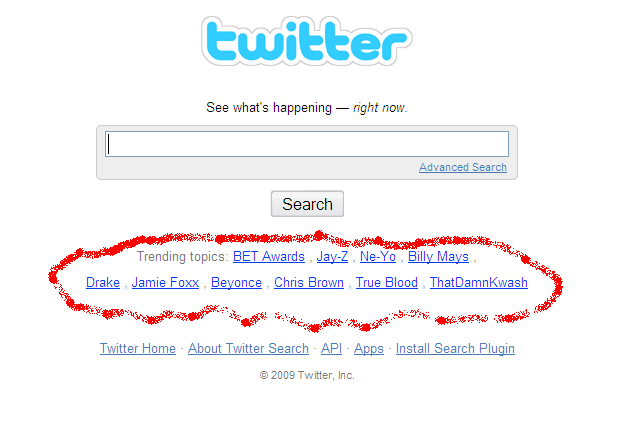
It looks like Twitter's current trending topics have some people on the alert and a bit apprehensive.

Check out this tweet. What's ridiculous is Foolish Julie here isn't alone by any stretch. It shows a complete disconnect with how Michael's death has impacted the black community. I don't watch the BET Awards and only did so because they said it was going to be a MJ tribute. Therefore, guess what? There was a huge number of people watching the show and and we talked about it as it happened.

But riddle me this? Even without that, why is it even an issue that black topics trend on the night of a major black awards show? I guess black folks aren't supposed to actually use the Internet.

Sorry, I have to just say it. These people are just stupid.

The USA is now post-racial? Yeah, okay.

Are they serious?

Well, thank goodness for screen shots and blogs. Because, yes, morons there are black people on Twitter.

Say it isn't so!!!

Posted via web from Regina's posterous

Read More...

Sphere: Related Content

Monday, June 15, 2009

Operation "Ignore Charles Hamilton"

This is the funny.


He's making some good points here.

Being abroad means I was like "who is Charles Hamilton?" However, I did see a video of his maybe two weeks ago. It was one where he was interviewing a young female rapper/poet. He said a bit too much and she punched him. Ouch!


Well, this seems to be more than a one time occurrence, hence the video above. Therefore, based on this advice: ignore Charles Hamilton. Thanks ;)

Oh, I didn't know this, but the girl in the video is Mary J. Blige's step-daughter.

BTW, he was just saying ignore his silly antics and comments. The kid's music is good. Check out this video:

Read More...

Sphere: Related Content

Sunday, April 5, 2009

Natalie White, aka PumaShock, on Star King

I got the video link to this yesterday. Someone asked me if I knew about it. Outside of my first year in South Korea, I never got in the habit of watching Korean TV shows. Plus, when this was all getting stirred up I was getting ready to move and when she was on the show I was back in the States.

This is the background story. There is a San Francisco based singer songwriter who goes by the name of PumaShock. Her real name is Natalie White. She's also a black American. She started putting up videos of her singing some of her favorite Korean pop songs: Natalie's YouTube Channel. Koreans took notice. There was a scandal when Taeyeon from a group called Girls' Generation said something like Ms. White was pretty for a black girl. (video link) Oooops! I'm not even going to touch that because after years of living in it I will get angry if I dwell on it. Plus, it's hard to get into someone's head. Maybe it was an innocent faux pas or maybe she is a blockhead. Either way, Ms. White is the focus here.

Anyway, it worked out for Ms. White that she got on Star King and seems to be on a marvelous PR junket in Seoul. She's meeting people in entertainment and, since that's what she wants to do, I say good on her. Here are the videos of her appearance on Star King.


Read More...

Sphere: Related Content

Saturday, December 13, 2008

Hipsters: trend or just a fad?

Okay, this is just a repost of an article by Jean Oh from the Korea Herald's Culture section.

This is a good article about the growing pop culture and fashion scene here in Seoul. What's funny is I'm seeing a lot of familiar faces in the pics. Yep, it's time to leave Seoul ;)

Hipsters: trend or just a fad?

Type in the word "hipster" and Naver's dictionary spits out the definition: "a person in the know, a well-informed person, a follower of fads." Then follows it up with a couple of alternatives: "jazz performer, jazz aficionado."

Hard to say that Naver has hit the nail on the head, but the appearance of "hipster" on this popular Korean internet portal site hints at something that becomes more obvious when you hit the streets of Seoul.

In small but growing numbers, trademark skinny jeans, Converses and vintage flannels pop out from the crowds. Add to that the recent introduction of "NYLON Korea" and "Dazed and Confused Korea" to the domestic magazine market, and it gives rise to the question: Are there hipsters in Korea?

Before delving into the current status of this nation's youth culture, the term "hipster" requires clarification. Taking its roots from the 1940s, when it initially referred to jazz enthusiasts, the word "hipster" is believed to come from a derivative of "hop," slang for opium.

Now, it serves as a somewhat ambiguous catchphrase used to describe the young and the hip. Today's hipster is into things that are cool, new and not mainstream.

In the recent past, cool meant fixed-gear bikes, skinny jeans, Converses, vintage flannel and the so-called "international hipster bible" Vice magazine. Whether any of this still holds true remains to be seen and proven.

Hipsters have been ridiculed and criticized for their lack of identity. They have also been upheld as trendy young people who do not deserve the bad rap the media sometimes gives them.

Good or bad, it looks like the legions of hipsters are growing, spreading through the internet and through the global proliferation of reportedly hipster-friendly brands like American Apparel, UNIQLO and Converse.

Has it reached Seoul?


Dos A Dos art director Kim Young-bin at the 7th Dos A Dos Party[youweresleeping.com]

Dos A Dos

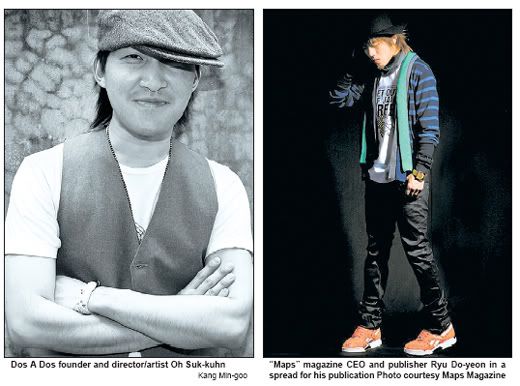
"I am not a hipster," says Dos A Dos founder and director/artist Oh Suk-kuhn.

Dressed from head to toe in vintage, including his 1,000 won cardigan, Oh is the force behind Dos A Dos, a party known for attracting an exciting and unusually dressed crowd - think swimsuits and guys wearing dresses.

And he does not seem to be too fond of hipsters.

"I don't like hipsters," artist Oh states firmly. "I'm too creative to be a hipster."

When asked if they come to his party, he answers, "Of course, lots of hipsters come. When we first started out, it was a sort of meeting of music aficionados and fashionable people. And then hipsters flowed in and I am not too crazy about it."

What about "real" hipsters? Oh pauses: "A real hipster is someone who has their own distinct and clear-cut color."

Oh is quick to separate himself and his Dos A Dos members from the crowd.

"I do not think that we are like those current New York hipsters who follow that which is hip, thoughtlessly," he elaborated.

It is hard to know what group Oh is a part of. A staunch devotee of vintage, "I can't wear new clothes," he explains, Oh was once a middle school kid who went to rock concerts and watched guys head bang to death metal. By the time he entered high school, Oh was donning skinny jeans.

And after spending about three years in England studying photography, he came back home to find, to his disappointment, that no one was listening to electro music.

"I was so frustrated that I started a party in a small space with a Korean friend from London," he said. "The first sort of official Dos A Dos party was in September 2006."

To his surprise, it drew a good crowd. From there on out, he and his members held seven more. The last Dos A Dos was in October.

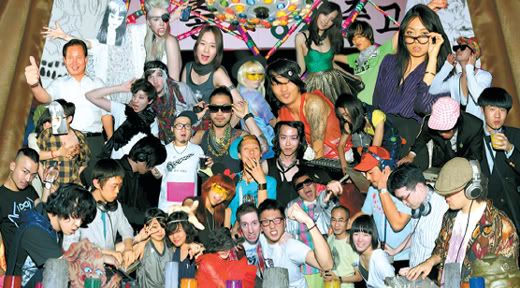
But what initially started out as a fashionable and artistic gathering of the like-minded grew into a party that drew 400 to 500.

The 29-year-old founder is not too thrilled about the overwhelming turnout, citing a change in partygoers, a theft and issues with the current venue as obstacles to his vision of Dos A Dos.

Whether or not he means hipsters when he says, "people came with a different attitude," is unclear. But Oh believes that hipsters are here to stay.

"I think hipsters will continue to appear."

Nylon, Dazed and Maps

According to Oh, the publication of domestic versions of magazines like Dazed and Nylon came as no surprise.

"They knew that it was time," he said. "A lot of things had already shown up. Street brand mags, (multicultural space) Daily Projects and Dos A Dos. So, of course, Nylon and Dazed came."

The original London-based Dazed and Confused and the U.S.-based NYLON have made a name for themselves for their unique approach to fashion, art and music. And now they have entered the Korean market.

Dazed and Confused Korea kicked off with its May issue and NYLON Korea with its September issue this year.

"Magazines like Nylon and Dazed don't show the trends of the masses," said Nylon Korea editor-in-chief Ketherine Koo. "It is for those who want to create their own style. They want something new all the time."

"We want to make a magazine for real hipsters," explained editor Koo. "But it is a mass market ... We hope that hipsters, at this point a minority, will lead the culture of the masses and that we will be, in turn, a medium that appeals to them."

The 38-year-old editor-in-chief maintained a positive outlook on the future of Korean hipsters.

"Right now, I think there a lot of young people with a hipster mindset and that they are increasing in great numbers," said Koo.

Dazed and Confused Korea editor-in-chief Annie Kim adopted a more conservative stance.

"Aren't they just one part of society?" Kim asked. "Like two or three, three or four out of 10? I think it may be exaggerated."

"There are hipsters though," the 33-year-old editor-in-chief continued. "It definitely seems to have increased. Kids who have just graduated, university students and contributing editors and people I meet seem to have that disposition."

When asked if Dazed and Confused Korea was a hipster magazine, Kim answered: "There is that inclination, but if you mean 'hipster' as in 'street-based subculture,' then we may have hipster-like elements but our magazine is upscale."

Yet, oddly enough, there is no official term for this group of Korean hipsters.

"No, there are no terms for trendy kids in Korea," said Kim.

Ryu Do-yeon, CEO and publisher of "maps" magazine, suggested "skinny tribe" and "BigBang style" as potential catchphrases for those who wear skinny jeans or subscribe to the flair of the hit Korean boy band.

Ryu, who first started out with an online magazine when he was 18, has now been heading his own domestic fashion rag for about two years now.

The 24-year-old publisher covers obscure musicians and artists, targeting "stylish people in their 20s, to help them dress up more."

In addition to artistic layouts, "maps" sports a hefty set of street shots featuring hip Koreans decked out in animal print skinny jeans, stylishly assembled blends of American Apparel and Comme des Garcons and, of course, vintage.

"I wanted to show Korean style to Koreans and to those overseas," said Ryu of his street section.

When asked if he thinks his magazine caters to hipsters, he answered: "You can say that it does. And you can say that it doesn't."

A collage of Dos A Dos party-goers and DJs[Kang Min-goo]

Daily Projects and Your Boyhood

According to publisher Ryu, fashion-forward people are the rise, and the boom in select shops serves as a result of the desire for "something new."

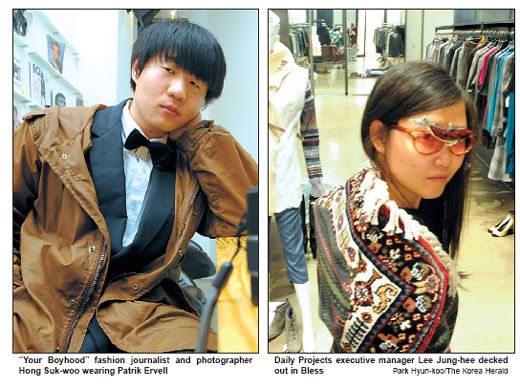
Among the slew of select shops that have hit Seoul, Cheongdam-dong's Daily Projects emerges as a pioneer in the world of fashion, due in part, to its executive manager Lee Jung-hee.

Educated at Parsons, Lee masterminded the Daily Projects' event that was part of Seoul Fashion Week's Generation Next, causing a stir in October. Her high profile participants included prominent fashion expert, Diane Pernet, who screened "A Shaded View on Fashion Film" in Korea for the first time, and Danish designer Henrik Vibskov, who presented during fashion week.

"I invited him (Vibskov) here," said Lee. "I went to Denmark to meet him. I was like, 'Yo, do you want to come?'"

Lee's multicultural space, complete with a cafe where one can pore for hours over a serious collection of reading materials - including the U.K.'s "Dazed and Confused," "i-D," and "Monocle" - and two floors worth of hip brands like Band of Outsiders and Bless, also showcases art.

"For some reason, we attract the younger public," said the 34-year-old executive manager.

When asked if she thinks the hipster trend has hit Korea, Lee answered: "Yeah, definitely. They are fashion masters."

"Young kids, like Japanese kids, starve themselves to buy something," she said. "I see that here too. (They) use all their cash on clothes and eat ramen."

Fashion journalist and photographer Hong Suk-woo, who previously worked as a buyer for Daily Projects, agrees that trendy items like fixed-gear bikes have been infiltrating Korea.

"Yes, there is a bike trend here," said Hong, 25, who runs his own fashion blog, "Your Boyhood" (www.yourboyhood.com). "I thought that was new. Is this not just a trend? Is it a culture? I still haven't sorted it out. There are a few fixed rider crews though."

"I think it might have lasting power," he said.

Hong, whose blog is currently posted as a link on "Face Hunter" (facehunter.blogspot.com), agrees that it looks like the hipster movement in Korea is influenced by globalization.

"Just looking at people's clothes, it seems similar," he said. "But it is where it originates from that matters."

"Korea is good at receiving trends," he continued. "However, now, clubs, DJs and bands are holding experimental performances. That seems to be different from what was happening two or three years ago."

"The year 2008 could be a turning point," said Hong. "Corso Como, Nylon, Dazed have come in."

Add to that the presence of American Apparel, UNIQLO and Converse, and it looks like some form of hipsterdom has entered Korea.

Details

Dos A Dos founder and director-cum-artist Oh Suk-kuhn is currently showing his works at the National Museum of Contemporary Art in Gwacheon as part of the "2008 I AM AN ARTIST" exhibition. For more information call (02) 2188-6000 or visit www.moca.go.kr

For more information on Dos A Dos go to www.Dosados.co.kr

Check out Hong Suk-woo's blog at www.yourboyhood.com, "maps" at www.themaps.co.kr, Dazed and Confused Korea at www.dazeddigital.co.kr and NYLON Korea at www.nylonmedia.co.kr

Daily Projects is located in Cheongdam-dong. Select shop opening hours are from 11:30 a.m. to 8 p.m. daily. The cafe is open from 8 a.m. to 11 p.m. daily. For more information go to dailyprojects.kr or call (02) 3218-4072, -4075.

Read More...

Sphere: Related Content

Monday, November 24, 2008

I have no idea what's happening here ;)

Why are they in pink and silver spandex space outfits? Why are they dancing around in various areas of Seoul (including one of my favorites, Myeongdong)?

Is it a Korean take on group performance art? I'm just not sure.

Read More...

Sphere: Related Content

Tuesday, August 12, 2008

[Regina Walton's Expat Interviews] Korea's trend-setting hip-hop culture

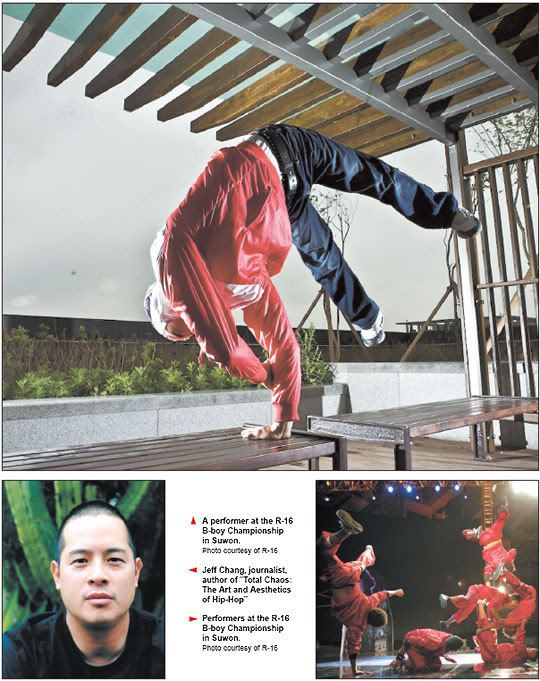
What I didn't realize when starting my interviews was the lag time between speaking with someone and getting it to print. I had the pleasure of speaking with Jeff Chang in early June at the R-16 b-boy dance competition. However, it's just making it to print today and it's almost two months later.

This interview is only around 600 words, so it's pretty short and leaves out some other things I asked Jeff about.

If I can figure it out, I'll post the rest of the interview as a podcast and I'll just update this post when I do it. Basically, what that means is I have no idea how to edit and upload at podcast. I've got to ask my pod casting friends, like ZenKimchi (who now does the weekly Seoul Podcast) or FeetManSeoul/Metropolitician how to do it.

In the meantime, check out the interview.

[Regina Walton's Expat Interviews] Korea's trend-setting hip-hop culture

Jeff Chang is a journalist and book writer whose writing focuses on hip-hop culture. He has written for many well-regarded publications, from the New York Times to Vibe magazine. He is the author of two books on hip-hop culture. His first was "Can't Stop, Won't Stop: A History of the Hip-Hop Generation." His second book, "Total Chaos: The Art and Aesthetics of Hip-Hop," is an anthology of essays and interviews. It focuses on the reach of hip-hop culture beyond its obvious elements of rapping or MCing; DJing; urban art and graffiti; and b-boying or break dancing. The book looks at how hip-hop culture has influenced other art forms like theater and film, fashion, photography, poetry, literature and painting.

I had a chance to sit down and talk to Chang during the recent R-16 B-boy Championship in Suwon on May 31 and June 1 at the Suwon Olympic Sports Complex.

For expatriates in Korea who are interested in hip-hop and b-boy culture, Korea is a new center of innovation. That's very exciting. When asked why he was attending the R-16 competition, Chang replied at length. "R-16 is recognized, I think, as one of the top b-boy events in the world, and, I think, for good reason. The Korean b-boys have really been able to put themselves on the map in a huge way. They've completely changed the game as far as b-boying goes. They breathe all kinds of new life into the art form that I think folks have been looking for a long time.

"And, so, I think the excitement around R-16 in the world has to do with the fact that it just seems that this (Korea), right now, is the place to be if you want to know what's at the cutting edge of hip-hop and what's at the cutting edge of the dance forms. I think, for instance, in the United States over the last two years, there have been all these dance competitions that have been going on. There is this huge craze for dance and, at the same time, that's created a hunger for the real thing. And I think this is the epitome of the real thing."

With such kudos for the Korean b-boy teams from someone so established and well-versed in hip-hop culture, the question is what exactly sets the Korean teams apart from the other fiercely competitive b-boy teams worldwide? What is it that makes Korean b-boy teams worth paying attention to?

For Chang, what it comes down to is both mastery of basic elements and innovation.

"I think it's a combination of the fact that these are crews that are fiercely and intensely competitive. They have completely mastered the forms and they're also completely transforming the forms. I was starting this afternoon to compile a list of all these different types of moves that Korean b-boys have innovated over the last five years, and it's mind-boggling. There are so many. And not just that; it's the whole form.

"It's the whole choreography. It's the way that they present the shows. It's the way that they use the stage. It's the way they engage the audience. It's all that and that hardcore b-boy attitude of 'I'm the best' and then proving it. It (hip-hop) allows folks to stake out their own identity and to then make that identity available to folks all around the world. What the Korean b-boys are doing in that sense is they're making Korea visible and accessible to millions and millions of kids all around the world.

"It's always been a grass-roots movement that's been about allowing people to express themselves in the deepest kind of way."

Read more about Jeff Chang and his writing at www.cantstopwontstop.com and www.totalchaoshiphop.com


The R-16 website
My link to Jeff's article on Korean b-boys and R-16

Here is a Adobe version of the article:
Read this document on Scribd: KH08132008


What's also exciting about this one was Jeff has been a journalist and author writing on this stuff for years, which means just by speaking with him, I had a chance to learn. Also, Jeff knows Miles Marshall Lewis who is another respected journalist and writer. Miles found me via my blog maybe a year or so ago. Miles is black expat living in Paris right now, so it's great to be in touch. It was really fun to interview someone he knows and respects.

Read More...

Sphere: Related Content

Thursday, June 26, 2008

Repost: Salon.com - Hip-hop, South Korea

A few weeks ago the R-16 b-boy dance competition happened in Suwon. I had a chance to go on Sunday. It was a lot of fun and I got to interview Jeff Chang who is a recognized hip-hop journalist and music critic. That interview is in the pipeline.

However, in the interim, Chang has written about R-16 for Salon.com. Check it out.

So you think they can break-dance?

Forget the Bronx and South Central. If you want to find the best hip-hop dancers in the world look farther east, to South Korea.

By Jeff Chang

Jun. 26, 2008 | This summer, the United States is reaching new heights of dance fever as TV shows like Fox's "So You Think You Can Dance" and MTV's "Randy Jackson Presents: America's Top Dance Crew" have returned to the airwaves. MTV's runaway hit is considered especially cutting edge, showcasing hip-hop dance groups from across America. But if MTV really wants the best dance crew, it should be looking in South Korea.

A&E

Photo by Joe Conzo

B-boy Physicx of the Rivers crew does his trademark elbow spin at the R16 competition in Suwon, South Korea.

"Of the top six or seven crews in the world, I'd say half of them are from Korea," says Christopher "Cros One" Wright, 33, an American dance promoter and b-boy who was recently in Suwon, South Korea, to judge the second annual global invitational hip-hop dance competition, called R16, that was held at the end of May.

The development of South Koreans' hip-hop dancing could be seen a cultural parallel to their sharp global ascendance in electronics and automaking. A decade ago, Koreans were struggling to imitate the Bronx-style b-boy and West Coast funk styles that are the backbone of the genre. Now, a handful of these crews are the safest bets to win any competition anywhere.

Certainly no country takes its hip-hop dance more seriously. The Korean government -- through its tourism board and the city of Suwon -- invested nearly $2 million in this year's competition. Two of the most successful teams, Gamblers and Rivers, have been designated official ambassadors of Korean culture. Once considered outcasts, the b-boys now seem to embody precisely the kind of dynamic, dexterous and youthful excellence that the government wants to project.

Although hip-hop dance goes back at least 35 years, the top Korean b-boys trace their histories back just 11 years, to 1997, the Year Zero of Korean breaking. By 2001, the first year that a Korean crew entered the Battle of the Year -- the world's biggest b-boy contest -- they won "best show" honors and a fourth-place trophy. Every year since, a Korean crew has placed first or second. Says Battle of the Year founder Thomas Hergenrother, "Korea is on a different planet at the moment."

The R16 competition, held at the Olympic Sports Complex, is broadcast live in prime time in South Korea and dozens of other countries. The government expects to gross $35 million from advertising and TV rights this year. And it isn't the only one profiting: Gamblers Crew, formed in 2001, may now be one of the most world's most lucrative hip-hop dance groups. The members regularly tour Asia, have endorsement deals with Fila, Kookmin Bank and Enerzen energy drinks, and will star opposite American teen idol Omarion in the $25 million movie "Hype Nation," the latest in the Hollywood dance-ploitation genre, set to open next year.

While some fans on the message boards for "America's Best Dance Crew" still don't know what a "b-boy" is, the word in South Korea has become synonymous with national pride. B-boy contests around the world attract mostly young males, but the R16 Sports Complex is full of grandparents, high school couples and teenage girls in their school uniforms. When one holds up a sign that reads "I (Heart) Physics!" she isn't referring to her college-prep curriculum, but to the 24-year-old, Bogart-faced, elbow-spinning star of the Rivers crew, Kim "Physicx" Hyo-Geun.

In South Korea, b-boying rules. The question even Americans are asking is, "How did this happen?"


During the 1970s, an array of dances practiced by black and Latino kids sprang up in the inner cities of New York and California. The styles had a dizzying list of names: "uprock" in Brooklyn, "locking" in Los Angeles, "boogaloo" and "popping" in Fresno, and "strutting" in San Francisco and Oakland. When these dances gained notice in the mid-'80s outside of their geographic contexts, the diverse styles were lumped together under the tag "break dancing."

The most physically demanding style -- the Bronx dance called "breaking" or "b-boying"/"b-girling" -- fueled a global fascination. In the mid-'80s, b-boys could be found spinning at the Olympics or at President Reagan's inauguration and promoting consumer products. But after the explosion, the dancers were cast off, the detritus of an exhausted fad.

Still, the dances took root around the world. While South Koreans have often been hostile to American imports, from Hollywood films to Washington beef (massive street protests against the government's lifting of the ban on U.S. beef broke out in Seoul the day before R16), hip-hop dance has been welcomed.

That may be partly because of South Korea's history of cultural repression of youth countercultures. During the 1970s, young Koreans in Seoul were being exposed to "Soul Train" and funk music via the U.S. Armed Forces Korea Network. A club scene arose in Itaewon to service American G.I.s. But as early as the summer of 1971, U.S.-backed dictator Park Chung-hee ordered his police to round up longhaired Korean men and cut their hair.

As the decade wore on, he escalated his "social purification" campaign, detaining artists, intellectuals and church leaders. In the first six months of 1976 alone, police reported checking over 600,000 men on hair length and possession of "obscene" T-shirts. Park's censorship committee blocked hundreds of American songs, from "We Shall Overcome" to "Me and Mrs. Jones."

"Black music was considered illegal because it was not good for the youth. The only music allowed was folk music," said Lee "MC Meta" Jae-hyun of the influential Korean rap group Garion, through a translator. "The music scene itself died. Influential music makers left the country." When he and his peers became enthralled with images of b-boys at the 1984 Olympics, they had no outlet for their creativity.

It was not until opposition leader Kim Young-sam became South Korea's first civilian leader in 1992 that youth culture seemed to flower again. At first, dance-friendly pop imports like Bobby Brown and MC Hammer spawned a host of Korean copies. "Up until then, it was all ballads," said Choi "DJ Wrecks" Jae-hwa, a pioneering Korean DJ who now spins for the Rivers crew, through a translator. But, Lee added, "the curiosity began and people became hungry for the real thing."

In just five years, Koreans would have their own thing.

It's a cool evening in front of the Ibis Hotel, an imposing postmodern gray slab that commands the Suwon skyline. Dozens of b-boys from around the world gather in groups in the lobby, bolts of color and noise against the hotel's minimalist white marble.

The Dutch crew, Funky Dope Manouvres, looks as ethnically diverse as Supercrew, the American one (which will fly directly from R16 to tape "America's Top Dance Crew"). Drawing dancers not just from Holland but Scandinavia too, FDM includes second-generation kids whose parents come from Brazil, Indonesia, Poland, Ghana and Suriname. Iranian-Swede Mahan "King Foolish" Noubarzadeh, 21, talks about how b-boying has brought together Muslims and Christians. Then he scans the lobby and sizes up the competition: "The favorites here? Gamblers and Rivers."

The next day is the marquee event, head-to-head elimination battles that are the heart of b-boying. Two crews challenge each other with aggressive, stylized choreographed steps and freestyle solo and ensemble moves. Egos are on the line. Tempers sometimes flare. "America's Best Dance Crew" doesn't dare approach this kind of a format. But the heat of the battle often makes the dancing spectacular.

Outside the hotel entrance, a Belgian dancer is challenging Kim "Bang Rock" Hyun-jin, 24, a genial round-faced dancer from Rivers, the defending R16 champs. They don't speak each other's language, but the Belgian is calling out the Korean by pointing to the ground and staring out from a chin-up tilt. Kim won't step in the cipher, the space between the dancers surrounded by a circle of onlookers that forms the battleground. So the Belgian starts with a six-step, then drops to a flurry of footwork and ends with a shoulder roll.

Now Kim has to respond. He humiliates the Belgian by imitating the European's movements, and climaxes with a series of virtuoso body spins. When he comes to a stop, he is leaning upside down at an inverted angle, balanced on a shoulder and a hand. He grins up at his opponent. This encounter is over. The Belgian offers a congratulatory hand.

Later, sucking on an ice cream treat, Kim laughs. "I didn't want to battle. I keep asking, 'Why?'" Of course, he knows the answer. It's the reason Korean crews regularly practice five hours a day, seven days a week. "We know there's always somebody trying to catch up with us," says 27-year-old Gamblers crew spokesman Chung "B-Boy Sick" Hyung-sik through a translator. "We always have to be ahead."

R16 co-organizer Johnjay Chon says that a decade ago, there were just five crews in the whole country. This spring, more than 50 entered the country's qualifying competition for R16. At events or clubs in Seoul, Chon regularly spots unknown b-boys taking out experienced pros. "What happens is they practice on the lowdown until they're up at a level where they can actually come out and shock somebody," he says. "They practice in the shadow."

Cho "C4" Chung-woon of Rivers says through a translator, "We've been praised for our technical skills, but that's because we would practice head spinning all day long. That's what sets us apart."

Still, the old "Asian work ethic" explanation is just part of the story. When Koreans first emerged, Americans praised them for their power moves -- the highflying crowd-pleasing spins, freezes and gymnastics moves -- but criticized the Seoul b-boys for lacking soul. They were thought to be mechanical, unable to rock with the beat, and lacking in "foundation skills," such as the top-rock and footwork moves that form the historical roots of the dance.

"What the Americans said really influenced them," says Charlie Shin, Chon's business partner and a Korean b-boy advocate. "They went back in the lab. It changed them."

They mastered routines, the choreographed ensemble moves that are essential parts of a showdown. They immersed themselves in the music and the rhythms. They studied the history of b-boying and hip-hop culture. Three members of the Rivers crew -- Born, C4 and Red Foot -- are now affiliates of Mighty Zulu Kings, a crew whose lineage can be traced back to hip-hop pioneer Afrika Bambaataa's Bronx River Project dances in the early 1970s. Even their crew name, Rivers, was chosen to capture an aspect of the hip-hop aesthetic.

"You know how rivers flow? Rivers flow swiftly, and that's also how we move and how we think," C4 says. "B-boys in other countries do it as a hobby, but to the Korean b-boys, our life is b-boying."

R-16 organizers Shin, 31, and Chon, 32, are what Asian-Americans call one-point-fivers -- young people born in Asia but raised bilingual and bicultural in America. Shin's 15th birthday came days after riots erupted in Los Angeles on April 29, 1992, after the Rodney King verdict, a traumatic period that Korean-Americans now simply call Sa-I-Gu or "4-2-9" the way one might refer to "9/11." Parts of Koreatown were still in flames and hundreds of Korean-American businesses had been reduced to ashes. The era had poisoned mainstream perceptions of Asian immigrants. White pundits used them to score rhetorical points against welfare and affirmative action, while black leaders boycotted their shops. But neither Shin or Chon was close enough to the fires to have been burned by them. You could call them members of the post-Sa-I-Gu generation.

Hip-hop formed a crucial part of their identity, and a source of redemption. "For me, growing up in the States, I had been called all kinds of names," Shin says. When he moved to Seoul eight years ago, supporting Korean b-boys became a cause. Seeing them win respect from others, he says, "kind of dissolved all that racial bullshit I grew up with." The Korean-Americans became exemplars of hip-hop culture at a moment when young South Koreans were trying to define a new national identity.

Chon was born in Japan and raised in Seattle. After forming and competing nationally with the multiracial Circle of Fire crew, he came to Seoul on a summer trip in 1997 to visit family. Armed with videos and DVDs of dozens of contests, Chon began scouring the clubs for b-boys to battle. He met the Expression crew -- now a hip-hop dance theater troupe -- and gave it a video of a legendary Los Angeles b-boy competition called Radiotron.

"A year later I came back and I just saw there were more b-boys. They were telling me, 'Oh you gotta see this footage,'" Chon says. "I'm watching it and it's the Radiotron [video] that I brought out a year ago. It's been dubbed so many times the screen is shaking."

During the year Chon was gone, teenagers such as the Gamblers' B-Boy Sick had caught religion after watching grainy videos like that one. Lively Internet groups brought hip-hop fans together. Japan's obsession with underground American hip-hop was at its peak, and CDs and videos found their way to South Korea through Tokyo. As South Korea's economy spiraled downward in 1997, a vibrant counterculture was emerging in Seoul.

At the Master Plan club in the Chungjeong neighborhood, rap groups like Garion, Artisan Beats & Keeproots and Drunken Tiger JK explored the rhythms of their native tongue and sometimes disclosed personal traumas or attacked social ills. In Taehongno, an area rich in college campuses, nightclubs, galleries and theaters, b-boys suddenly appeared. The Rivers crew and Expression crew, South Korea's first Battle of the Year winners, were among the b-boys who gathered there.

They battled all evening in front of the crowds at the popular Maronie Park, then moved to the clubs in the early morning hours. When dawn broke, they headed to school. Their intensity impressed Chon. "I'm like, 'OK how does this work?'" he says he asked the b-boys. "I just sleep in school" was their invariable reply.

These Korean hip-hop heads were the first generation to grow up after authoritarian rule. Those before them had come of age on the front lines of demonstrations against American-backed dictators. But these youths lived under relative, if yet unstable, democracy and prosperity.

They were also mostly working-class outsiders. "The minute you're born in Korea, depending on what your economic background is, or who your parents are, what network you're in, what neighborhood you're in, what high school you went to, what college you went to, your life is pretty much decided for you," Shin says. "The b-boys, it's not like they're the most highly educated kids, but they're good at what they do, and they put as much effort into practicing as the other kids do into the Korean SATs."

Because South Korea is still a country at war, looming over every young man's life is mandatory military service. For working-class b-boys, it acts as a passage into a bleak future. "If they're not in college, they have to do some kind of menial job," according to Shin. Many say that the prospect of military service is the main factor that has accelerated the Korean breaking scene's development. "You see that hunger and that drive," says Korean-American filmmaker Benson Lee, whose 2007 hit documentary "Planet B-Boy" featured a DMZ scene with members of Gamblers and Rivers as battling soldiers.

They know that the freedom of b-boying can't last. "The service will come up when you're 21, 22. But they can always extend that using some excuse," Chon says. "A lot of the b-boys -- now they're like 26, 27, they haven't gone. They have to go soon. They keep putting it off because the culture is kind of peaking now."

He estimates that four out of five b-boys currently competing in South Korea have postponed their service or have illegally evaded their conscription. Chon and Shin say they know many b-boys who have mutilated themselves to dodge the army. Kim "Bang Rock" Hyun-jin of the Rivers crew says through a translator, "Everyone tries to avoid the service." Then he switches to English for emphasis. "It's like going to hell."


On the final day of R16, there are more government officials in suits wandering around backstage, the crowd is thicker and louder, the TV crews are everywhere, and the energy is high.

Through the opening rounds of the crew-on-crew battles, the Gamblers and Rivers dispatch their rivals easily. In the semifinals, the Gamblers face the fluid and elegant Brasil All-Stars, whose moves vibrate with the traditions of capoeira. They win in a pleasingly close contest, three judges to two. But when the Rivers crew faces Russia's Top 9 crew from St. Petersburg in the other semifinal -- potentially a classic duel of power versus finesse -- tension builds.

On an arena stage, crews must face each other across the floor, as if across a DMZ turned battleground. This staging emphasizes the metaphor of the attack. By the rules, each crew must give the other its space on the floor while it is performing. They alternate their turns. No touching of opponents is allowed.

But minutes into the contest, Physicx begins dancing before Russia's tiny dynamo Flying Buddha has finished his solo. (See the battle here.) When Buddha moves over to stare down Physicx, who has begun a difficult flare sequence, a Rivers member pushes him away. Physicx backs out of the cipher, comes around to high-five Buddha and motions for him to retake the floor. Instead Top 9 starts a three-man routine. Physicx steps back in to disperse Top 9, then motions again to Flying Buddha. The Russian takes a wide berth, flings off his light blue shirt, does a six-step, then launches into a spectacular one-armed move known as an air chair. Now Top 9 is fired up.

B-boy Robin, Russia's assassin in a brown Yankees hat, oversize polo shirt and cargo slacks, circles the floor and then taunts the Koreans by pulling back his eyes. Some in the crowd gasp at Robin's slanted-eye dis. But his subsequent solo, featuring a Tony Hawk-style hand plant and surging rolls broken up with one-armed freezes, is flawless. In what b-boys call a "commando" attack -- a routine in which a run is begun by one or more b-boys but finished by another, named for the post-gang-era Bronx dancers who invented it as a tactic to prevent the other crew from immediately responding -- C4 dives through two Rivers members and leaps straight at Robin, pulling his own eyes back, then miming a castration of Robin. The crowd roars.

But as the battle continues, Rivers seems exhausted, while Top 9 gains momentum. In their final routine, the Top 9 b-boys do a number of clever duet Lindy Hop-style routines, jumping off each other, flipping each other into spins and forming circles for crewmates to leap through. When Top 9 wins 5-0, some in the crowd boo. But this won't be Rivers' day. It finishes fourth behind the Brasil All-Stars.

In the finals, South Korea's Gamblers crew counters Top 9's routines with elaborate commandos and ample personality. (See the battle here.) As the clock ticks down, the dancers play "pass the hat." B-boy Pop handstands across the stage and balances on his left hand. Then he arches his body into the heart of the Top 9 line and passes a white baseball cap to a hand-spinning Soul Soy. On the Gamblers' last run, b-boy Sick chases Robin and Top 9 out of the cipher, drops down for some fleet footwork, then quickly contorts himself through a set of wire-doll freezes that wouldn't look out of place on a Cirque du Soleil stage.

When the Gamblers are announced as the champions, Pop flings his shirt into the crowd and strikes a kung-fu matinee idol pose at the edge of the stage. Cameras and cellphones flash. Soul Soy announces to the media that it is donating its R16 winnings to victims of the earthquakes in China and Myanmar. It's an audacious statement. The $15,000 first-place prize is the largest that has ever been offered at any b-boy event in the world.

Later, Sick signs autographs and takes pictures with two stricken schoolgirls. As he waves and disappears into the bus, they clutch their autographed programs and continue blushing and bowing. There are few big-name b-girls now in South Korea, but who knows? Perhaps those girls will form the next generation of champion dance crews.

"The world is a big place, man, and there's another hungry competitor stepping up," R-16 judge and legendary Rock Steady crew b-boy Ken Swift says. "It's a cycle, and the cycle is based upon crews like these Korean crews who go out and inspire these new fans. And then five years from now, those new people are going to be saying, 'OK we're the shit now.'"

Read More...

Sphere: Related Content

Wednesday, March 12, 2008

Tricked Out Hoopties

Update 1: April 3, 2008 @ 10:53am

I was walking to my office and I see a similar (or is it the same) car this time with girly accouterments like pretty pastel flowers and smiley faces.

Of course, I had to snap a couple of pictures.


_____________________________

What's funny about Korea is sometimes you see some weird similarities between Korean pop culture and ethnic pop culture. There is no denying that in black and Latino urban culture in the States that the tricked out hoopty is a pop culture phenomenon of sorts.


Now I'm not familiar with the subculture. I just know that there is one. It's involves like most car subcultures cool cars of some sort and women in very little clothing. What's funny is in Korea you'll see cars that have all sorts of weird additions to them. Now these aren't the most expensive cars and the additions are just so ghetto that I'm usually smirking a bit when I see them.

I was walking to my office today when I saw this one.


Clearly, this is one Korean interpretation of a pimped out hoopty ride. I say "pimped" because of the Playboy logo. Can you imagine this guy picking up some poor girl for a date...in that? Well, considering the number of tricked out hoopties I've seen, it's part of the culture of some younger male drivers here. Maybe she wouldn't mind.

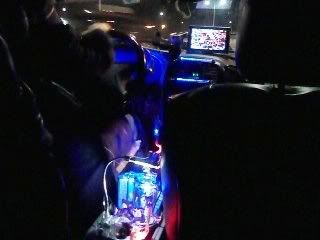
While I'm at it here is a pic of the inside of a tricked out Korean taxi cab I got in just before I left for vacation in January. They can't really mess with the exterior, I guess, so he went all out with the interior. What's funny is a couple of weeks before that I was in a similarly tricked out taxi cab.


You'd never see that one in Japan ;)

Read More...

Sphere: Related Content

Thursday, March 6, 2008

Even A Blockhead Could Sell That...

I was on the subway heading to work this morning when I noticed this advert.

The first thing I thought was "whatever it is, I guess even a blockhead can sell it."

That tickled me, so I'm sharing.

Read More...

Sphere: Related Content

Tuesday, February 26, 2008

Podcast with the Metropoltician: Korean Wave Ebbing

A bird's eye view of Hallyu-wood (thank God that lame-brained plan was scrapped).

I'm finally recovering from the worst jet lag ever.

I think it has a lot to do with the crazy travel schedule I had.

Basically, I went from Seoul, to L.A., to Miami, to the Bahamas, to NYC, back to L.A. and then up to San Francisco in three weeks. I adjusted to the time zone in California just fine and spent most of my time there, but, for some reason, adjusting back has been just brutal. I think this is the first day where I've not napped.

However, beyond that I've not gotten much done.

In the useless cycle of web surfing that I was doing I did notice that I'm on another podcast over at the Metropolitician's blog and I didn't link it here.

Here it is. This one is about the Korean Wave and how it's ebbing.

There are many reasons for it and I lack the skill to be meaningful, understandable, or well-spoken on the issue right now.

All I want to do is nap, but I think the jet lagged excuse can only last for a week or so, so I've got to just get over it.

Read More...

Sphere: Related Content

Thursday, January 3, 2008

Repost: London Korean Links - LKL quiz of the year: the answers

I was clicking around and found this Korea-focused year end quiz on the London Korean Links website. And, good for you, it has the answers!

LKL quiz of the year: the answers

Question 1: Corporate crooks and corruption

Match the alleged quote with the appropriate chaebol

  1. The conglomorate had run a vast network that bribed government officials, prosecutors, tax collectors, journalists and scholars

  2. I don’t want to take a gamble on causing a crisis in the country’s economy

  3. The sentence of one year and six months is a bit too heavy

A. Hanwha

B. Hyundai

C. Samsung

Answers: 1: C; 2: B; 3: A

This has been such a good year for this type of thing that it was a struggle to select the appropriate quotes.

Hanwha Group Chairman Kim Seung-younThe Hanwha quote, of course, relates to the get-out-of-jail trick by convicted thug, loving father and budding pyjama-model Kim Seung-youn, Hanwha’s Chairman.

‘The sentence of one year and six months is a bit too
heavy,’ Presiding Judge Kim Deuk Hwan told a packed courtroom at Seoul
Central District Court, citing Kim’s health condition and a lack of a
previous criminal record.

Sources: Straits Times, 11 September 2007, Chosun Ilbo, 12 September 2007, LKL, 19 May 2007

Chung Mong-koo (from the Chosun Ilbo)The Hyundai quote, is again from the get-out-of-jail trick by the Hyundai Motor chief Chung Mong-koo.

“The Hyundai Motor Group plays a huge rule in the country’s economy and Chung,” said Judge Lee Jae-hong. “I don’t want to take a gamble on causing a crisis in the country’s economy [by puttinghim in jail].”

In February a court found Mr Chung guilty of embezzling about $100m of company funds and inflicting about $224m of damage on affiliates inthe process of their rights offerings.

The suspension of the sentence is contingent on Mr Chung, the son of Hyundai’s founder, fulfilling his promise to donate about Won 1,000bn to charity, building a concert hall, opera house and other cultural centres nationwide over the next seven years. And giving lectures on
corporate governance, a subject he is clearly an expert on.

Sources: FT, 7 September 2007; Asia Sentinel 6 September 2007; Chosun Ilbo 7 September 2007

Finally, the Samsung quote relates to claims by an ex-presidential aide that he received a bribe from Samsung.

Sources: International Herald Tribune, 19 November 2007; Asia Sentinel 24 December 2007

Question 2: Why was an octopus in the news this year?

  1. For causing the death of a vegetarian film critic, shocked by watching a scene from Oldboy

  2. For finding some Koryo dynasty pottery on the seabed

  3. For assaulting a Cheju Island diver (haenyo)

Answer is of course (2). Source: Chosun Ilbo, 5 June 2007

Question 3: What would you be doing if you were “toying with a duck’s legs”?


  1. Executing a particularly difficult b-boy dance manoeuvre

  2. Playing baduk - and about to be beaten by a particularly sophisticated strategy

  3. Engaging in some Joseon dynasty rumpy-pumpy

Answer: (3). Source: Chosun Ilbo, 28 September 2007, on the discovery of Choson-dynasty pornographic play.

Question 4: Who is reported to have said: “I admit that even if I left the writing of my thesis to someone else, and that person plagiarized, the mistake is with me”?


  1. Shin Jeong-ahShin Jeong-ah, apparently not only too idle to do her own work, but also careless enough to hire someone too idle to do the job properly

  2. Hyundai Motor chairman Chung Mong-koo, talking hypothetically in one of his lectures on corporate governance

  3. Junko Sagawa, the Japanese student propositioned by her professor

Answer: (1) - Shin Jeong-ah

The Shin Jeong-ah story had so many juicy ramifications that it was hard to pick just one. The Marmot has this particular story. He also has the Junko Sagawa story, but Junko Sagawa is not accused of plagiarism.
Jeon Do-yeon


Question 5: Who has been named among the 50 most influential women in the entertainment industry?


  1. Jeon Do Yeon, following her performance in “Secret Sunshine”

  2. Kim Yun-jin, for her popular following in “Lost”

  3. BoA, for her continued chart success in Japan

Answer: (1) Jeon Do Yeon. Source: Chosun Ilbo, 3 August 2007

Question 6: Who said: “Sexiness is my weapon” - and what war was she fighting?


  1. HyoleeIvy, in the battle of the K-pop charts

  2. Hyolee, in the battle to conquer Japan

  3. Shin Jeong-ah, in the battle for influence in the art world

Answer (2) - Lee Hyolee
Well, it could have been any of them, but the quote I was thinking of was Hyolee’s. Source: Chosun Ilbo, 5 June 2007. For photos of Ivy which might make you think she said something similar, visit Popseoul.

———

Other stories I didn’t get time to work into this quiz were

Kim Yuna and Lee Teuk (a recent success of Kim Yuna is reported in the Chosun here)

Read More...

Sphere: Related Content

Saturday, November 17, 2007

Soulja Boy and Soulja Boy Knockoffs ;)

Two entertaining knockoffs of Soulja Boy's "Crank That".

Kids:


The kid who starts off on the far right but ends up in the front breaks the dance down!

Thanks to the Hello Negro blog for that one.

Winnie the Pooh and crew:


Thanks to Scotty Crowe for that one.

The original:


Update 1 - Dec. 7 @ 10:29pm
Oh...another.

Crank That Kosha Boy

Read More...

Sphere: Related Content

Friday, November 9, 2007

Damn You, John!

Update: January 4, 2009 @ 12:30pm

Ha! Over a year later, 2 Girls 1 Cup has come back to haunt me. This time, there is nothing gross and no gagging. There is only friendly banter in a FB thread. But that thread gave me this link. (thanks Jeff.)

Check it out:


- The best video clips are right here

See what you started Mayer?
______________________


Okay, John posted this video yesterday.

2 Guys 1 Cup


It's a parody of a very popular video on the Internet right now. The video he and his buddy Sherrod Small are making fun of is incredibly gross. I'm NOT posting the link. If you really must see it, email me and I'll give you the direct link. The website everyone says go to is buggy to say the least.

However, I will post the challenge and me, being an idiot, doing the challenge just out of sheer morbid curiousity and guilt from laughing at all the other reaction videos I'd watched.

The challenge:


Me meeting and suffering through the challenge:

And, funny me, okay? ;-)

Just to be clear, this is not be reacting to John and Sherrod's parody. This is me reacting to the 2 girls 1 cup video. Two guys eating frozen yogurt from the same cup...strange, maybe, but that's the point of the parody. However, gag reflex inducing, not.

John and Sherrod, see you in February, and I'm going to kick your asses.

Update 1 (Nov. 10, 2007 @11:57am)
Oh, update! Yes, I usually put updates first, but this one I think you have to see only after you're well versed in what this crazy 2 Girls 1 Cup thing is all about.

These two posted a response to John and Sherrod's parody. It's hilarious:

Read More...

Sphere: Related Content